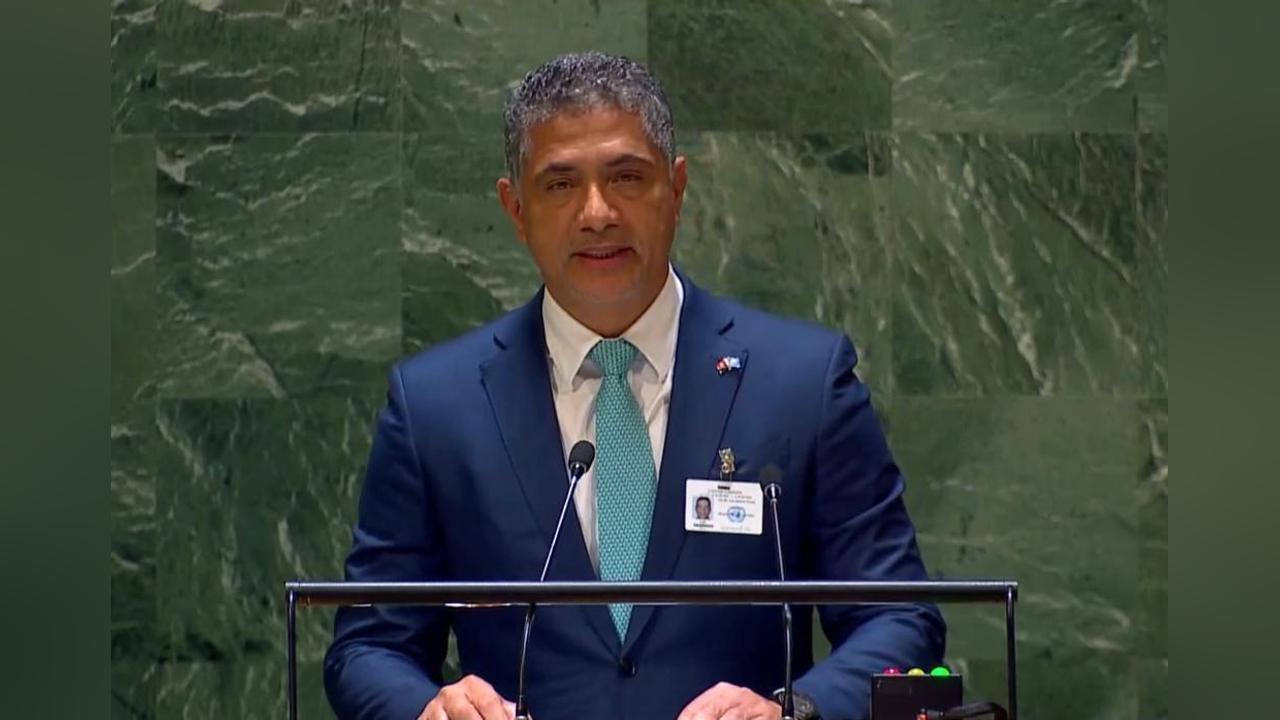
Africa-Press – Angola. The Minister of Energy and Water, João Baptista Borges, announced this Thursday, in New York (USA), for the five-year period 2023-2027, in the field of water supply, an investment of more than USD 4 billion.
Speaking at the United Nations Conference on Water, which takes place from the 22nd to the 24th of this month, João Baptista Borges advanced that the program includes the execution of new systems for capturing, treating and distributing water, which will expand, by 1,149 m3/day, the water supply in the country, particularly Luanda, and connection to the network of 1.6 million families.
This financial effort, he added, will make it possible to raise current per capita consumption from 40 liters/inhabitant/day to 70, moving towards meeting the targets of the 2030 Agenda of the Sustainable Development Goals (SDGs).
“Despite the abundance of water resources in Angola, there are regions, in the southern part, cyclically affected by long droughts, which lead to the formation of migratory waves of the population and animal transhumance, costing high human and material sacrifices”, asserted the minister.
To deal with the situation that has existed for decades, João Baptista Boerges stressed that the Angolan Government had recently decided to develop a program of structuring actions consisting of the construction of channels and transfers between basins, as well as the construction of dams with reservoirs for the accumulation of rainwater, including the rehabilitation of dozens of dams, in the provinces of Cunene, Namibe and Huíla.
The program, he said, with a budget of USD 4.5 billion, began in Cunene province, with the completion of the CAFU Canal, with water collection from the Cunene River and its distribution over 165 km of open channels, with a potential benefits for more than 250,000 people and more than 300,000 animals, in addition to irrigating the soil along its route.
In this effort, according to the minister, the government counts on the participation of entities and multilateral credit agencies, such as the World Bank, the African Development Bank, the French Development Agency, with whom it has been developing, since 2018, the Institutional Development of the Water Sector (PDISA).
The program in question, he said, is already in phase II and with visible results, both in terms of infrastructure, with the rehabilitation and expansion of municipal water systems, the construction of laboratories for measuring water quality, as on the institutional front, with the creation and training of 17 provincial water companies that will manage the assets under construction, as well as guaranteeing an acceptable quality service to the beneficiary populations.
The second phase of the PDISA, he said, will include wastewater sanitation systems in the country’s main coastal cities, with the aim of improving the population’s health conditions and combating waterborne diseases.
João Baptista Borges, who calls for equitable and rational management between the different users, from a perspective of justice, intergenerational balance and international harmony, noted that Angola is developing actions of different dimensions, namely in the constitutional and infra-constitutional areas, training and institutional strengthening, investment in water supply infrastructure, creation and financing of public water and sanitation companies, economic and tariff regulation.
For the minister, in order to guarantee the right to access to drinking water and sanitation enjoys constitutional dignity, the National Water Plan, with a period of validity until the horizon of 2040, contains a comprehensive vision of the actions to be carried out in the short, medium and long term.
The minister recalled that the volume of investments, in the water sector, reached, in the period from 2017 to 2022, a total of USD 1,937.77 million, with the average access rate, for the urban and rural population, situated at 60% , considering a population universe of 30 million inhabitants.
According to the minister, Angola also attaches great importance to shared water resources, being bound by the commitments established in the SADC Protocol on the matter and integrated in the 5 international commissions for the management of the basins of the rivers Cunene, Cuvelai, Cubango or Okavango, Zambezi and Congo-Oubangui-Sangha.
Meeting with World Bank
On the sidelines of the United Nations Conference on Water – UN 2023, Minister João Baptista Borges participated, at the invitation of the World Bank Group, in the meeting of ministers of water and sanitation.
During the meeting, those present shared experiences and achievements regarding the still existing water challenges and spurring action on water and sanitation development in the Southern and East African Region.
On the occasion, minister João Baptista Borges gave a general overview of ongoing projects financed by the World Bank, worth around USD 1 billion.
The Angolan official also spoke about the projects being carried out, namely the Electricity Sector Improvement and Access Project (ESIAP), the Water Sector Institutional Development Project (PDISA) and the Bita project.
João Baptista Borges emphasized the Government’s attention to the Program to Combat the Effects of Drought in the southern region of the country, noting that the scale and scope of investments are immense, which could result in the fulfillment of the SDGs for water supply and sanitation, with emphasis on for rural areas.
The government official reaffirmed the commitment to guarantee the continuous development of different actions and projects with a view to achieving progressively and in an integrated manner, the established goals, internally and internationally.
For More News And Analysis About Angola Follow Africa-Press