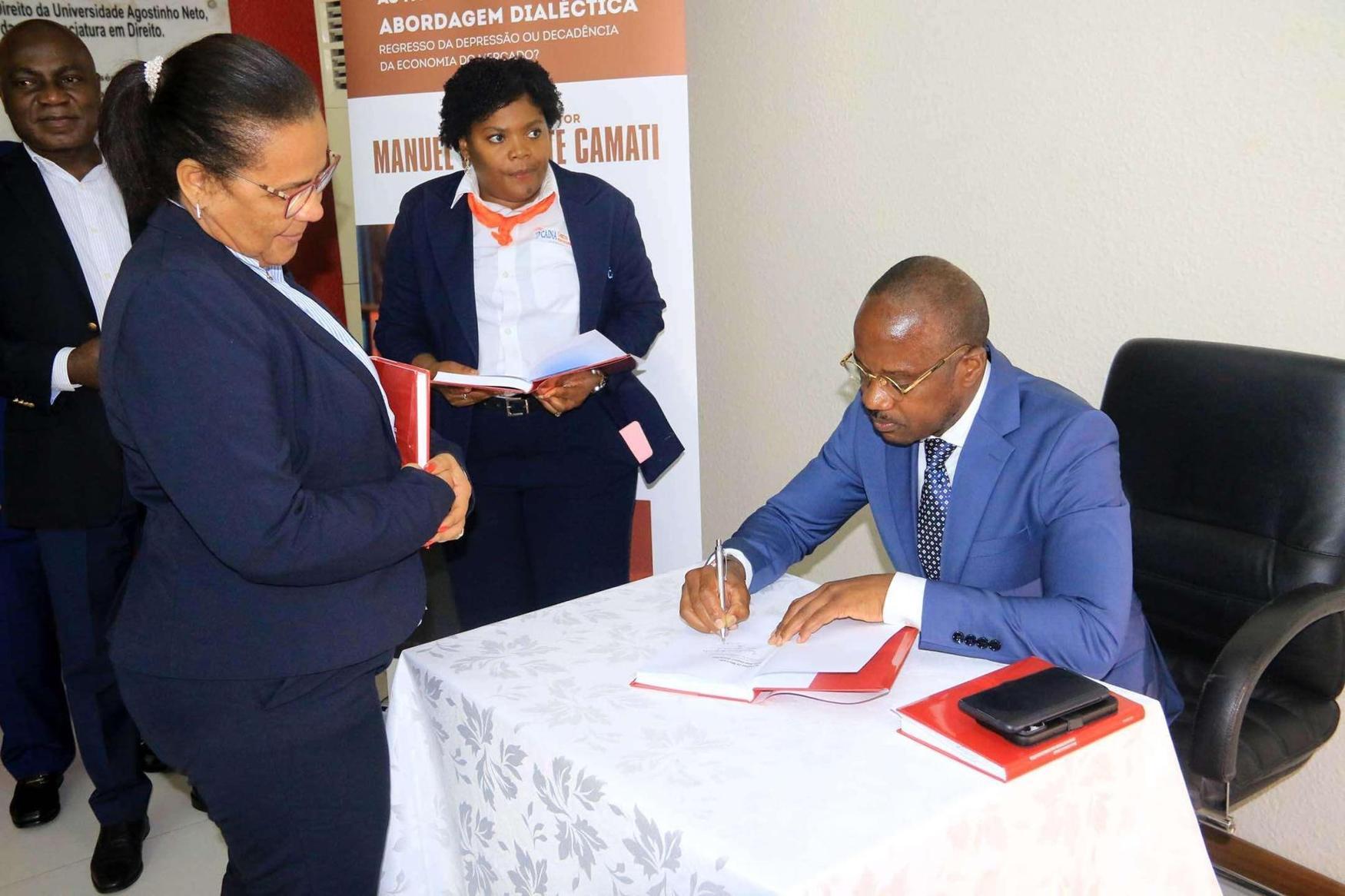
Africa-Press – Angola. Angolan academic Manuel Sabonete Camati launched, this Friday, in Luanda, the didactic work “Market Failures – A Dialectical Approach of an economic nature”, in parallel with the Angolan reality.
The book is the evolution of the doctoral thesis, recently defended by the author, according to which it provides a comprehensive view of the dynamics of economic phenomena in the modern world and the options regarding the models adopted.
At the time, Manuel Camati considered that there was a new position, which would be a third way or theory, which must be centered on the human being, on man, as the great novelty of the book.
“There are other nuances that arise from our own constitution and other models, but this is the reality: the mixed market system, that is, a third way that has the human being at its center”, he highlighted.
The author says that this book was not written with the reality of Angola, but that the solutions highlighted can be useful for Angola.
“Since there are several solutions, I recommend advising people to read the work, but not in a hurry, as the new features are your starting and ending points”, recommended the assistant professor.
In the first phase, one thousand and five hundred copies of the work were published by “Almedina”, in Coimbra – Portugal, to be sold at twenty-five (25,000 kz) thousand kwanzas.
In said work, the author mentions that his first (work) has to do with banking law, monetary policy and exchange rate policy. This one has to do with economic policy.
According to Manuel Camati, the work was based on the observation of the two market systems that exist and that are sometimes taken in extreme ways, hence the attempt to find a middle ground.
In turn, Professor Carlos Feijó, part of the presídium, clarified that the author’s initial purpose is the market economy itself, hence the book criticizes the planned economy system.
“In this work, Manuel Camati makes a comparison between the capitalist system and the socialist system, and also reflects on what the role of the economic rule of law should be in the economy?”, he characterized.
He mentioned that Dr. Manuel Sabonete Camati opted, in this thesis defense, for themes that are very current in the context we live in Angola to this day, as they deal with the reality that lives in Angola, from the 90s to the present day.
Carlos Feijó underlined that the thinking expressed in this work tries to situate what was debated in theory, in a market economy, and the relationship with the State, especially with Africans, and, in particular, the Angolan.
“The central problem that this thesis outlines is whether neoliberal, socialist or merely liberal theories are worth it, or whether we still have a third way”, analyzed the university professor.
This is Manuel Camati’s second work, which also seeks to know whether the State should intervene in the economy or not? And if so, under what circumstances? Or should we simply choose to carry out any intervention in the economy, even if it is promotional or not?
The first work has to do with banking law, monetary policy and exchange rate policy. The second, with economic policy.
For More News And Analysis About Angola Follow Africa-Press