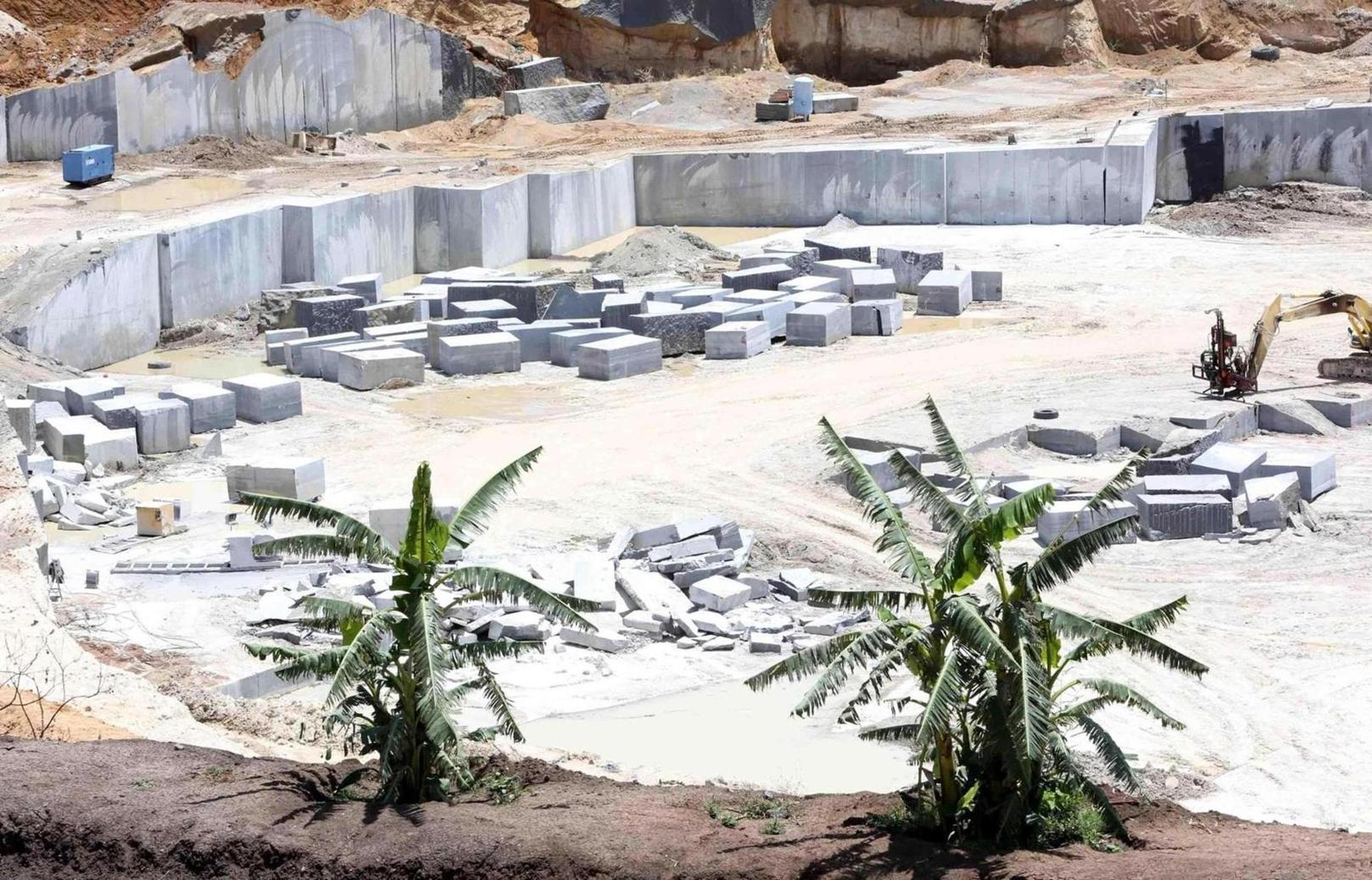
Africa-Press – Angola. The director of the Office for Economic and Integrated Development of Huíla, Domingos Kalumana, defended Monday, in Lubango, the allocation of tax revenues from the ornamental stones subsector to the province, to directly benefit the communities where it is exploited and promote environmental sustainability.
The province of Huíla contributes 90 percent of the country’s exploration and export of ornamental rocks. The sector’s revenues are collected through taxes and fees, which is why Law No. 7/11 of 16 February, On the General Fee Regime, stipulates that the revenues arising from them must promote social purposes.
The Mining Code, approved by Law No. 31/11 of 23 September, in article 245 states that five percent of the income tax rate for the mining industry must revert to the municipality under whose jurisdiction the respective mine is located.
However, Joint Executive Decree No. 189/16 of March 30 was revoked, which allocated revenues of 10 percent of what is collected from the mining sector to the provincial government and five percent to municipal administrations.
Joint Executive Decree No. 536/22 of October 25th is currently in force for the purposes of allocating revenues collected in the mining sector, which does not direct the allocation of revenues from the sector to the competent provincial government based on the territory.
The exceptions include only revenue collected from documentary processes of mining investment in construction materials, in the prospecting and exploration phase.
According to the source, these values are “insignificant”, compared to the income collected from the export of ornamental rocks, surface tax, royalty, income tax, as well as other revenues within the scope of the subsector.
Domingos Kalumana explained that the revenues in reference are the result of the main activity and of greatest interest to the province for the benefit of communities in exploration areas and beyond.
“The allocation of revenues collected in the subsector to the provincial government responsible for the territory, allows solving the problem of the population that suffers from the environmental impacts of the exploitation of ornamental rocks and that expects development of their areas with the contribution of the area”, he highlighted.
In the first half of the current year alone, Huíla produced 97 thousand 172.37 cubic meters of ornamental rocks, of which 57 thousand 895.66 cubic meters were exported. During this period, in revenue, 326 million 054 thousand 737 kwanzas were collected, all for the central coffers.
The province of Huíla contributes 90 percent of the country’s exploration and export of ornamental rocks. The sector’s revenues are collected through taxes and fees, which is why Law No. 7/11 of 16 February, On the General Fee Regime, stipulates that the revenues arising from them must promote local social purposes.
The Mining Code approved by Law No. 31/11 of 23 September, in its article 245, indicates that five percent of the income tax rate for the mining industry must revert to the municipality under whose jurisdiction the respective mine is located.
However, Joint Executive Decree No. 189/16 of March 30 was revoked, which allocated revenues of 10 percent of what is collected from the mining sector to the provincial government and five percent to municipal administrations.
Joint Executive Decree no. 536/22 of 25 October is currently in force, for the purposes of allocating revenues collected in the mining sector, which does not direct the allocation of revenues from the sector to the competent provincial government based on the territory .
The exceptions include only revenue collected from documentary processes of mining investment in construction materials, in the prospecting and exploration phase.
According to the director, these amounts are “insignificant”, compared to the income collected from the export of ornamental rocks, surface fees, royalties , income tax, as well as other revenues from the subsector .
Domingos Kalumana explained that the revenues in reference are the result of the main activity and of greatest interest to the province for the benefit of communities in exploration areas and beyond.
“The allocation of revenues collected in the subsector to the provincial government responsible for the territory, allows solving the problem of the population that suffers from the environmental impacts of the exploitation of ornamental rocks and that expects development of their areas with the contribution of the area”, he highlighted.
For the source, the revenues collected through fees and emoluments on ornamental rocks are all sent to the National Treasury, the National Agency for Mineral Resources, the Geological Institute of Angola and the Workers’ Social Security Fund of the Ministry of Mineral Resources, Oil and Gas , leaving aside the provincial government and its communities.
He stated that the subsector in question must promote economic development, social inclusion, the transformation of new environmental zones to compensate for the damage caused to the environment with the exploitation of ornamental rocks, but this is difficult without the allocation of revenue to the Provincial Government.
The mining industry, according to the source, is one of the key sectors for the development of the province and the southern region, therefore, there is a need to create synergies to boost national and foreign private investment.
“The elaboration of studies of opportunities, feasibility and preparation of quarries for the extraction of ornamental rocks to present concretely to investors, is fundamental for attracting and capturing investments, aimed at exploration and transformation, in order to increase the employment rate in the province,” he added.
The Huíla ornamental stone subsector is made up of 18 operational extraction companies and five processing companies. The rock complex has various shades such as Angola black, brown, blue in darkness , gray, pink and silver.
Among the municipalities of production, Gambos, Chibia and Lubango stand out, while those undergoing transformation include Chibia, Lubango and Humpata.
angop
For More News And Analysis About Angola Follow Africa-Press