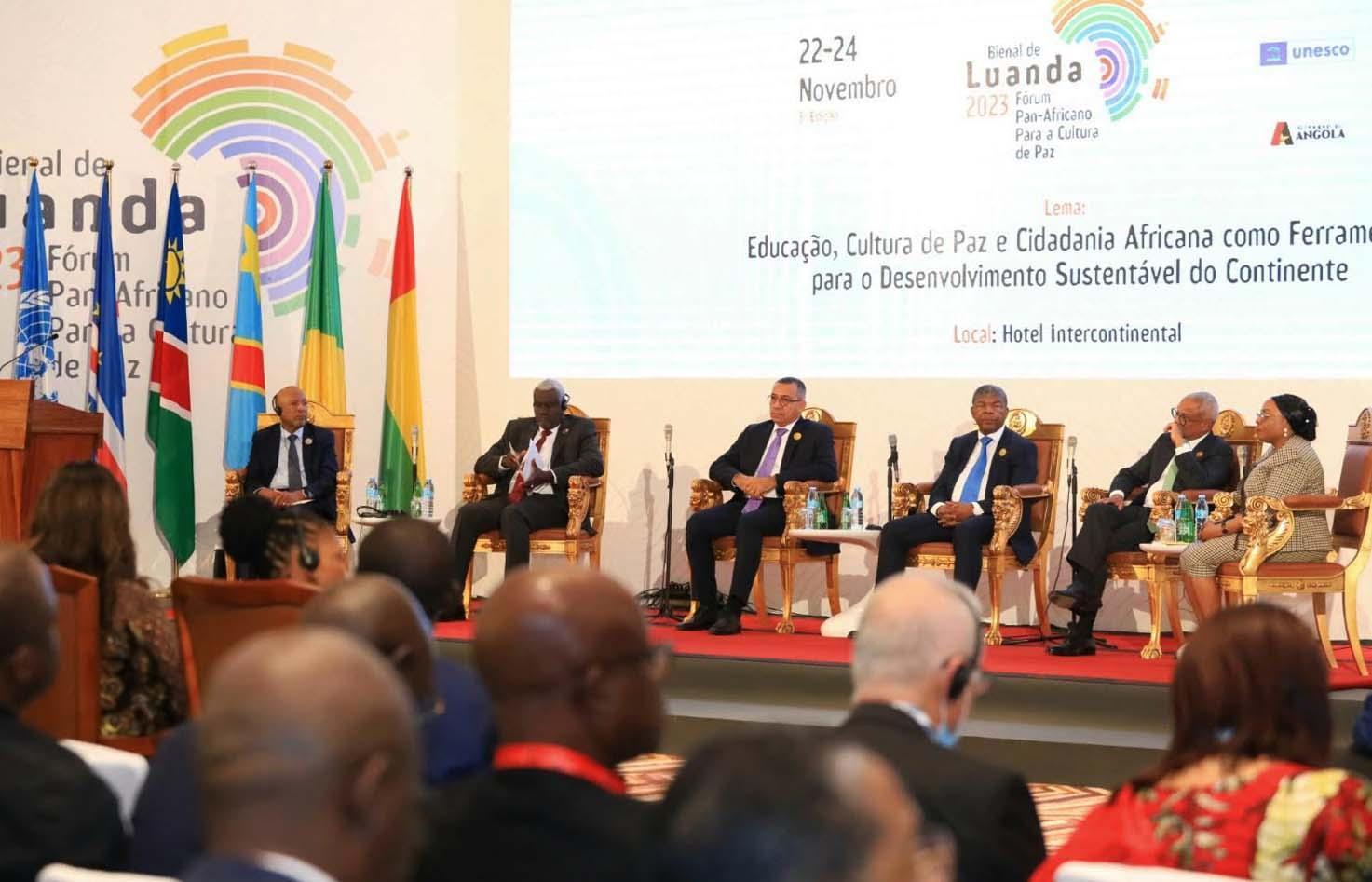
Africa-Press – Angola. With an agenda essentially devoted to the peaceful resolution of conflicts, the third edition of the Pan-African Forum for the Culture of Peace opened this Wednesday, under the gaze of several countries on the continent emerging from civil wars and others still under tension.
Also known as the Luanda Biennial, the Forum is a biannual meeting in support of the Pan-African Movement for the Culture of Peace and Non-Violence, in a joint initiative of the Angolan Government, UNESCO and the African Union (AU).
It is part of the contributions to the implementation of the “Action Plan for a Culture of Peace in Africa”, adopted in 2013, within the scope of the AU campaign “Let us act for Peace” included in the United Nations 2030 Agendas and 2063 of the AU with the initiative “Silencing the Guns in Africa”.
According to the United Nations, Africa is the continent with the highest number of long-lasting conflicts on the entire planet, with 24 of the 54 countries that make it up experiencing wars or other forms of violence in recent years.
Currently, the main armed conflicts on the continent are concentrated in the so-called Sub-Saharan Africa and distributed across the central, eastern and Sahel regions, where the Democratic Republic of Congo (DRC), Sudan and Somalia are the most violent and long-lasting cases.
There are also pockets of tension in countries such as Mali, Burkina Faso, Niger, Guinea-Conakry, Nigeria, Ethiopia, Mozambique and, more recently, Gabon.
In essence, conflicts in Africa have a set of common factors, as their roots, being basically motivated by territorial disputes, political crises emerging from coups d’état, tribal rivalries induced by ethnic or religious issues, as well as disputes over water and resources. minerals.
Genocides, massacres, mass rapes, child armies and the extermination of entire communities with axes are the most frequent common results of current conflicts in Africa.
Another common feature is the death of more civilians than military personnel, in addition to serious humanitarian crises resulting from massive population movements.
At the threshold of yet another electoral election to choose a new President of the Republic, on December 20th, the DRC is still grappling with the continuation of one of the most complex conflicts on the continent.
Since the end of 2021, the country has been struggling with the return of instability to the eastern region and the rekindling of tension on the border with neighboring Rwanda, accused of arming the March 23 Movement (M23) rebellion.
This is an offshoot of the so-called Second Congo War, today considered the most lethal armed conflict since the Second World War, after reaching a death toll of 5.4 million people in 2008.
In turn, Sudan was the scene of the continent’s longest armed conflict, with around 2.5 million deaths and four million refugees, between 1962 and 2003, before the south’s secession in 2011.
More recently, the country plunged into a new cycle of war, with an armed insurrection that began on April 15, 2023, with the number of lives lost in seven months of military confrontations estimated today at close to eight thousand, in addition to millions of refugees in neighboring countries and/or internally displaced people.
Meanwhile, a situation of widespread instability and insecurity prevails in Somalia, where the actions of extremist groups led by the al-Shabab movement continue to sow grief and terror among the population.
It is realities like these that are at the center of attention at the third Luanda Biennial, taking place until Friday, in the Angolan capital, under the motto “Education, culture of peace and African citizenship as tools for the sustainable development of the continent”.
For More News And Analysis About Angola Follow Africa-Press