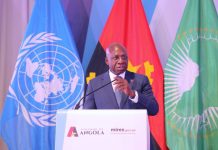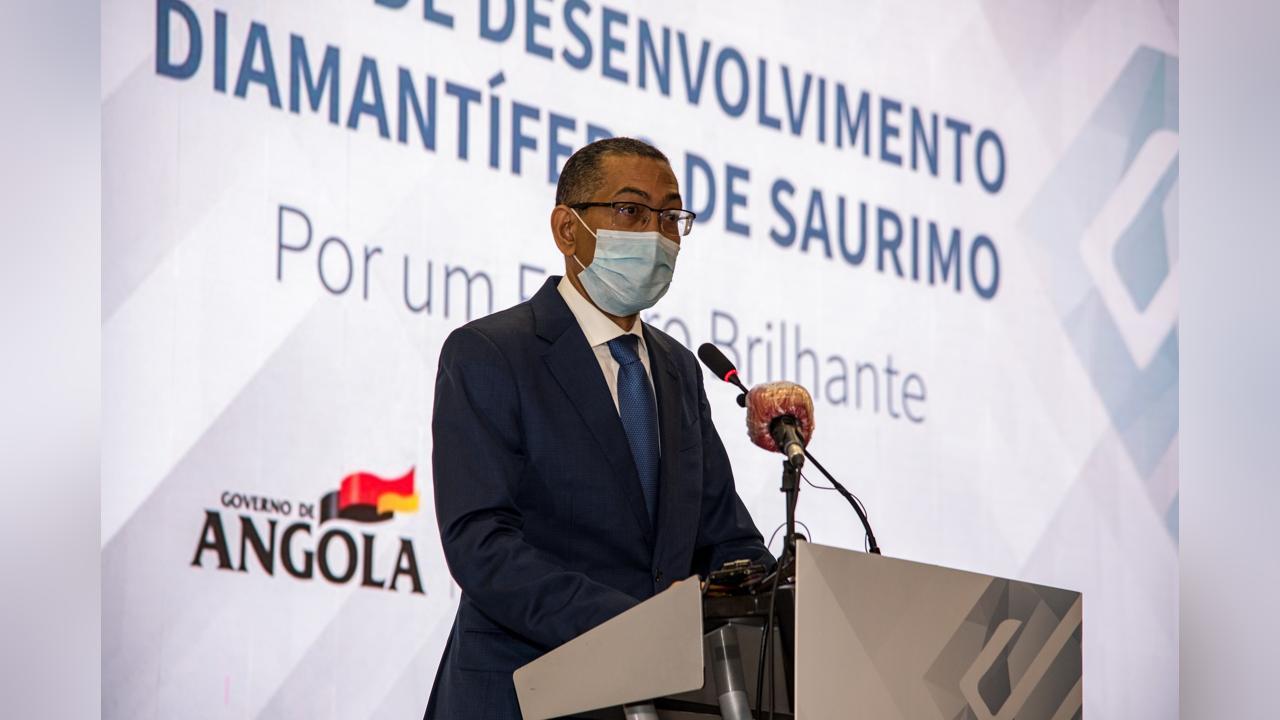
Africa-Press – Angola. The inauguration of the first Municipal Administrative Infrastructure of Saurimo, Tuesday, in Lunda-Sul, represents an important step towards transforming the municipality into the nucleus of national development, stated the Minister of Territorial Administration, Dionísio da Fonseca.
When speaking at the ceremony to officially open the doors of the infrastructure built within the scope of the PIIM project portfolio, the minister assured that the transfer of powers is not an act that takes place on its own, considering it necessary to boost local revenue and make available human and material resources, so that bodies and services fulfill their mission.
“I’m referring to boosting local revenue and not the provision of financial resources”, he added, highlighting that the latter implies, as a rule, passive behavior, while the former calls for proactiveness and pragmatism.
Local bodies, the minister also said, must always comply with the rule of law, be “more active and resourceful” in promoting initiatives, capable of increasing their own revenue collection through the State’s Integrated Financial Management System.
“It is necessary for each municipal administrator to be able to identify and leverage the economic potential of the territorial district that directs and executes public policies according to the context, without leaving anyone behind”, he added, ensuring that he was sure that, in this way, they would fight local asymmetries and would promote the harmonious development of the country. The Municipal Administrative Infrastructure, built in a space of 50 thousand square meters, according to the minister, is the first of a total of eight being implemented in the municipalities of Belas, Negage, Catumbela , Cuito, Menongue, Cacongo, Cuanhama and, of course, Saurimo.
Built in 18 months, the one-story building comprises two auditoriums, four secretariats, offices, green area, exterior lighting, guardhouse and a parking lot with capacity for 90 vehicles.
“It aims to accommodate, in the first phase, the Municipal Administration Services and, subsequently, the Chamber and the Municipal Assembly, which may be established in this territorial district”, explained the government official.
Municipal infrastructures, he said, are the largest projects in the PIIM portfolio, under the responsibility of the Ministry of Territorial Administration, added to 36 Administrative Residential Complexes and 33 Rehabilitation, Expansion and Equipping of Municipal Infrastructure Projects.
“With the implementation of PIIM, we sought to achieve two strategic objectives, namely: Proximity Governance and Harmonious and Inclusive Development of the Country”, emphasized Dionísio da Fonseca, justifying the proximity strategy, by ensuring an administration that is more present in the lives of citizens and allowing for citizens to be more present.
The minister also defended a more efficient and effective administration in solving citizens’ problems, highlighting the participation of the most resilient municipal bodies and services, in the face of various present and future economic, climatic, political and social challenges and shocks.
The administrative and financial deconcentration and decentralization program implemented, according to the governor, has this purpose, to increasingly reinforce the execution of projects and ensure that the municipality is, effectively, the epicenter of national development.
Dionísio da Fonseca also stated that deconcentration is a locomotive in a progressive sense, supporting the fact with the evidence of Presidential Order no. 237/23, of 18 October, which authorizes the transfer of responsibility for the management of irrigated perimeters to the provincial governments of Bengo, Huíla, Cuando Cubango, Moxico, Cuanza-Norte and Cuanza-Sul.
“By stating that the citizen must be more present in the day-to-day administration, we intend to appeal to everyone’s behavior that values life more, preserves the common good and contributes to the urban development of communities”, he said.
Potential of cities
The Minister of Territorial Administration considered the country’s cities to have the potential to be a national reference. Regarding the specific case of Saurimo, Dionísio da Fonseca praised the fact that it is a city in which the inhabitants carry out more community work in the areas of Public Cleaning, Environmental Preservation, Maintenance and Conservation of Gardens and all economic enterprises and social resources made available.
“We need to engage all communities in the conservation of assets. We cannot continue to watch acts of vandalism against public property undaunted and serene”, argued the government official.
Accidents
Road safety in Lunda-Sul worries the minister. As proof of this, Dionísio da Fonseca called for the need for motorcycle taxi drivers to carry out their work risk-free, warning that the activity can and should be carried out with greater safety, through the use of helmets and respect for traffic rules.
“Let us make this commitment, not just as a mere legal or administrative imposition, but as a measure to preserve the lives and physical integrity of citizens”, urged the minister, drawing attention to the seriousness of the number of victims of motorcycle accidents. .
“During the last month, 1,148 road accidents were recorded nationwide, resulting in 227 deaths and 1,355 injuries, with an average of 56 deaths per week and 338 injuries”, he lamented, highlighting the fact that, between January and October This year, Lunda-Sul recorded 375 accidents, including car and motorcycle collisions, crashes followed by rollovers and pedestrian collisions.
JORNALDEANGOLA
For More News And Analysis About Angola Follow Africa-Press