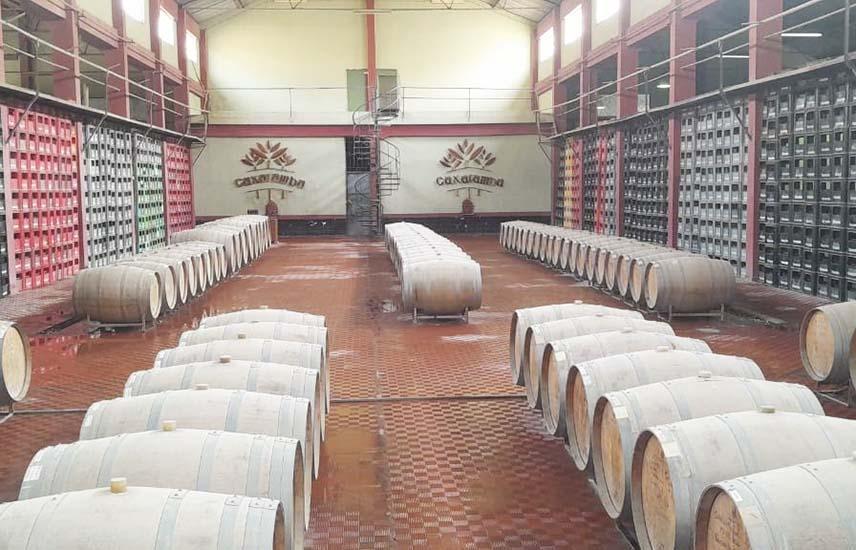
Africa-Press – Angola. Caxaramba, a brandy and rum factory based in Lobito, province of Benguela, received, this week, the first thirty tons of national pineapple to start the production of drinks with a low alcohol content, Saturday.
The company’s managing partner, Ricardo Guerra, revealed that this first supply comes from the commune of Monte Belo, municipality of Bocoio.
“The factory has the capacity to absorb ten tons of pineapples per day”, he informed.
He said that it is located in the old pineapple wine factory and, as a result, it was possible to recover the machines and adapt them to new technologies.
“Our main concern, despite having sugarcane as our brand image, is to also work with other products that allow us, in some way, to make up for the shortage of other beverages in the primary sector”, he explained.
He assured that Caxaramba will continue to experiment until it reaches the desired profile, with a low alcohol content, with some drinks being fermented, initially, and then distilled, which is the house’s specialty.
He gave as an example “Booster” and “Sminorff”, fruity drinks with four to five percent alcohol content.
Asked about the quantity extracted in the first production, the manager did not give a time horizon, but said that it will not take long as it is “a matter of getting exactly the profile you want”.
“We have an open door for all producers because we want to receive large quantities, within the prices established for an industry that wants to produce and transform, in accordance with our core business (main business)”, he highlighted.
He also said that it is the company’s management’s intention to have land for production, but, at this stage, the priority is to buy quality products from farmers that meet their needs.
Ricardo Guerra recalled that, more than fifty years ago, the province of Benguela had pineapple-based beverage factories, such as CIFAL, in Lobito, Dusol, in Benguela, and another in Alto Hama (Huambo).
For many years, pineapple producers in Bocoio, Monte Belo and Balombo have faced difficulties with production, ending up with several tonnes being spoiled due to lack of outlets and markets.
It is a practice for producers to rent three-wheel motorbikes, known as “Caleluias”, to reach difficult-to-access areas where they harvest the product and then place it in vans to transport it to the markets in Lubango, Namibe and Luanda.
According to industry agents, this process sometimes exceeds the amount raised from the sale of the product.
For More News And Analysis About Angola Follow Africa-Press