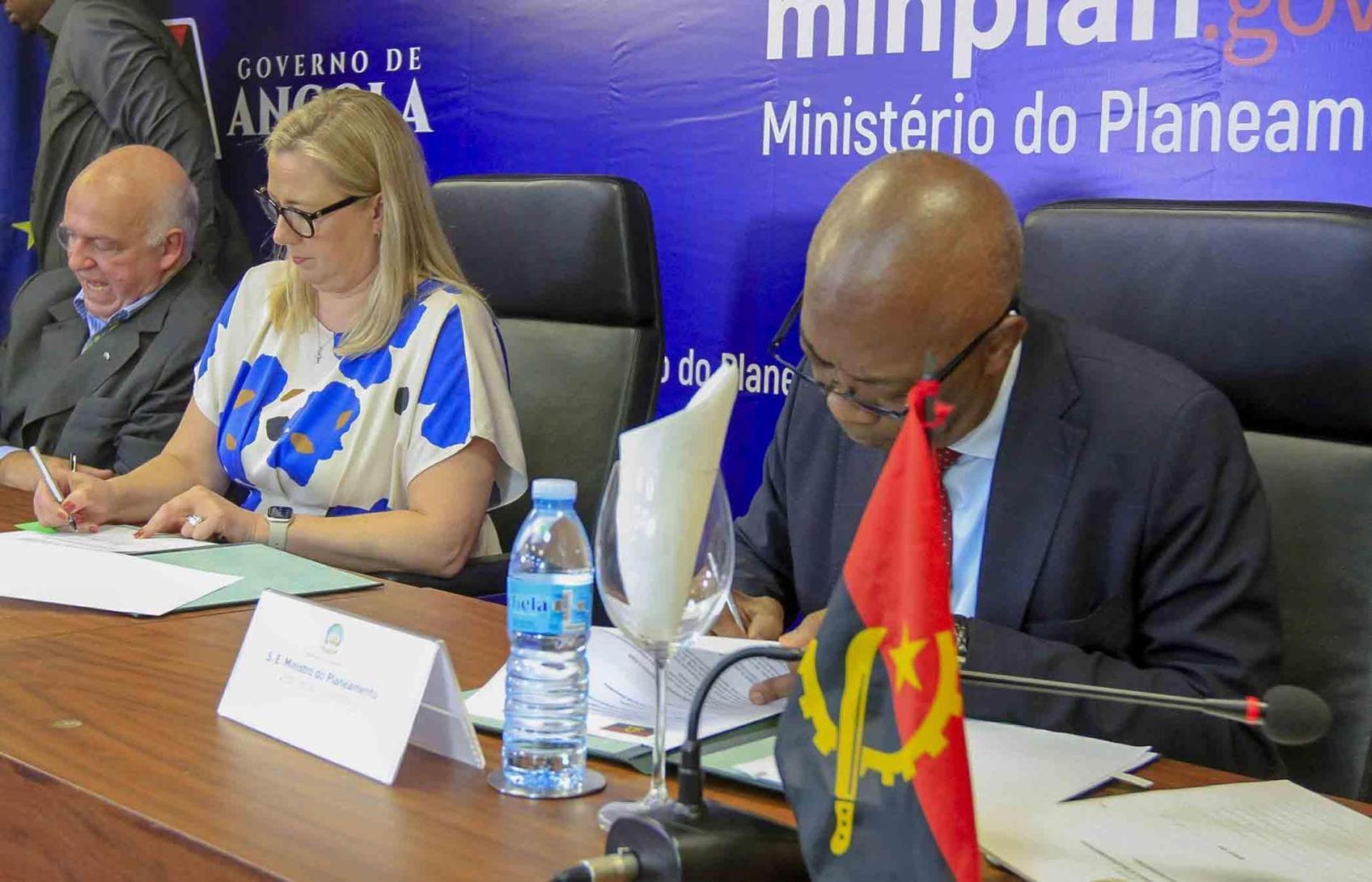
Africa-Press – Angola. Four financing agreements, valued at 90 million euros (1 euro is worth 895 kwanzas), were signed this Wednesday, in Luanda, by the Angolan Government and the European Union, with a view to financing programs related to the blue economy, justice and rule of law.
The respective documents, which also cover the areas of solid waste management and civil society training, were signed by the Minister of Planning of Angola, Victor Hugo Guilherme, and the Commissioner for International Partnerships of the European Union, Jutta Urpilainen.
On the occasion, the Angolan minister highlighted that the four conventions are in line with the National Development Plan 2023-2027 and reveal the Government’s commitment to these matters.
According to Victor Hugo Guilherme, the signing of these conventions constitutes yet another effort towards a projected and diversified economy, in addition to promoting a resilient and sustainable ecosystem, as well as having a fair nation with equal opportunities, prioritizing justice and human rights.
According to the minister, the proposed actions contribute to strengthening the two priority development pillars, namely the development of human capital and food security.
The financing, which will be disbursed until 2027, is part of the Multiannual Indicative Program of Aid for Cooperation and Development of the European Union (EU) in Angola, which has been running since 2021, through the Neighborhood Instrument for Development Cooperation and International cooperation.
The sectors covered by the aforementioned conventions are priorities for the Government of Angola, and are also areas in which the EU and its member states have experience that they can share.
For the area of urban solid waste management, in the province of Luanda, with a budget of 25 million euros, the program envisages implementing circular economy models, developing new value chains and offering new sustainable business opportunities, as well as reinforcing environmental governance at provincial and municipal levels.
The project also aims to contribute to the reduction of greenhouse gas emissions resulting from the extraction, processing, demand and consumption of virgin materials.
For the empowerment of civil society, the main objective is to strengthen the capabilities of this social fringe, to play a role in national political dialogues and influence national public policies.
The program, with a budget of 10 million euros, will also support the training of Angolan civil society as an actor in governance and development, promoting the strengthening of human rights and democracy.
This convention will also contribute to promoting reinforced and effective participation of civil society, especially actors and networks that are underrepresented in decision-making, such as women, young people and the most vulnerable sections of society.
For the sustainable blue economy in Angola, budgeted at 30 million euros, it is expected to promote the conservation and sustainable management of marine resources and coastal ecosystems, in a context of climate change.
Specifically, this program aims to preserve and sustainably manage biological resources and marine ecosystems, as well as improve the inclusiveness and economic, social and environmental sustainability of food value chains of aquatic origin and improve the commercial viability of aquatic food products in local markets.
The financing for the field of justice and rule of law, valued at €25 million, will serve to strengthen and promote access to justice for all citizens and especially for women, young people, children, people with disabilities and people living in rural areas in Angola.
For this sector, activities will be developed to reinforce the performance and professionalism of staff at the main institutions of the justice system, as well as to reinforce the fight against organized crime, with emphasis on money laundering, corruption and asset recovery..
To this end, resources and training will be made available to improve e-justice and data protection, privacy rights and cybersecurity.
The Multiannual Indicative Program for Angola 2021-2027 was approved by the European Commission in December 2021 and covers the priority areas of sustainable economic diversification, transparent, responsible and effective governance and human development.
In total, the strategic programming framework, lasting seven years, has an indicative financial allocation of 275 million euros for the period 2021-2024, of which 90 million will be allocated to the four financing agreements signed.
Of the global amount, 82.5 million euros were allocated to the programs ‘Revitalization of Agricultural Education and Professional Training in Angola’, ‘Support for the Formalization of the Economy’, ‘Social Protection and Support for Public Financial Management’, ‘Measures of Dialogue Support between the European Union and Angola’ and ‘Communication and Visibility of Cooperation’, in 2022.
In 2023, 26 million euros were disbursed from the European Fund for ‘Sustainable Development Plus’, an instrument called ‘Global Gateway’, aimed at promoting sustainable investments in European Union partner countries.
For More News And Analysis About Angola Follow Africa-Press