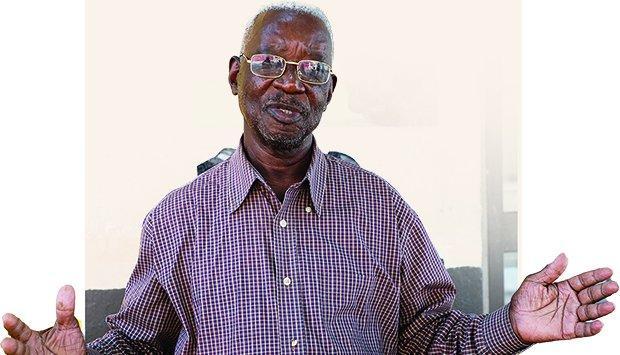
Africa-Press – Angola. António Campos, born on 27 December 1950, is one of those “stars” who are hard to miss in the world of great contemporary Semba figures, who can be found all over the Sambizanga, Marçal and Bairro Operário neighbourhoods. Even though he has never been a full-time professional musician, due to his knowledge of the history of Semba and its main creators, our interviewee has no doubts: his backyard has welcomed the cream of Angolan music.
Tony Cubano gives us some interesting insights into some of the members of the so-called “glorious nucleus” of the most well-known artists in the world of pure Semba. The conversation extends to other aspects of life, starting from the colonial period, going through the country’s transition phase towards the achievement of National Independence and culminating with the passage into eternity of two people, with whom he shared unforgettable moments of friendship and familiarity: Bangão and Nagrelha.
It is known that during the height of the revolution, you closely followed the trajectory of Sabata and Urbano de Castro. What memories do you have of these two men? Did you know them well? At the time, some people called them “bandits”…
The settlers always treated them like this… It’s true that many people had their own adventures, especially the blacks, and everything got mixed up at that time. They weren’t just treated as “criminals”, but as “terrorists”… In 1975, they realized they had to fight for their country and became 100% revolutionaries! I’m talking more about Sabata, but I met Urbano de Castro in 1975, as a musician, at Ngola Cine. The “Preta Fula”, as he was nicknamed, used to do shows before he became a musician. He would even raise eyebrows with his teeth.
It was also at this time that I met, through the “groups”, Artur Nunes, who was a very cultured person, whose father was American. He was a hunter and lived in Sambizanga, Cuba neighborhood. His father sold the animals’ skins, of which he used the largest ones to make bass drums.
I think he learned to sing Kimbundu so well within his family and in the “groups” that, at the time, frequented the homes of Messrs. Pascoal Kabuja, Barrigana, Adão Kiboelo, the man with the “bassulas”, etc.
People would leave work and attend these “groups”, as you say, but some say that it wasn’t always a peaceful environment. Do you agree?
Yes, it’s true. There was some confusion, but there was mainly confusion when it came to defending the honor of one’s partner. The flirting, you know? (laughs). So, you leave your neighborhood and invade the other person’s territory to conquer, what do you expect? Some jokes, and some serious ones! (laughs).
But who invaded more? Those from Sambizanga or those from Marçal?
It was vice versa. There were strong rivalries even within these neighbourhoods. In Sambizanga, if you went to Bairro Alfredo, you had to have friends; if you went to Santo Rosa, the same thing happened. And what’s more: there were also those fights in which two adults would get into a fight (the main reason, you know). After getting drunk, they would go to the store, buy a bottle of wine, have a drink with Coca Cola and calm things down.
Now, those who used knives were already considered criminals and many people did not trust them. What is happening today with these children who act in bloodthirsty groups is something else. This is much worse… Without a doubt!
And what did the police do at that time? I am referring to the scenario that was taking shape in relation to the arrival of National Independence…
We took advantage of the opportunity to follow the development of the struggle, through the “Angola Combatente” Program, but everything was done in secret, protected by the “groups” we were in contact with.
When did you younger people feel like things were really heating up?
That was when we started hearing the news that other African countries had gained their independence from other colonial regimes. It was from then on that our eyes opened wider. I had a misfortune: I had formed a group in the Cuba neighborhood (Sambizanga) and we were getting ready to embark for Congo. The group was made up of many of my friends, such as Tomás Miguel Ambriz, Sango, etc., but instead of taking my backpack straight away, I didn’t. I went to see them and went back to get it. When I came back, they were no longer there. I cried! The next day, I heard our code on the radio: “Attention, attention, Cuba neighborhood; the Baobab Tree Was Well Watered and Gave Good Múkua”. That meant that the “Múkua” group had arrived safely!
Do you miss those times a lot?
I miss it a lot, because many good things happened too. For example, the problem of garbage. There was a white man, Santos Quipexe, who, as a inspector, went around practically the entire shanty town by himself. And the streets were clean, one house after another, despite the precarious living conditions…
When exactly did your patio open? Who were your first customers, the first ones to show up with their guitars, reco-recos, in short, the serenades, what were they like?
It opened in 1980, if I’m not mistaken, and among the first regulars, I remember the late Fortes, who was the bass guitarist for Dimba Ngola, Dionísio Rocha, Zeca Tirilene, António Salazar Fragoso dos Santos “Zarga”, in short, many famous people. Back then, they already served fried fish with sauce. The late Zé Fininho used to say that anyone who went to Bairro Operário and didn’t eat Tony Cubano’s fried fish didn’t know BO (laughs).
So many people passed through here that once Mr. Mendes Ribeiro even did me the special favor of bringing two white ladies to sing fado in this humble little house. It was a spectacle!
Who was Mr. “Zarga”?
He was a gentleman who played for Ferroviário. He was a commercial agent for the CUCA brewery since colonial times and actively participated in the organization of the famous “CUCA” Tournament. In short, he was an eternal figure of Luanda and the country, whose personality, quite cultured, deserved the respect of many people of his time and of more recent times.
He was also the founder of the group “Os Gingas”. He was an old man who always deserves to be taken off his hat! May he rest in peace!
Are there other people in the neighborhood who have left a big impression on you?
Yes, obviously. Lourenço Bento, who worked at TAAG, and others more connected to the music world, like the people from África Ritmos, Kinito, Jadinho, Salviano, etc.
And of the other groups of your time, which one did you like the most?
They were Kiezos and Jovens do Prenda. Especially because they were the ones that attracted the crowd the most and the guys also enjoyed their performance. But, despite also having friends in the latter group, I liked Kiezos more. I knew them all in Marçal, they were my friends, I watched their rehearsals and this greatly influenced my choice.
Was there a tough rivalry between these two sets?
There was a work issue, as they were all friends of each other. In the meantime, other groups emerged, such as Merengues, and later Semba Tropical, but we cannot forget Negoleiros do Ritmo, which was a group basically formed by intellectuals, not to mention Ngola Ritmo…
Is there any special story you can tell us about Bangão?
Bernardo Jorge Martins Correia? He was a good friend of mine! Whenever he was going to sing, no matter what show it was, he would often come to my house and give me money. For example, when he went to sing at one of President José Eduardo dos Santos’ New Year’s Eve parties, Bangão came into my living room and made the same gesture with some crisp dollar bills. That day, he came with a car full of costumes, because when he performed, he would change his costume for each performance.
He would often leave his house in Sambizanga and show up here in the early hours of the morning, wearing shorts. He would say goodbye to his wife and when he got home he would say to me: “Dude, call Filipa and tell her I’m already at your house!” He was a very simple person, very attentive, without any prejudice!
And what do you have to say about Dom Caetano?
With him and other friends we founded a group in Sambizanga, which was called “Os Sete Incríveis”, in which Dom Caetano only sang together with the late Zeca Sá, as rhythm guitarist. We played in the halls of Faria or Braguês, in Sambizanga, on Sundays, at matinees, with the instruments of the other groups. When our group broke up, Dom Caetano and Zeca Sá started to perform together and Gaby Monteiro went to Jovens do Prenda, where he was very successful.
Let’s build a bridge between generations. Did you have strong ties with Nagrelha?
I met his family long before he joined mine. I met his mother, Maria Caio, in Baião (Sambizanga) and his father, António Maia, in Zangado (Rangel). Much later, he had a relationship with my daughter’s daughter, whose name is Mira “Mãe Grande”. My relationship with him was always good, because he always treated me with great respect.
Did his death also take you by surprise?
Yes. I was very shaken, because before there was a person who had gone to the hospital where he was admitted, and said that he spoke normally. The boy showed no signs of leaving. When the misfortune happened, I was very shaken.
The Suburban Triangle and the Glories of Urban Music
Marçal, Sambizanga and Bairro Operário, this was the triangle of suburbs, experienced by António Campos throughout his almost seventy-five years of age. It is a trajectory full of more joys than sorrows as he gained the friendship of the main “glories” of music of the 60s / 70s and saw the blossoming of many others, from Elias Dyá Kimuezo to his son-in-law and grandson Caio Mendes “Nagrelha”.
Owner of the famous Quintalão da Pracinha, located near the old Majestic Hotel, more precisely opposite Bar América, in São Paulo, “Tony Cubano” is part of the group of older people who became famous precisely because he managed to bring together, in a small rustic space, names such as Carlitos Vieira Dias, Vate Costa, Augusto Chakayá, Dom Caetano, Bangão, Velho Zarga, Mangalha, Tonito and Zeca Tirilene, Marito, Cirinéu Bastos, Carlos Lamartine, Gaby Monteiro, Zecáx, in short, all those who, at the end of each working day, managed to make the musical notes of each masterpiece of their fantastic recordings pour out there, until the sun peeked out the next day, with a time already set for a new meeting, well-watered and chewed.
We met him after he had returned from his usual shopping at the São Paulo market, where he is a regular customer. Fried fish is his specialty. Gone are the days of good barrel wine, with which he delighted his friends in the backyard, but he keeps traditional Angolan music alive, whenever he can! However, many of his companions from long and well-lived nights have departed to another dimension.
“Tony Cubano” is a man of many stories, many of which could easily enrich the great historical and cultural heritage of that “Suburban Triangle”, which, in fact, he considers “his”.
It is already known that many inspired melodies and lyrics were born there, as well as that, after public musical shows by the most diverse groups, refined artists did not hesitate to sit on a long wooden bench to unwind from the “hardships” of life, with or without company. What was most interesting was the interaction between several generations from different parts of the city and beyond.
A fado group from Lisbon even “performed” in that space, although some of the comfortable conditions were regrettable. However, all the artists knew that they were not at the “Karl Marx” Cinema, nor at the Atlântico or Miramar. Much less at the Olympia or the Coliseu dos Recreios de Portugal. The atmosphere was different, one of family, among friends and drinks of reco-reco and fried fish, without the refinement of a Parisian-starred chef.
JORNALDEANGOLA
For More News And Analysis About Angola Follow Africa-Press