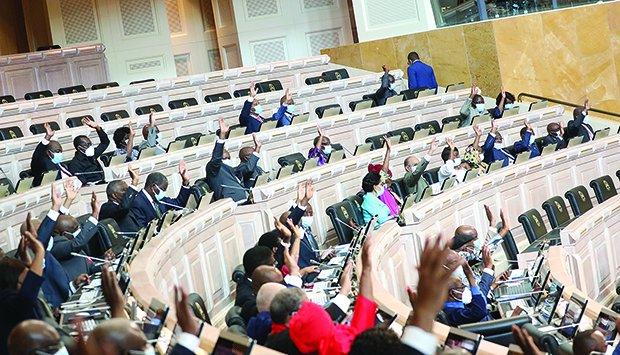
Africa-Press – Angola. The strategy for training human resources in the Health sector was yesterday, in Luanda, among the main topics of debate in the ordinary plenary session of the 5th Legislative Session of the IV Legislature of the National Assembly, with the deputies defending greater appreciation of national staff with the payment of better subsidies.
The majority of opposition deputies highlighted the MPLA initiative and asked the Executive for more viable strategies to combat the main diseases, especially malaria, considered the main cause of mortality in the country.
Lucas Ngonda, from FNLA, praised the readiness of professionals in the sector during the Covid-19 pandemic and recommended better solutions to address their social concerns: “The country must provide better social conditions that dignify health professionals, so that can proudly serve the country”.
He denounced the lack of specialized personnel in different areas, considering that this has led to the hiring of cooperators who, unfairly, receive better salaries in relation to national staff with the same categories.
Miraldina Jamba, from UNITA, said that the existence of a strategy for training human resources is of interest to the entire Nation, advocating equality in access to specialization for health professionals and the placement of gynecology and obstetrics services in national, general hospitals and municipal.
“We have received many complaints about discrimination in access to specialized medical training”, he said, stressing that doctors placed in distant municipalities must enjoy salaries in line with the place where they carry out their activity.
The leader of the PRS, Benedito Daniel, pointed out that the strategy for training staff in the Health sector should increase the satisfaction of doctors and nurses to increase productivity and create mechanisms to attract and retain talent. For the politician, a successful strategy must correspond, in an assertive way, to the recommended objectives and guarantee the physical and psychological well-being of professionals.
He also mentioned the lack of balance between needs and available resources, as the first condition requires an effective means of evaluating progress and achievements, while Cesinanda Xavier, from CASA-CE, recognized that there is a health system well organized in the three levels of assistance (primary, secondary and tertiary), but admitted ineffectiveness in the first, which houses the medical centers and municipal hospitals.
According to the deputy, about 80 percent of the population is treated in municipal centers and hospitals, “where there is a glaring lack of essential materials for basic care”. and national – weaknesses persist, such as the lack of human resources.
He defended greater commitment to preventive medicine and basic sanitation to avoid, above all, malaria, which is the main cause of mortality in the country.
Media Package
The deputies were not unanimous in approving the proposals that amend the Press Laws and on the Exercise of Broadcasting Activity, contained in the Media Legislative Package. Both diplomas are the legislative initiative of the President of the Republic as the holder of the Executive Power.
The first diploma received 125 votes in favour, 38 against (by UNITA) and nine abstentions, while the second was approved by 120 deputies, rejected by 43 and two abstentions.
Marcolino Nhany, from UNITA, justified the negative vote in relation to the proposal that amends the Press Law, indicating that it does not materialize the fundamental right of Angolans to freedom of expression. “This is the fourth time that the Press Law has been revised, without, however, realizing the fundamental right of Angolans to freedom of the press”, he said.
He stressed that his party would like to vote on a law that guarantees the principle of contradictory, a basic rule of impartial, truthful and objective journalism, therefore, he underlined the intention to vote on a diploma protecting the independence of the mandates and careers of journalists, which check out the defense of the freedom of professionals in the class to elect the Editorial Boards.
“Introducing artifices such as redefining concepts of public interest and institutional communication just to violate the Angolans’ right to freedom of the press is a setback, because it attacks pluralism and the separation of powers,” said Marcolino Nhany.
In response, João Pinto, from the MPLA, recalled that his Parliamentary Group approved the amendment of the press law to clarify and introduce rules on polls, samples and opinion surveys as a means of disseminating media content to be defined in specific diplomas.
He denounced the attempts to associate the public interest with public bodies, stressing that the amendment of the diploma will also demand greater respect for trademarks, patents and earnings of individual or collective actors published in the press. For the deputy, the exercise of press freedom should not be done “with abuse” by employers, coercion and attack on professionals.
The Draft Law Amending the Law on the Exercise of Broadcasting Activity received 120 votes in favour, 43 against and two abstentions.
After the diploma voting process, only UNITA deputy Araújo Pena reacted to justify that he voted against it, because it “does not improve the framework of broadcasting activity, much less the democratization of society”.
Araújo Pena considered the minimum value of 55 million kwanzas for the opening of community radios “very high”, because for the reality of the country this is “limiting”. He stressed that, currently, low-power transmitters also introduced in the law cost less money and the online radio solution would help to dispense large sums.
The vote on the Bill of Polls and Opinion Surveys was also not consensual. The diploma received 122 votes in favour, 43 votes against and two abstentions.
Health Progress And Gains
Evelize Frestas, from the MPLA, indicated the “considerable” improvements in the quantity, diversification and quality of health professionals, associated with other gains in the field of hospital infrastructure, built in recent years in the national territory. She exemplified the construction of more than 700 health units, of which 4 are at the tertiary level, spread across the different provinces, which provide more than 8,237 beds.
The parliamentarian also spoke of the medical procedures carried out in the country, which were previously only possible abroad, recognizing that they saved money with the medical boards.
Among the most evident progress in the training of professionals in the current five-year period, the deputy highlighted that the degree in Medicine went from five courses in Luanda, at the time of Independence, to nine, and from 40 to 600 graduated doctors per year, in addition to the training of 38 thousand middle technicians, of which 60 thousand in public institutions.
In turn, deputy Nvunda Salucombo (from the MPLA) said that the approach to the issue must be interpreted through the principles of the Angola-2025 long-term strategy, emphasizing, in this particular, the social inclusion aimed at the construction of infrastructures.
“In terms of social inclusion, lucidity is needed to recognize that, when National Independence was proclaimed, the country inherited an enormous social burden, translated by thousands of Angolans who could not read or write. 85 percent of the adult population at the beginning of the 70s was illiterate”, he recalled.
Contributions
The president of the National Assembly, Fernando da Piedade Dias dos Santos, said that all the proposals and recommendations presented for the improvement of the sector in the human resources chapter will be dealt with in the specialized work committees.
He considered the debate very constructive, which “demonstrates once again the commitment of parliamentarians to voters”.
The debate on the strategy for training staff in the Health sector took place before the agenda. Just yesterday, the seat of Parliament registered the swearing-in of members of the Board of Directors of the National Civil Aviation Authority.
Courts of Common Jurisdiction
Yesterday, the National Assembly unanimously and definitively approved the Proposals for a Law on the Organization and Operation of Courts of Common Jurisdiction, and for an Amendment to the Law on Merchant Marine, Ports and Related Activities.
MPLA deputy Vigílio Tyova justified the favorable vote of the party’s Parliamentary Group to the Draft Law on the Organization and Functioning of Courts of Common Jurisdiction with the fact that it was within the parameters of the Constitution of the Republic.
Diamantino Mussokola of UNITA also welcomed the passage of the proposed law. He referred that the same, once well applied, will contribute to the reduction of the procedural volume in the courts of first instance. He appealed to judges and public prosecutors before the courts to refrain from subjective criteria in the interpretation and application of the law.
For More News And Analysis About Angola Follow Africa-Press