Africa-Press – Angola. The community aquaculture project, which is being developed in the province of Lunda-Sul, allowed the direct involvement of more than 50 families of young people who practiced diamond mining.
Implemented within the scope of the Support Program for Economic and Social Development of Lunda-Sul (PADES) and with five years of existence, the project has already benefited close to five thousand permanent families from the various communities in the region. In addition to community fish farming, PADES also promotes the Agricultural sector , essentially encouraging the production of cassava and maize.
Of the five thousand families benefited, the project has a direct workforce of 50 families. Speaking to the press, as part of the festivities of the 27th anniversary of Sociedade Mineira de Catoca, the coordinator of PADES, João Reis, stressed that the 40 young people who practiced diamond mining are now direct workers of the community project.
It should be noted that the project tripled the indirect employment framework, a group which also includes a large number of ex-garimpeiros. One of the examples is the ex-garimpo practitioner Adão Jorge, 30, who took up the practice of illegal activity in the province of Cuanza-Norte. The citizen joined the community project, because it guarantees the family’s monthly support. “Here I am safe, because in the mining we depended on God to find a stone and support the family”.
Performance
PADES is financed by Sociedade Mineira de Catoca, with institutional and technical support from the provincial government. Comprised of two components, one for family fish farming logistics and the other for the delivery of fingerlings to communities, the program allows the annual delivery of between 100,000 to 200,000 fingerlings, goals that have been exceeded from time to time.
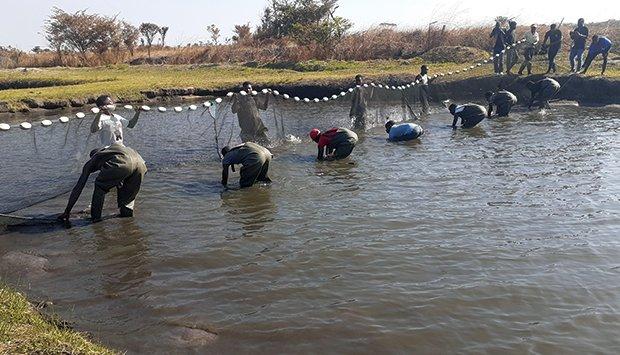
With regard to reproduction, 100 tanks were built in the Monaquimbundo commune, municipality of Saurimo, with dimensions ranging from 10 by 20 meters and 20 by 25 meters. As far as depth is concerned, some are one meter and others are one and a half meters. Of the tanks in question, some were designed for practical classes for students at the commune’s Agricultural School.
The project coordinator, João Reis, highlighted that the tanks were made by the community, which spared no effort to make the program possible, taking hoes, pickaxes and other necessary materials, which made the initiative possible. “We managed to implement the project in all municipalities and in some communes, with a representation of five tanks in each one, which allows the harmonious development of community fish farming”, he highlighted.
Feed Shortage
The scarcity of feed and its high price in the national and international market prevents the reproduction of fingerlings to promote commercialization activity. If it were possible, said João Reis, the tanks could produce up to 800,000 kilograms of Tilapia.
Currently, at the local market level, 25 kilos of feed for the reproduction of fingerlings costs between 19 and 26 thousand kwanzas, depending on the quality. “We buy the feed at very high prices and it doesn’t pay off, because the high cost product affects all Tilapia producers”, he stressed.
As a result of this constraint, the coordinator of the community project said that the species can be fed with leaves and other products. “We have possible rations to feed the matrices and after they grow we distribute them to the population”, he clarified, defending the need to find other solutions, to counteract the difficulties with the cost of raw material.
For More News And Analysis About Angola Follow Africa-Press