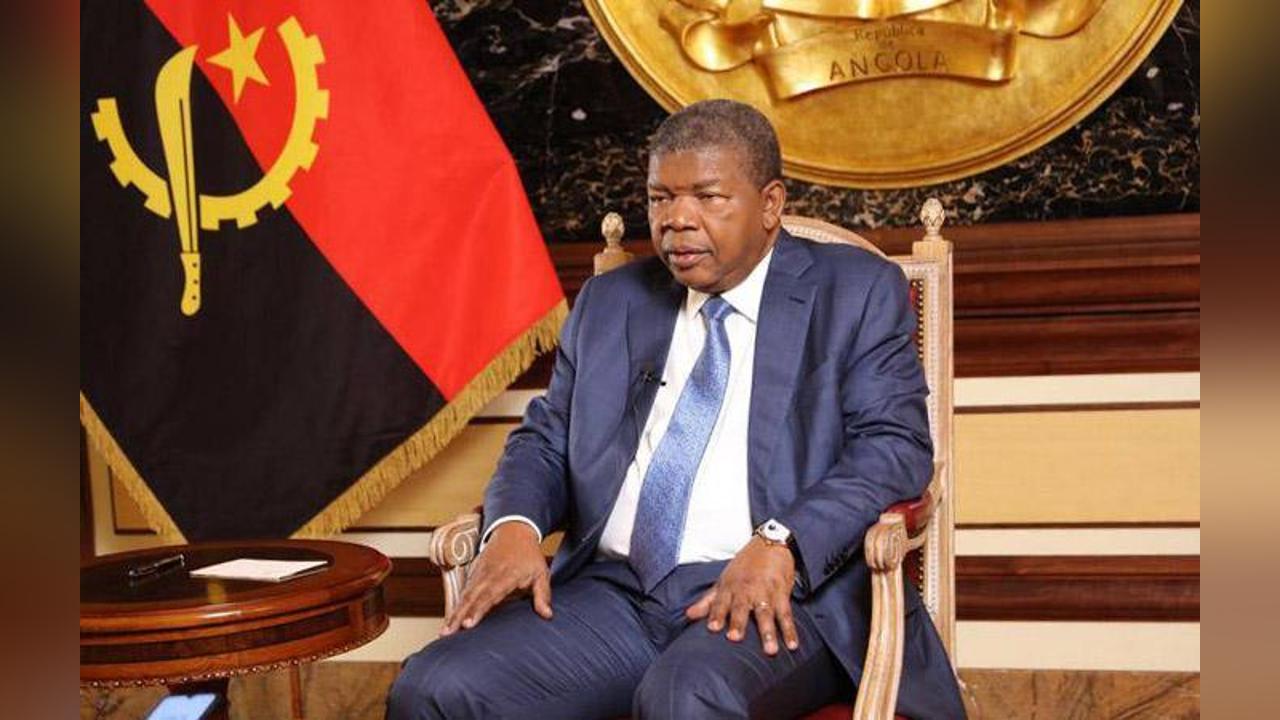
Africa-Press – Angola. The President of the Republic, João Lourenço, said that Angola could become a supplier of gas and green hydrogen to Europe.
In an exclusive interview with Euronews, João Lourenço says he believes that the production of natural gas, not associated gas, in Angola will experience a boom in the coming years.
For this purpose, he adds, a new consortium was formed for the production of gas, exploring the identified reserves.
“Gas in Angola has not developed much because there was a lack of legislation. Angola did not have specific legislation for gas, focused on gas, and this inhibited multinationals in some way. But this situation is outdated, since 2017”, said the Angolan statesman.
In this interview, President João Lourenço also talks about the new model of cooperation that Africa wants with the West and the impact of the war in Ukraine, stating that it goes beyond the European continent.
Here is the integral:
Euronews: I have to address the war in Ukraine. In most of the resolutions that were adopted by the General Assembly of the United Nations, and which were aimed at Russia, Angola abstained, Why?
João Lourenço, President of Angola: There were three resolutions, of which Angola abstained in two. Abstention is not disapproval. Abstention is abstention, it should be interpreted as such.
In the second resolution, Angola voted in favor of it, because the resolution was very concrete, it aimed above all to condemn the annexation of the four regions that make up the Donbass, and Angola understood that the aggression in itself was already bad, it was already serious, but worse than that aggression was the annexation of a foreign territory, of a neighboring country, a member of the United Nations. Therefore, there Angola had a very clear option of voting in favor of the proposed resolution at the time.
In the case of the most recent one, Angola abstained. But first, he was careful to try to negotiate – we can use that term – either the withdrawal or the easing, so to speak, of just one paragraph. I am referring, specifically, to the operative paragraph, as they call it, or P9, which referred to, let’s say, taking the aggressor to an international criminal court. It’s not that it can’t be done, but we understand, and we know negotiation methods, that when you’re negotiating you always have to leave an open door. And we believe that at this moment the priority is to bring Russia to the negotiating table. Everything must be done in order to bring the two parties, but above all Russia, to the negotiating table to achieve a ceasefire that will last and negotiate peace not only with Ukraine but with NATO.
Euronews In your opinion, what is the impact of this war on Africa?
João Lourenço: Africa is not an isolated island in the world. We live in a globalized world, with a very large interdependence between nations. Therefore, the economic crisis, the energy crisis, the security crisis that this war in Ukraine has caused affects all countries in the world, without exception, and perhaps the African continent more, because we have more vulnerabilities.
Euronews: You are committed to contributing to the pacification of the African continent. In the case of the Central African Republic, he defended the lifting of the arms embargo on the government so that it could defend itself. Is this the only solution to peace?
João Lourenço: It is certainly not the only one. The country needs to comply with the Luanda roadmap. Somehow started to fulfill, but the process is not finished. It is therefore necessary to negotiate with all the living forces in the country, with the opposition, in particular, at least the opposition that is in central African territory. And to give opportunities to other political actors so that they can participate in the political life of the country.
Euronews: In the case of the east of the Democratic Republic of Congo, there is a humanitarian crisis that is serious, derived from a war. What initiatives did you propose at the summit of heads of state and government (African Union) to resolve this crisis?
João Lourenço: Are you referring to the latter in Addis Ababa?
Euronews: Yes, exactly.
João Lourenço: Well, the proposals were not just from Angola. They belong to various heads of state. What needs to be highlighted is that it was concluded that two steps must be taken, above all one step, which is to try to reach, at all costs, a definitive ceasefire, because it has been violated on several occasions, which came out following the Luanda summit was repeatedly violated.
A new ceasefire must be reached. It is necessary, immediately, after this ceasefire, to take the next step of cantoning the M23 forces. And for this cantonment process to take place, the summit concluded that there is a need to deploy the regional force, which is made up of four five countries, Kenya, Burundi, South Sudan, Uganda and Tanzania. Therefore, of these countries only one already has troops on the ground. I am referring to Kenya, which is bearing the expense of maintaining its force on the ground. But the other four countries are having some financial difficulties in covering this deployment operation and the African Union Summit, especially its Peace and Security Committee, will resort to the continent’s Peace and Security Fund to cover this expense.
Euronews: How do you negotiate with these armed groups?
João Lourenço: The Addis Ababa summit tasked Angola with establishing direct contact with the leadership of the M23, in order to convince them to accept the ceasefire and the cantonment of their forces. And we started, immediately, the fulfillment of this mission given to us. And at this very moment, Angola is already maintaining contacts with the leadership of the M23.
Euronews: The current geopolitical context forced us to review our priorities. Europe is currently looking for an option to replace Russian gas. Is Angola an alternative?
João Lourenço: Angola is an alternative. Angola, at the moment, produces more oil than gas, although we have some gas. But we constituted a new consortium for the production of gas. Therefore, several multinationals, in consortium, will start to explore more gas in Angola, there are identified reserves.
Gas in Angola has not developed much, because there was a lack of legislation. Angola did not have specific legislation for gas, focused on gas, and this inhibited multinationals in some way. But this situation has been outdated since 2017, and we believe that the production of natural gas, not associated gas, in Angola will experience a boom in the coming years and, therefore, from then on, Europe will be able to count on Angola as an important supplier only gas but also green hydrogen. We are already making contacts with some European countries for the production of green hydrogen.
Euronews: Angola continues to depend almost exclusively on oil. But one of the flags of his government is the diversification of the economy. Where are we?
João Lourenço: We are fine, we are fine. Therefore, the non-oil sector of our economy is experiencing growth that is, shall we say, satisfactory. And we will continue on this path. But it will take some time for, say, oil revenues to take a backseat. Therefore, today they are still the most significant, but the trend is reversing. The turning point will come when the national GDP will be made up mainly of revenues from the non-oil sector.
Euronews: It is proposed to develop Tourism, Agriculture and Fisheries. In relation, for example, to tourism, there is the so-called “historical diaspora”. An estimated 12 million US citizens are of Angolan descent. How can this connection be strengthened?
João Lourenço: We started to make contact with some representatives of the African diaspora in the United States of America. They have already made some visits to Angola, I mean Angola and not just Luanda. They were not limited to Luanda. They are very excited. I don’t mean returning, but establishing this connection, somehow interrupted, over the centuries. Therefore, on our side there is this interest and we are going to provide all the necessary support so that, today, Afro-descendants maintain this connection with us, with the continent, in particular with Angola.
Euronews: Is it easier today for a businessman, an investor, to settle in Angola?
João Lourenço: Yes, it is certainly much easier. And it’s not me who says it. They are themselves, since we, over these little more than five years in which I have been in charge of the country’s destinations, one of our concerns has been to create a business environment different from the one we found. A better business environment. One of the particularities of this better business environment is, without a doubt, the fight against corruption. I cannot guarantee that there is no longer corruption in Angola. By the way, there is corruption all over the world. But what I can guarantee is that corruption in Angola today is no longer carried out with impunity. That is, whenever the authorities become aware of this practice, no matter who does it, the case will not go unpunished.
Euronews: At the last African Union summit you were with the Portuguese prime minister and António Costa said that one of the topics they mentioned was how to boost relations between Europe and Africa. What can Angola do at that level?
João Lourenço: What can Angola do at this level? … Telling Europeans that what we want are true cooperative relationships, which sometimes does not happen, and we want to combat a certain paternalism that sometimes exists. And to say that we also have something to offer Europe, it’s not just Europe that has capital, that has know-how to offer our continent. We too have something very important to give in return. Therefore, the benefit of cooperation between our two continents is reciprocal.
Euronews: What can the European Union and the Member States do to boost these relations as well?
João Lourenço: What the European Union can do, and in a way it is doing, is to discuss with us on an equal basis, the interest in North-South cooperation. Therefore, changing some rules of the game. It is evident that, today, our continent is practically decolonized, but even so, even decades after colonization, international relations are still not fair. There are international rules that are everything in trade, in the trade of raw materials, and we need to sit down and renegotiate.
By the way, it is not for nothing that we intend, Africa intends to have a seat in the G20, it intends to have a seat, one or more, as many as possible, as a permanent member of the Security Council of the United Nations, precisely to correct these relations that, to date, we still consider them to be somehow unfair.
Euronews: The US Secretary of State, Antony Blinken, said that Angola is a strategic partner. For you, in which domains?
João Lourenço: In fundamental areas of the lives of countries, namely, in the field of security, I am referring to international security. Angola has a word to say. And in the economic field, in the production of food to feed the world. We have enough territory and enough water. We lack capital and know-how to be a country that supplies food to… not to Angola, but to the world.
Euronews: The US is going to invest two billion dollars in a photovoltaic system. One of Angola’s objectives is to develop renewable energies. Are you on the right path?
João Lourenço: We are not very far from reaching the goal we set ourselves. Currently, 64% of the energy produced in Angola no longer comes from polluting sources, 64% of the energy is hydroelectric, essentially hydroelectric, but it is also beginning to be photovoltaic.
Last year, we inaugurated two large photovoltaic plants in the province of Benguela. We have a project planned for the east of the country and we have this big project with an American company that will produce and supply energy to four provinces in the south of Angola.
Our goal is, by 2026, to make the leap, to go from 64 to around 70% of energy from clean sources.
Euronews: In addition to all these economic transformations that are already underway, you promised the creation of municipalities. When are the elections?
João Lourenço: This is not a matter of promises.
Euronews: It was an election promise…
João Lourenço: No, it is not electoral, it is a decision. We presented this issue of municipalities shortly after the beginning of my first mandate. So, I came to the Presidency of the Republic of Angola in 2017 and, if I’m not mistaken, it was in 2018 or 2019, I’m not very sure, that at a meeting of the Council of the Republic and, on our initiative, mine, we talked about the possibility to organize local elections. And this is all a process, it’s a process.
There have never been municipal elections in Angola. It will be the first time. When will they happen? I don’t know, but they will have to happen, necessarily.
For local elections to take place there must be legal support. We are in a Democratic State of Law. Everything has to have legal support. The experts defined a set of more than ten municipal laws and most of them have already been approved by the National Assembly, with the exception, I believe, of a fundamental one. More than one will be missing, but one that is fundamental is missing, which is the definition of timing for the holding of these same elections.
In other words, there are two different positions. There are those who think that, for the first time, the country should hold municipal elections in all municipalities in the country. This is a position. And there are those who are more cautious, I wouldn’t say more conservative, but more prudent, and consider that, as it is a new experience, it would be, let’s say, a shot in the dark, starting with all the municipalities in the country. They think this could be done in stages. When this dispute is overcome, between political forces, the law is approved and from then on the Head of State will be in a position to create the conditions to call the Municipal Elections.
For More News And Analysis About Angola Follow Africa-Press