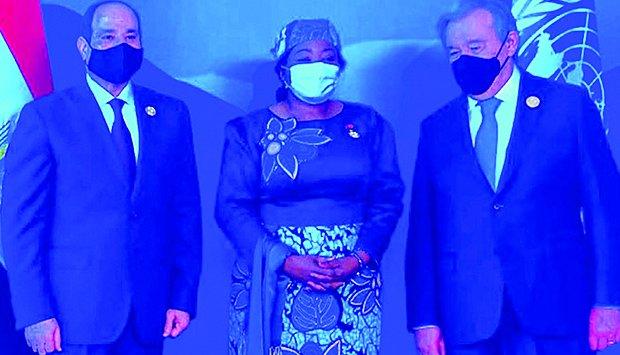
Africa-Press – Angola. The Vice-President of the Republic, Esperança da Costa, appealed yesterday, in Sharm El Sheikh, Egypt, for the creation of an early warning system and the operationalization of the African Humanitarian Agency.
“They are of extreme urgency, as they will make it possible to identify the multiple dangers related to climate change, collect and share data to respond to the different problems related to climate change, including forced displacement”, stressed Esperança da Costa when speaking at COP27, representing of the Head of State, João Lourenço.
According to the Vice-President, Angola is in line with the position of the African group that has taken great initiatives to honor the commitments made during COP26, being committed to increasing renewable energy sources by 70% by 2025.
During her speech at the Conference of States Parties to the United Nations Framework Convention on Climate Change (COP27) in Sharm el-Sheikh, Esperança da Costa reaffirmed that she hopes for the effective contribution of all in the identification of lasting solutions that respond to the global challenges related to with climate change, highlighting the “assertive choice of themes under development, guiding everyone to reflect on the alarming climate emergency that humanity faces”.
He recalled that COP26, held in 2021, in the city of Glasgow, reinforced that the union of synergies and the coordination of joint strategies to combat the climate crisis is transversal, considering that this is “the only way” to achieve the common good and save the planet.
National Strategy for Climate Change
The Vice-President of the Republic said that Angola recognizes that climate change has had a negative impact on the implementation of different development plans, which is why it “approved the National Strategy for Climate Change, which establishes a vision until 2030, with the aim of ensuring the adaptation of the Angolan territory and contribute to the global effort to combat its causes”.
As part of the program to combat drought in the south of the country, Esperança da Costa said that Angola has implemented water storage infrastructures, with the water transfer system from the Cunene River, the first of several structuring projects to combat drought, with the creation of conditions for the development of Agriculture, ensuring greater resilience to communities.
Preservation of biodiversity
Regarding the preservation of biodiversity, the Vice-President stated that Angola has increased its conservation areas, highlighting the initiatives for transboundary forest protection in Maiombe, which includes action plans included in the efforts of the African climate initiative for the preservation of the Congo Basin, a initiative of the Heads of State and Government of Central African countries.
According to Esperança da Costa, this reaffirmed the commitment and responsibility in the fight against climate change and deforestation with a view to guaranteeing environmental protection and avoiding natural disasters.
Resource transfer
The Vice-President of the Republic stated that any strategies to combat climate change will not be successful if international cooperation is not strengthened, which assigns a central role in the sharing of knowledge and in the transfer of technological and financial resources from industrialized countries to the less advanced, especially Africa, which is one of the continents that pollutes the least and suffers the most from the consequences of climate change.
He recalled that last May, during the Extraordinary Humanitarian Summit and the African Union Donor Conference, held in Malabo (Equatorial Guinea), which was also attended by private sector companies, partners and donors, pledges of funding budgeted in more than 100 million dollars to combat the problems linked to climate change and the humanitarian crisis in Africa, although there is a “somewhat timid attitude towards materialisation”.
“The nexus between climate change and the challenges of peace and security at a global level, especially in Africa, is increasingly evident. Rising temperatures, increasing oceans on the planet, prolonged droughts and other extreme weather effects are affect the lives and livelihoods of communities around the world, aggravating economic, social or political conditions, leaving vulnerable populations very prone to conflict and instability”, he stressed.
As Champion of the African Union for Peace and Reconciliation in Africa, according to Esperança da Costa, the President of the Republic, João Lourenço, “considers that the risks and threats associated with climate change require a more comprehensive international approach, which also includes a review and adaptation of continental and multilateral peace and security mechanisms, so that their intervention instruments are more efficient in responding and in line with the challenges that are emerging in the world”.
At the end, the Vice-President of the Republic said that she hoped that during the Summit the Member States would assume pragmatic commitments and coordinate actions to stop the emission of carbon, by investing in alternative energy sources that guarantee the survival of the planet.
For More News And Analysis About Angola Follow Africa-Press