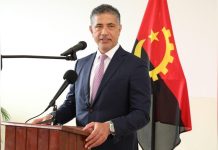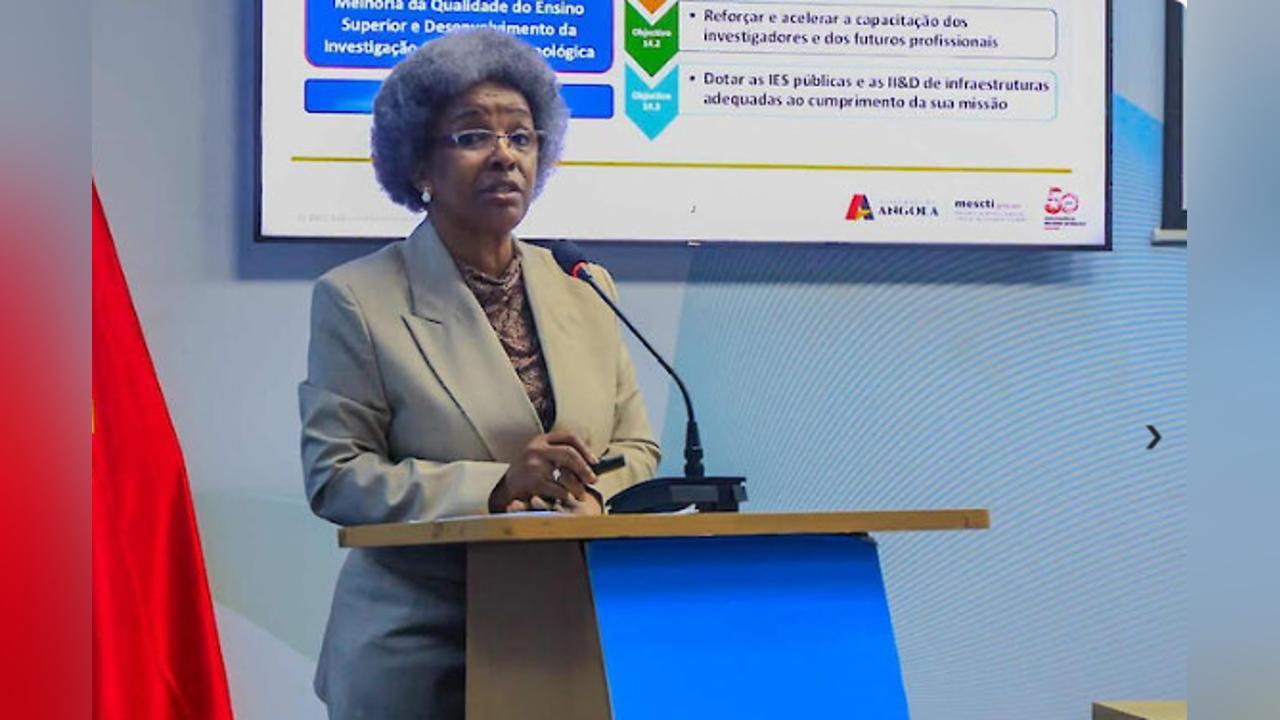
Africa-Press – Angola. The Angolan government has set a higher education goal of expanding and diversifying its educational offerings by 2027, the Secretary of State for Science, Technology, and Innovation (MESCTI), Alice de Fátima e Almeida, said Thursday in Luanda.
In statements made during the 45th thematic session hosted by the Ministry of Telecommunications, Information Technologies, and Social Communication, she emphasized that the priority strategy involves strengthening higher education institutions and reinforcing and accelerating the training of researchers and future professionals.
The strategy also includes strengthening public higher education institutions and research institutions, as well as developing adequate infrastructure to fulfill their mission, within the framework of MESCTI’s Program 14.
The secretary highlighted the expansion and diversification of educational offerings, as the country has 106 higher education institutions in operation, with 1,200 undergraduate courses, 287 postgraduate courses, 229 master’s degrees, 28 doctorates, and 30 specializations.
She also discussed the curricular harmonization of higher education institutions, highlighting two already harmonized courses, 67 in the process of harmonization, and 24 still pending.
Regarding the implementation of the evaluation system, she reported that internal evaluations (self-assessments) were conducted in 89 newly created offices, and external evaluations in 550 courses, corresponding to 46% of the educational offerings.
In the field of medicine and health, she said that 145 evaluations were conducted, with 63 accredited and 82 non-accredited courses.
In the field of educational sciences, she emphasized that 139 evaluations were conducted, with 70 accredited and 69 non-accredited courses. In the field of engineering and technology, 236 evaluations are currently underway.
Regarding the strengthening and acceleration of the training of researchers and future professionals, the Secretary of State highlighted the strengthening of scholarship projects, whose indicators point to 318 internal scholarships aimed at teacher training, the review of the 300 program and also 150 external scholarships, of which 73 are ongoing and 86 will be implemented in the 2025/2026 academic year.
Regarding infrastructure rehabilitation, the Secretary of State highlighted the Master Plan for the future Research, Development, and Innovation Center at Katyavala Bwila University, the construction of the third phase of the University of Namibe, the construction of infrastructure at Lueji A’Nkonde University, and the rehabilitation of the National Center for Scientific Research, reinforced with two new laboratories.
Regarding the main challenges and prospects, Alice de Fátima e Almeida highlighted increasing literacy in entrepreneurship and innovation, training teachers, non-teaching staff, and students in innovation methodology, entrepreneurship, and critical thinking, as well as the integration of regular training in pedagogical innovation.
In turn, the Secretary of State for Social Communication, Nuno Caldas, stated that the exercise provided by the session reaffirms the vision and strategic reorientation of the Executive’s public policies, as part of the 2023/2027 National Development Plan, as well as the Executive’s commitment to human capital.
For More News And Analysis About Angola Follow Africa-Press