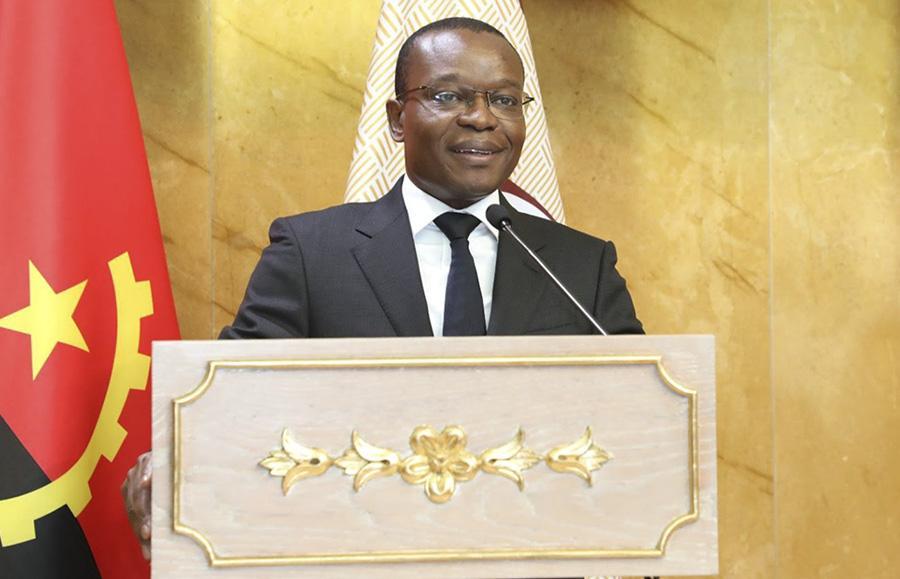
Africa-Press – Angola. The Minister of State and head of the Civil House of the President of the Republic, Adão de Almeida, stated, this Thursday, that the changes made in the political-administrative division over time have brought benefits to the populations of the provinces of Lunda-Norte and Bengo.
Speaking in Parliament, as part of the discussion and approval, in general, of the Proposed Law on the Political-Administrative Division (DPA), he highlighted the various projects implemented in those regions for the well-being of the population.
He recalled that, in 1978, the province of Lunda-Norte was separated from Lunda-Sul and over the years the latter benefited from several projects that had a positive impact on the lives of the populations.
Among the projects, he highlighted the creation of the Luegi A Nkonde University, Higher Pedagogical School, faculties of Medicine and Law, Technical School of Cuango and the centrality of Mussungue, with 5,004 apartments.
He also referred to the construction of the general and maternal and child hospital in Dundo and the national road 225, which connects Dundo to Xamuteba, measuring 450 kilometers.
Adão de Almeida also mentioned the existence of around 109 primary schools, 120 health units, including four general hospitals and nine municipal hospitals, as well as the rehabilitation and final phase of the Luaximo hydroelectric plant, which will increase the capacity of 08 to 34 megawatts.
The Minister of State also highlighted the progress made in the province of Bengo, since it was subdivided from Luanda, in 1980.
In the education sector, he highlighted the construction of 216 schools in primary education, 73 schools in the first cycle of secondary education, 15 schools in the II cycle of secondary education, two teacher training schools, seven in professional technical education and one in special education..
In the health sector, he listed the existence of three general hospitals in Barra do Dande and the recently opened hospital: Reverendo Pereira Inglés”, the provincial hospital, six municipal hospitals and 27 health centers.
He also highlighted the inauguration of two centers in the province of Bengo, namely Kapari and Bukula, called “Teresa Afonso”.
“Therefore, saying that there was this division and it did not produce any results for people’s lives does not seem to us to be the most correct view. If we discuss whether more needs to be done or whether we should do more, we are all in agreement”, he stressed.
The Minister of State responded to the concerns of deputies, especially those from the opposition, who questioned the benefits of the changes made in the political-administrative division over time in the provinces of Lunda-Norte and Bengo.
On November 11, 1975, Angola became an Independent State and chose to maintain the political-administrative division of 1971 in force. At that time, in 1975, the Angolan population was estimated at around 6.5 million inhabitants.
Several specific changes followed, with emphasis on those made in 1978, which divided the province of Lunda into the province of Lunda-Norte and the province of Lunda-Sul, and in 1980, which divided the province of Luanda into the province of Luanda and Bengo. In other words, for 44 years the country has had 18 Provinces and approximately 160 Municipalities.
For More News And Analysis About Angola Follow Africa-Press