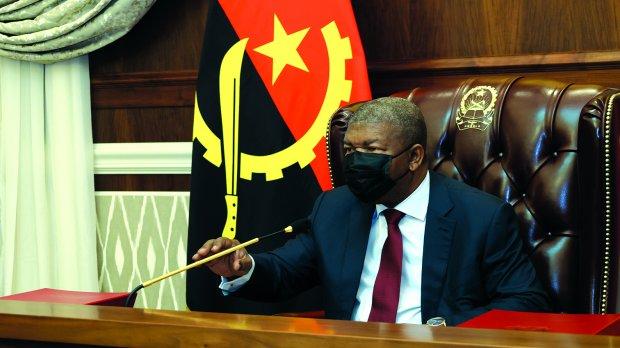
Africa-Press – Angola. National citizens over the age of 35 will, in the coming days, also have access to vacancies for admission to the Civil Service. The measure is part of the new Civil Service Basic Law, which was discussed yesterday at an ordinary session of the Council of Ministers, guided by the President of the Republic, João Lourenço.
Speaking to the press at the end of the meeting, the minister of Public Administration, Labor and Social Security (MAPTSS), Teresa Dias, clarified that the diploma makes access, by age, to the Civil Service unlimited. The limit, for 35 years, violated the constitutional principles, with regard to the right to work. “We understand that we must eliminate this age limit”, stressed the minister, for whom the issue was a matter of concern for citizens.
Teresa Dias said that citizens who are admitted to this condition will be able to see their right to retirement safeguarded. The official said that the new Civil Service Basic Law will also change the time limit of a fixed-term employment contract, known as a fixed-term employment contract, from 12 to 24 months, thus ceasing all rights and obligations at the end of this period, including salary entitlements.
The minister stressed that the idea, with this measure, is to prevent the accumulation of people in the Public Administration who, under this employment contract, stay there for 10 to 15 years, then obliging the State to classify them. Still in the news chapter, Teresa Dias said that the new diploma in the sector will reduce the weekly working hours to seven and introduce the teleworking regime, given the dynamics imposed by the Covid-19 pandemic.
Mobility Domain
In the field of mobility, an act that allows the employee to move from one ministerial department to another, the Minister of Public Administration, Labor and Social Security stressed that the new Law will limit the period of secondment to a period not exceeding three years, extendable just for once. “Sometimes, this mobility expedient ends up forgetting its point of origin, which is not good from the perspective of what is the management of Public Administration”, she stressed.
Probationary Period
The new Civil Service Basic Law, according to the minister, will also reduce the probationary period from five to one year. He said that this measure will value human capital, give more rights and guarantees to public servants, “who are eager to have their rights and obligations in their fullness, as is already the case in other realities.” He explained that people in probationary regime are not yet civil servants, but administrative agents and, in this condition, they have limited rights, one of which is not to strike. which they deserve the transition to the definitive framework.
Interim
Teresa Dias also announced that the new Civil Service Basic Law brings, as a novelty, the time that someone must stay as an inmate in a certain function. She made it known that the time, provided for by the legal diploma, cannot exceed 12 months. Violation of this principle, she warned, leads to the declaration of the position as vacant, which can be occupied by the interim manager, as long as he meets the requirements to be there.
The new Civil Service Basic Law, according to the statement from the Council of Ministers, establishes the fundamental principles and rules applicable to the Civil Service regime, in terms of its concept and scope, as well as its mission and objectives for employment relationship in the Civil Service.
The document also adds that the legal diploma consolidates the rights and guarantees of civil servants, brings together in a single instrument the fundamental bases of the Civil Service, thus avoiding the existing legislative dispersion on the matter, clarifying and developing, in the of the formal law, several matters on public functioning are insufficiently addressed by the diplomas in force.
The Minister of Public Administration, Labor and Social Security said that this new law repeals Law 17/90 of 20 October, on the principles to be observed in Public Administration. “A Law that has been in force for 32 years, made in a political, economic and social context different from the current one and, therefore, completely outdated”, he said. The Law, which is part of the administrative reform underway in the country, was duly disclosed and discussed, not only at the level of the human resources managers of all public institutions, but also by the unions. “We had the opinion of all the ministerial departments in which we have civil servants and, therefore, it is important to say that it is not exhausted”.
Teresa Dias made it known that all steps are being taken so that the diploma, which had already been worked on for some time, is approved by the Council of Ministers and scheduled in Parliament next month.
Situation in the Democratic Republic of Congo
The situation in the Democratic Republic of Congo was analyzed Thursday in Luanda by the President of the Republic, João Lourenço, and the special envoy of the UN Secretary-General for the Great Lakes Region, Huang Xia.
Huang Xia told the press, at the end of the audience with the Angolan statesman, that the Great Lakes Region is experiencing an “extremely complicated situation” in the East of the Democratic Republic of Congo (DRC), which “can lead to disturbances or even a conflict on a large scale”.
The Chinese diplomat at the service of the United Nations acknowledged Angola’s experience in conflict resolution, stating that Angolan diplomacy can contribute to the pacification of the region.
Regarding the summit in Luanda, which is being prepared under the auspices of President João Lourenço, and which will bring together, in the near future, the leaders of the DRC and Rwanda, the UN SG’s special envoy considered it “important” for the launching of the bases for dialogue between the parties in conflict.
He assured that the UN will continue to support Angola’s diplomatic efforts, so that there is a positive outcome in the resolution of this conflict.
For More News And Analysis About Angola Follow Africa-Press