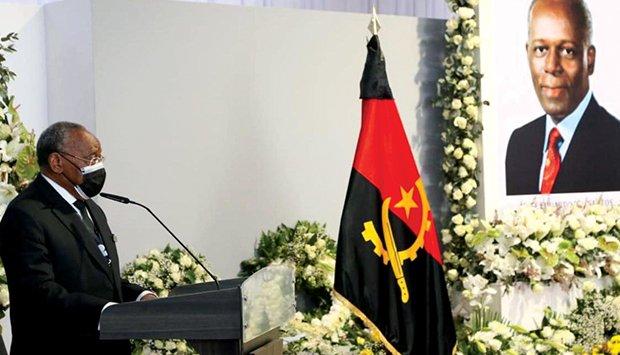
Africa-Press – Angola. The writer and former president of the National Assembly, Roberto de Almeida, declared, this Sunday, in Praça da República, that it is not “neither light nor light effort”, to write about the former President of the Republic, José Eduardo dos Santos, given his “multidimensional stature”.
When reading the eulogy during the funeral, Roberto de Almeida recalled the process that led the late President to exile, where he joined the National Liberation Struggle.
To the Heads of State and Government, representatives of sovereign bodies, deputies, the diplomatic corps, leaders of political organizations, ecclesiastical entities, traditional authorities and the population, who witnessed the State funeral, the former secretary general of the MPLA recalled that , at the age of 37, in 1979, the former President of the Republic was chosen to direct the country’s destinies, replacing the founder of the Angolan Nation, Agostinho Neto, having proved to be a patriot and humble activist, on whom the country could count without vacillations. Roberto de Almeida spoke about the academic, political and military career of the deceased, whose urn, containing the body, is already resting in the tomb built in Praça da República.
The politician also recalled that José Eduardo dos Santos, after attending primary and secondary education at the “historic” Liceu Salvador Correia, went underground at the end of 1958, having assumed the leadership of the MPLA youth movement in December 1962, during the first conference of the party, in Leopoldville, Republic of Congo.
The nationalist also told in his biography that the President Emeritus of the MPLA joined the Popular Army for the Liberation of Angola (EPLA) in the same year, and the following year he was elected the first MPLA representative in Brazzaville.
The deputy to the National Assembly highlights, in the eulogy, that, in November 1963, José Eduardo dos Santos benefited from a scholarship at the Institute of Oil and Gas, in Baku, capital of Azerbaijan, a member state of the former Soviet Union, having obtained a degree in Petroleum Engineering.
Having figured twice on the roll of honour, José Eduardo dos Santos attended a military course in telecommunications, having been appointed, from 1970 to 1974, to direct these services in the Second Political-Military Region, in Cabinda, where he remained until the fall of the Portuguese colonial regime.
Also in 1974, the former President of the Republic participated in the Inter-Regional Conference of Militants, in the third military region, having been elected a member of the Central Committee and the Political Bureau of the MPLA. In mid-1975, José Eduardo dos Santos was appointed MPLA representative in Brazzaville, and in June of the same year he coordinated the party’s Foreign Affairs department, and, cumulatively, Health, Education and Culture.
With the proclamation of National Independence, on November 11, 1975, José Eduardo dos Santos was appointed Minister of Foreign Affairs, and with his “intense” diplomatic action he managed, in February 1976, to admit Angola as a full member. in the Organizations of African Unity (OAU), currently the African Union (AU), and the United Nations (UN). In 1976, he is appointed to the post of First Deputy Prime Minister and, two years later, Minister of Planning.
At the party level, from 1977 to 1979, he was secretary of the MPLA Central Committee for Education, Culture and Sports, National Reconstruction and Economic Development and Planning.
After the death of the first President of Angola, António Agostinho Neto, in 1979, the ill-fated was elected, in the same year, President of the MPLA, of the People’s Republic of Angola and Commander-in-Chief of the Popular Armed Forces for the Liberation of Angola. (FAPLA). Three years later, he opened the country to the market economy and, in 1992, he opened the country to multipartyism, which allowed the first General Elections in the history of the Angolan nation to be held.
Roberto de Almeida also mentioned, during the eulogy, the handing over of President José Eduardo dos Santos to the total liberation of Namibia and Zimbabwe, as well as the fight against the hideous “apartheid” regime in South Africa, giving ” full compliance” with President Agostinho Neto’s guidelines, according to which “In Namibia, Zimbabwe and South Africa is the continuation of our struggle”.
As President of the Republic and Commander-in-Chief of the Angolan Armed Forces (FAA), Roberto de Almeida said that the ill-fated man led the entire process of preserving life and the integrity of the territory, until the signing of the Peace Accords in 2002, in Moxico province, which put an end to the long armed conflict and enshrined the reunion of the Angolan nation.
FESA leader highlights courage
On behalf of the José Eduardo dos Santos Foundation (FESA), the secretary-general of the foundation, João de Deus, highlighted the contribution to the pacification of the country, noting that, in 1979, when he was appointed to assume the position of President of the Republic, Angola lived the epic of a devastating generalized civil war.
João de Deus, who read the FESA message, of which José Eduardo dos Santos was patron, highlighted the fact that the former President of the Republic’s governance was characterized by the promotion of peace, reconciliation between all Angolans, as well as the national reconstruction, humanism, justice and democracy.
He considered José Eduardo dos Santos a patriot of transcendent importance, due to his political and humanist dimension. “The feeling in memory of “Zé Dú” will remain in our hearts”, expressed João de Deus, for whom the former President was an actor and protagonist of relevant facts in the recent history of the country.
The secretary general of FESA praised his achievements as a humanist, philanthropist and altruist citizen. He referred that José Eduardo dos Santos created the foundation to promote mutual assistance, solidarity, love of neighbor, as well as access to social assistance for the vulnerable population, aware that the State, by itself, was not in a position to exclusively given the numerous problems the country was facing as a result of the war.
Among the Heads of State invited, the former President of Namibia, Sam Nujoma, was the only one to speak at the event. Throughout his message, Sam Nujoma thanked the support given by President José Eduardo dos Santos to the fight for Namibia’s Independence, stressing that with his physical disappearance he not only lost Angola, but also Southern Africa and the world.
The great nationalist and exemplary leader
In the message from the MPLA board, the party’s vice president considered former President José Eduardo dos Santos as a “great nationalist and exemplary leader”, who sacrificed all youth for the well-being of Angolans .
“José Eduardo dos Santos was a bit of every Angolan”, said Luísa Damião in the message, having also stressed that it is not easy, in a few minutes, to talk about the size of a man with a great trajectory and a patriot with high qualities. human.
He recalled, by the way, that the President Emeritus of the MPLA, in the various facets of his life, marked with indelible ink the quality of doing good, without looking at sacrifices, dedicating his whole life to the well-being of the Angolan people.
The former President of the Republic made friendships that he knew how to keep and protect throughout his life, said Luísa Damião, adding that some of these colleagues and friends constituted the “booster ball”, for José Eduardo dos Santos to join the struggle for self-determination and the Independence of the country.
Luísa Damião considered President José Eduardo dos Santos a “diplomat of fine treatment and a skillful negotiator”, who carried out with “brilliance” the entire process that led to the end of the border crisis with South Africa and, at the same time, the rise of Namibia and from Zimbabwe to independence.
The party leader mentioned the fact that it was under the leadership of José Eduardo dos Santos that the solution was found that ended the war in the country, which earned him the nickname “Architect of Peace” and signed the Memorandum of Understanding for the Peace and Reconciliation, in the province of Cabinda.
He conveyed his feelings of regret to the family of José Eduardo dos Santos, having left the MPLA’s commitment to do everything to continue to cement unity and cohesion within the party.
For More News And Analysis About Angola Follow Africa-Press