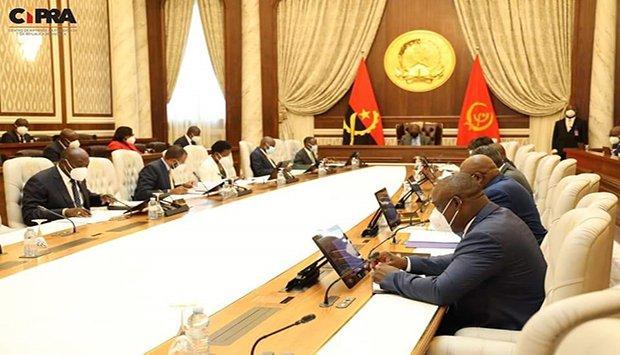
Africa-Press – Angola. The Economic Commission of the Council of Ministers approved, this Monday (14), the National Plan for the Promotion of Fisheries (PLANAPESCA) which will, among other activities, encourage the sustainable management of living aquatic resources and the diversification of sources of public revenue, promote competitiveness and employment in the sector.
The strategy approved during the meeting, guided by the President of the Republic, João Lourenço, also foresees an increase in fishing, aquaculture and salt production and productivity, as well as promoting the social responsibility of companies in the protection of fishing communities.
The Secretary of State for Planning, who spoke to the press at the end of the meeting, explained that the approved Plan will preferentially encourage business fishing activity, increase production and processing of salt fish, as well as contribute to the development of trade and increased tax revenues.
Milton Reis explained that PLANAPESCA forecasts an average annual growth in fish production of around 4 percent and salt by 15 percent. With PLANAPESCA, fishing production is expected to go from the current 596 thousand tons to 750 thousand tons in 2027. And salt production will go from the current 201 thousand tons to around 472 thousand tons in 2027.
The Secretary of State for Planning announced that PLANAPESCA will have a financial package of 144 billion kwanzas, equivalent to three hundred million dollars, which will be spread over five years, in an annual amount of 28.8 billion kwanzas that will be made available by the Executive to the private sector and operated by Banco de Desenvolvimento de Angola at an interest rate not exceeding 7.5 percent.
This line of financing, he added, will essentially be intended to support the construction of private infrastructure, construction of production of inputs for the Fisheries sector, production of feed for aquaculture and mariculture, production of machinery and equipment for the fish sector, industrial production that derives from the transformation of products in the fisheries sector.
The Plan to be executed between 2023 and 2027 also foresees the creation and development of logistical platforms, as well as commercial activities and distribution of food of fish origin.
For the implementation of this plan, the Multisectoral Commission was created, to be headed by the Minister of State for Economic Coordination and assisted by the Minister of Fisheries and Marine Resources. This commission, he said, will be supported by a technical follow-up unit to ensure the smooth execution of the plans.
For the Fisheries sector, the Economic Commission of the Council of Ministers considered an order that creates the Multisectoral Commission for Supervision of the National Plan for the Promotion of Fisheries.
PLANAGRON
Also at the same meeting, the Action Plan of the National Promotion Plan for Grain Production (PLANAGRAN) was approved. Among them, the production of corn, wheat, soy and rice stands out.
This document indicates the actions to be developed, with a view to achieving the goals of the plan, with emphasis on increasing the quantity and quality of grain produced, replacing the use of imports, better
productivity improvement, using the available land more efficiently and with better results.
Its mission is also to increase the amount of cultivated land, so that production takes place on a larger scale, particularly in the eastern provinces of the country.
According to the final communiqué, the implementation of this instrument will contribute to the country’s food self-sufficiency, the development of agriculture and production support infrastructure, job creation and the development of value chains adjacent to grains. , such as Livestock, Fishing, Milling Industry, among others.
The Secretary of State for Planning, Milton Reis, said that the Executive does not intend to change the legislation on the Land Law, but to create the bases and “put on a digital platform that is easily accessible to promoters, all the legislation that contributes to having access land and so that a promoter can develop his project”.
The PLANAGRÃO, said the official, foresees financing of around 1.7 billion kwanzas that will be handled by the BDA, through the National Development Fund and also of 100 billion kwanzas that will be offered by the Fundo Activo do Capital de Angolan Risk to support companies.
He announced that the Executive has already started, via the Ministry of Public Works, Urbanism and Housing, Agriculture and also the provincial governments, the process of identifying the areas where land is available for the production of these grains.
He said that the intention is to create a Land Bank that will allow promoters to obtain information about the land to implement their projects.
“Every promoter who has a project that wants to produce grain will have access and full support from the Executive, through the Multisectoral Commission and its technical units, whether from financing issues for national promoters, or for foreign investors who want to come produce the grains in our country”, he maintained.
The Secretary of State clarified that, despite the PLANAGRÃO favoring the eastern provinces, it will be implemented throughout the national territory. The project, according to Milton Reis, is also open to foreign investors so that they can participate in the implementation of this Plan to reach the goals of self-sufficiency in grain production.
Diploma to eradicate child labor
The Economic Commission of the Council of Ministers approved a Presidential Decree that updates the list of jobs prohibited or restricted to minors, with the aim of combating and eradicating child labor.
The Secretary of State of the Ministry of Public Administration, Labor and Social Security (MAPTSS), Pedro Filipe, declared, at the end of the meeting, that Angola has a strategy in this regard and a Commission was also created in 2021 with the purpose of main goal of combating child labor.
Pedro Filipe said that the latest survey of multiple indicators by the National Institute of Statistics (INE) pointed out that more than 25,000 children carry out child work prohibited for minors.
In order to update the real numbers, he added, MAPTSS is working with the National Statistics Institute, the General Labor Inspectorate and INAC, to update the survey.
He acknowledged that there is a “very large” number of children who are working outside the formal sector, namely in agriculture, civil construction, shoe shiners and car washers.
He stressed that this situation worsened with the emergence of the pandemic: “This is not an exclusive phenomenon of Angola, but transversal to almost all countries in the world, with main incidence in the African and Asian continents”.
The MAPTSS Secretary of State reinforced that the proposal does not only bring repressive measures. For Pedro Filipe, it is not enough to prohibit, but also to have more welfare and proactive actions so that “it can, as far as possible, support the most needy families who are faced with these difficulties and end up allowing younger children to be engaged in labor activities”.
For More News And Analysis About Angola Follow Africa-Press