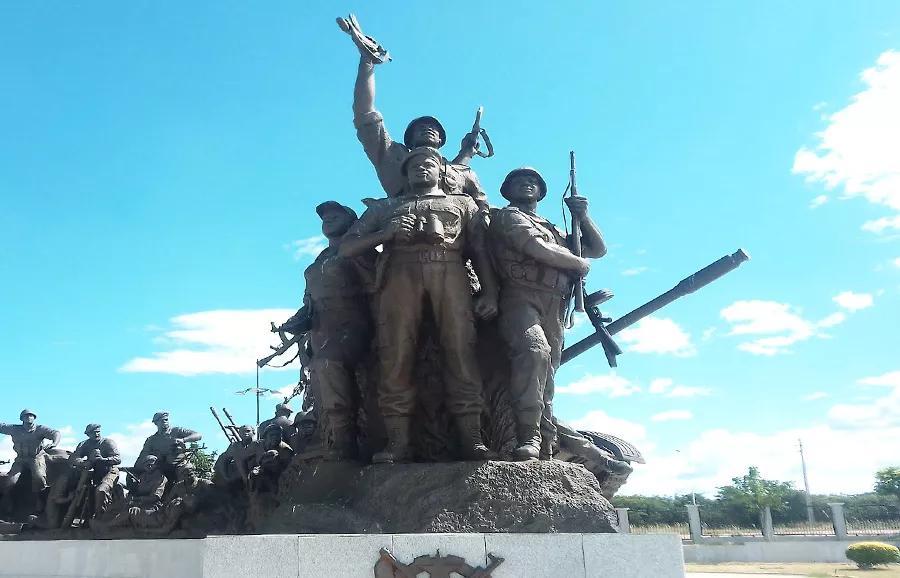
Africa-Press – Angola. The governor of Cuando Cubango, José Martins, stated, this Thursday, that the Executive is working so that the Memorial of the Battle of Cuito Cuanavale, which took place between 1987 and 1988, is elevated to a World Heritage Site.
The official spoke during a lecture on “Political, economic and military background in the national, regional and international context of the Battle of Cuito Cuanavale”, in which retired general of the Angolan Armed Forces (FAA) Higino Carneiro,
José Martins said that great steps had been taken towards the implementation of the project, as, in addition to infrastructure issues, technical and administrative matters were also taking place.
He informed that at the invitation of the Ministries of Culture and Tourism and Higher Education, Science, Technology and Innovation, experts from the United Nations Educational, Scientific and Cultural Organization (UNESCO) have already worked, on some occasions, in Cuito Cuanavale in creating conditions to ensure that the municipality is effectively made a World Heritage Site.
He mentioned that one of the required conditions is related to the reconstruction of the scenario in the Cuito Cuanavale region, taking into account what the municipality was like before the period 1987 to 1988, the image that presented the Sá Maria neighborhood up to the Tumpu Triangle.
José Martins said that it was for this reason that he invited young people to visit, on Friday morning (22), the aforementioned area, in order to assess the remaining remnants of the military offensive carried out at the time, protected by a security device. military personnel of the Angolan Armed Forces (FAA).
The governor clarified that the objective is to keep the military resources used safe, as they constitute material proof of the history of the Battle of Cuito Cuanavale, as an essential condition for the purpose of making the municipality a heritage site, alongside another effort to bring the military equipment for the municipality, for the real portrait of what actually existed.
On the other hand, he highlighted the issue of valuing the Memorial of the Battle of Cuito Cuanavale and the components of its surroundings.
The second phase of the work, informed the governor, has already been awarded for the completion of the surroundings of the Memorial to the Victory of the Battle of Cuito Cuanavale, whose shipyard of the company in charge was visited today by the Minister of National Defense, and Veterans of the Fatherland, João Ernesto dos Santos.
José Martins predicted that the completion of the works will allow tourists to find spaces for leisure, accommodation, among other tourist attractions, as the work includes the construction of 70 homes for the population of the village of Sá Maria, which provided, during the battle , diverse support for government troops.
He highlighted the construction of 25 protocol houses, along with other equipment that promotes the well-being of the local population, such as electricity and drinking water.
He recalled that on January 17th, the Government of the province of Cuando Cubango held the 1st Investors’ Forum of the Angolan Region of Okavango, to provide conditions for tourist attraction, taking into account the potential of the region, with the largest hydrographic basin of the Transfrontier Project Okavango-Zambezi, through the Cuando and Cubango rivers.
History of the Battle
Taking place from November 15, 1987 to March 23, 1988, the Battle of Cuito Cuanavale is considered by politicians and historians to be the beginning of a turning point in favor of peace and liberation in Southern Africa.
After three decades and in a demonstration of its appreciation and honor, in memory of all those who fought in the Battle of Cuito Cuanavale, the date is celebrated for the second time as a national holiday in Angola and the Southern African region by the countries that are part of SADC.
Considered to this day one of the largest military confrontations of the war in Angola’s post-independence period, it was the longest battle on the African continent since the Second World War.
The location of the battle was the south of Angola in the region of Cuito Cuanavale, province of Cuando-Cubango, where the armies of Angola (FAPLA) and Cuba (FAR) clashed against the FALA linked to UNITA, with the support of the greatest power regional military, South Africa.
March 23, 1988 marked the end of the Battle of Cuito Cuanavale, becoming a turning point in the war that had been dragging on for years, encouraging an agreement between South Africans and Cubans to withdraw troops.
The signing of the New York Accords led to the implementation of UN Security Council resolution 435/78, leading to the withdrawal of Cuban forces from Angola, the release of Nelson Mandela and the independence of Namibia.
Tribute to Heroes
To honor the memory of all those who fought in the Battle of Cuito Cuanavale, the Angolan Government built, in an area of 3.5 hectares, a sculptural complex, with a view to immortalizing the sacrifice of the thousands of Angolans who fought against the regime’s troops. apartheid.
The imposing building measuring almost 35 meters high in the shape of a pyramid (an explicit reference to the Tumpu Triangle, site of the last battle) erected on a total area of 3.5 hectares, at the entrance to the headquarters of the municipality of Cuito Cuanavale, symbolizes memory and the bravery of the heroes of the 1988 battle.
The infrastructure has two floors, a terrace and is supported by three reinforced concrete beams. It is equipped with an elevator capable of transporting five people.
Right at the entrance to the historic monument’s courtyard, there are two statues of soldiers, one of the former Fapla and the other Cuban, with their fists raised in a sign of victory.
In the same perimeter, there is a library and a museum, in the latter there are weapons captured during the fighting and the material used by the extinct FAPLA and Cuban troops.
About the municipality
The name Cuito Cuanavale, one of the municipalities in the province of Cuando Cubango, comes from the Cuito and Cuanavale rivers, which converge in this region, and has three municipalities, namely Longa, Baixo Longa and Lupiri.
With an area of 35 thousand 610 square kilometers, the municipality of Cuito Cuanavale, province of Cuando Cubango, has an estimated population of 42 thousand inhabitants.
ANGOP
For More News And Analysis About Angola Follow Africa-Press