Africa-Press – Angola. The oscillation in prices of the main agricultural inputs is negatively influencing the production of various products in the field, via irrigation, in the commune of Funda, Cacuaco, Luanda, where cooperatives talk about the reduction of the harvest.
These are inputs such as fertilizers, seeds and insecticides, whose prices have changed in recent months compared to the first quarter of the same year.
The president of the agricultural cooperative Hispano Angola, Higino Sacova, regretted the fact, at a time when the prices of rural products in the informal market are also changing.
The manager, by way of example, points to the price of a liter of insecticides which rose from Kz 10,000 in the first quarter to Kz 12,000, a 50 kilogram bag of fertilizers from Kz 18,000 to Kz 35,000 , urea from Kz 12 thousand to 32 thousand kwanzas, values that he considers unsustainable for the desired production.
“Due to the lack of fertilizers each partner produces only 1 ton per hectare, this is due to the high price of production inputs. To get an idea, 1 hectare needs at least ten bags of fertilizer and 300 grams of seed”, he stressed.
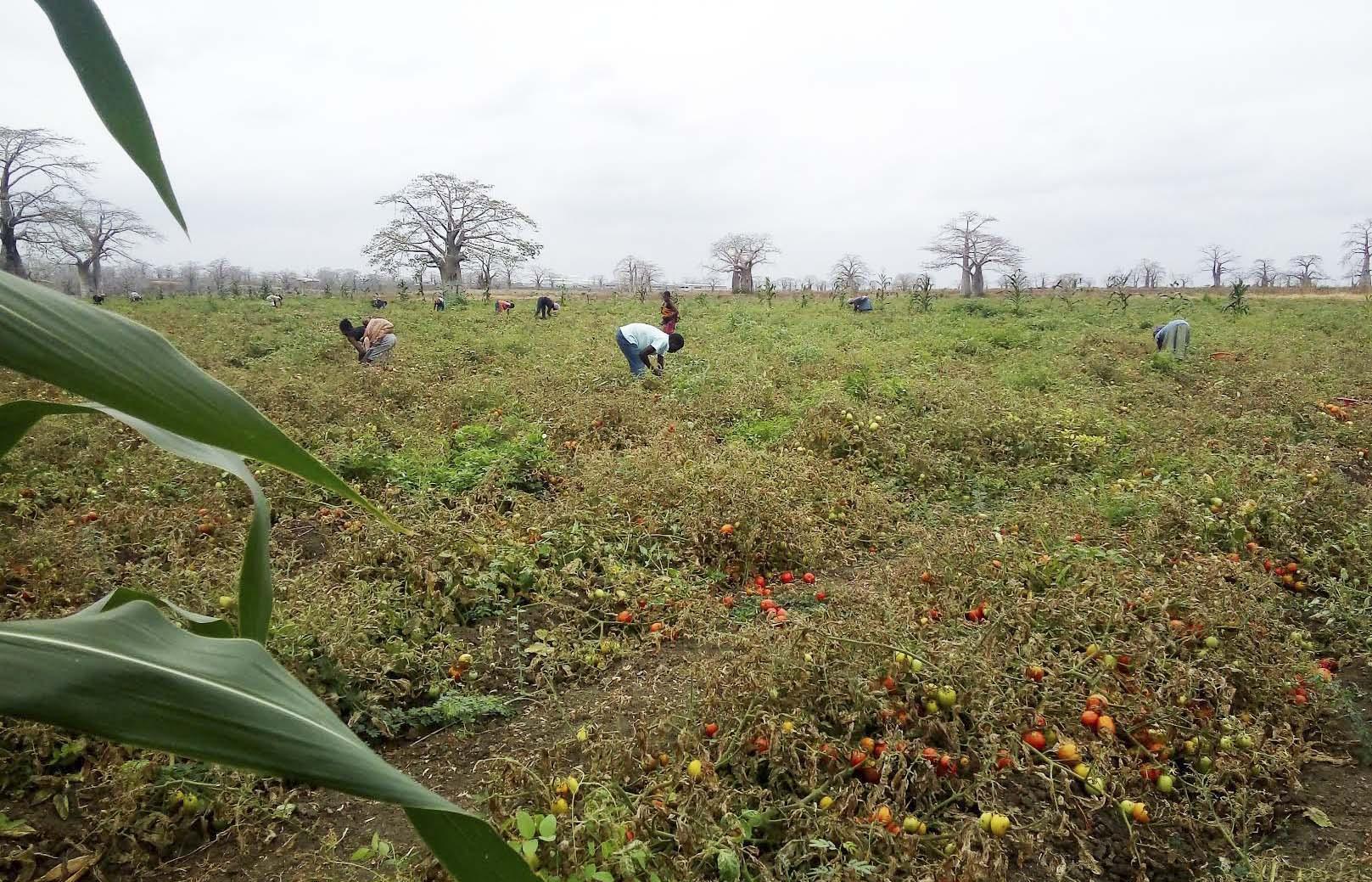
The cooperative has 350 hectares available on the experimental farm for the activity.
Higino Sacova said that, at this time of year, the farm is producing cabbage, cabbage, tomatoes, potato and gimboa branches, goods produced in the rainy season that make this farm a reference in the Funda area, but currently in reduced quantities.
Looking at what is gained, he referred that currently the cost of production continues to be greater than profits, even producing more than 25 tons of the referred products, whose production is sent to informal markets.
water drainage
In addition to the high prices of inputs, the experimental farm, located in the Mulundo neighbourhood, in the commune of Funda, has been devastated by floods in the rainy season, which directly affects production in large quantities in the period.
According to the president of the cooperative, Higino Sacova, at a time when the rainy season is approaching, 100 hectares are flooded, out of the 350 controlled, causing production losses of more than 10 tons of production of cabbage, cucumber, pepper and corn.
“With these floods, approximately three million kwanzas can be lost in each production at that time”, lamented the manager who sometimes resorts to systems that allow to suck water from the fields to mitigate the damage.
Cooperative has been operating since 1982
The cooperative was created in 1997, but operated as an association in the 1980s.
It currently has 141 members, of which 117 are men and 23 are women.
In 2007, the cooperative benefited from micro-credit provided by the Banco de Poupança e Crédito, valued at US$56,000 divided among 112 farmers, that is, US$500 for each peasant).
Since then, Higino Sacova says that the cooperative has never benefited from credit again.
The manager stressed that the cooperative has been receiving support from the Action for Rural Development and Environment (ADRA) for a year, after it rented some machines and cleared 3,000 meters of ditches, in addition to providing support with seeds, fertilizers and formations.
“We have already requested support from some banks, but without success”, lamented Higino Sacova.
Funda commune
Considered the green belt of the city of Luanda, dominated mainly by undergrowth, mangroves and palm trees, cultivated and cared for by nature, the commune of Funda offers favorable conditions for those who want to invest in cultivation, especially vegetables, tubers and fruits.
With a source of arable land, watered by the waters of the Zenza River, which rises in the province of Uíge and crosses large portions of the provinces of Bengo and Luanda, the annual levels of agricultural production are around between six and 12 thousand tons/year, a figure produced by 25 cooperatives, covering an area of 1300 hectares.
Official data indicate that the town has an extension of 56 kilometers, 18 neighborhoods and an estimated population of 65,595 inhabitants. This population, for the most part, is dedicated to agricultural production.
ANGOP
For More News And Analysis About Angola Follow Africa-Press