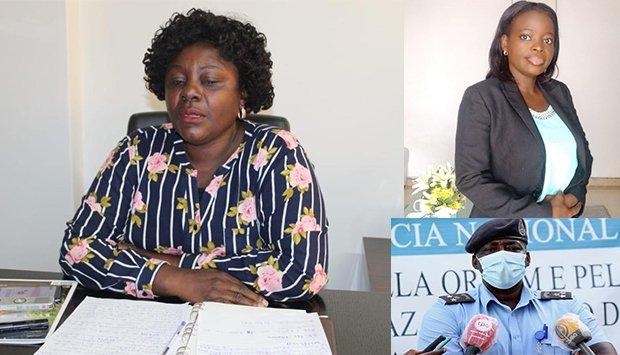
Africa-Press – Angola. The search for peaceful solutions to the problems of Angolan families has been, in recent years, one of the main references of the Ministry of Social Action, Family and the Promotion of Women (Masfamu), which remains concerned about the growing cases of violence, said yesterday, in Luanda, the national director for Family Policies, Equality and Gender Equity.
Santa Ernesto asked, on the occasion of the International Day of Non-Violence, celebrated yesterday by the world, for a greater promotion of peace and tolerance among Angolan families. “Masfamu and partners have been working uninterruptedly, through special programs and projects, designed to educate and sensitize people on the promotion of peace and tolerance,” he said.
The date, he added, should also serve as a reflection on the growing number of cases of violence, especially among families. “We need to reflect more on the consequences that the scourge of violence has on families, from the point of view of physical, psychological, social and economic integrity”, she asked.
Projects such as “Jango de Valores”, the “Conversas em Família” platform and the National Value Rescue Program, in which 17,002 people are enrolled, of which 10,362 are women and 6,640 men, have been, for Santa Ernesto, one of the solutions to minimize the situation. “At the national level and in alignment with a United Nations campaign, Masfamu will join the 16-day initiative of activism against violence against women and girls across the country, with protest marches, lectures, as well as actions of family, legal and psychological counseling”, he said, adding that the activity takes place from 25 November to 10 December this year.
Worrying numbers
A total of 4,283 cases of violence were registered last year, by the Family Counseling Center for Social Action, criticized yesterday, in Luanda, the national director for Family Policies, Equality and Gender Equity.
Among the most frequent cases of violence are those of a sexual, patrimonial, psychological, verbal, physical and work nature. “The targets are generally young people aged between 15 and 49, mostly women and children,” he lamented, adding that the National Children’s Institute obtained a record of 211,583 cases last year.
The family counseling center, he said, had a record of 1,319 complaints, made by men, and 7,382 by women, with the most relevant being those referring to family abandonment. The new Penal Code, he argues, will be an asset in this regard.
Psychologist advocates more concrete actions
The fight against violence and for the defense of peace and tolerance, for psychologist Suzana Diogo, involves more concrete actions against all forms of violence. “Citizens must condemn, see and, in essence, any and all acts, or omissions, capable of injuring or causing damage to the physical, psychological, moral, sexual, or religious integrity, of oneself or of others”, he stressed.
Violence, he explained, should not only be associated with physical acts, such as a cut, a slap or a push, but also with words that tend to cause suffering and deprivation to another person.
Among the very common social practices capable of generating acts of violence, the psychologist highlights defamation, slander, discrimination, prejudice, harassment, manipulation and blackmail. The damage caused by psychological violence, she said, runs to a very large scale, although it often goes unnoticed.
“Psychological violence causes serious damage to mental and physical health and still constitutes a serious violation of human rights, to the point of causing low self-esteem, depression, anxiety, isolation or social withdrawal and emotional dependence”, he said.
In children, he added, violence can interfere with the normal rhythm of development, in some cases creating trauma. “Some of them live in environments where violence is daily and continuous. Sometimes, they end up learning that problems are solved simply by resorting to force or power”, she pointed out.
The encouraging role of the National Police
Encouraging non-violence has been one of the purposes of the National Police, which seeks, in some awareness-raising actions, to encourage society, particularly young people, to have a greater culture of peace and tolerance.
However, physical violence has been a common indicator in many neighborhoods in Luanda. Manuel Agostinho, 34, was once one of the victims of physical violence, perpetrated by criminals. A resident of Zango 4, he says he was robbed when he left home at 5:00 am to go to work. One of the criminals, he said, even hit his right arm and face with a kitchen knife. Luckily, he managed to escape with his life.
The trauma of physical and psychological violence haunts many residents of the capital. Even National Police officers are victims. But women and children are the most vulnerable.
The head of the Citizens’ Assistance Center, of the Inspectorate of the General Command of the National Police, superintendent Mateus de Almeida, says that there are several cases of citizens going to the site to denounce the various forms of violence to which they are subjected. Some cases are resolved by the corporation.
The spokesman for the National Police in Luanda, Superintendent Nestor Goubel, informed that dozens of cases of physical and sexual violence have come to the attention of the corporation, through complaints made by citizens.
Social problems, allied to the exaggerated consumption of alcoholic beverages, have led, for Nestor Goubel, many citizens to resort to physical violence, which in many cases has resulted in death.
The last practice of the youth, which has generated numerous problems, is, he added, the struggles between groups, a situation that creates instability in some neighborhoods. “On the International Day of Non-Violence, it is necessary to remember that many families are victims of this practice, at home or on the street”.
André da Costa
For More News And Analysis About Angola Follow Africa-Press