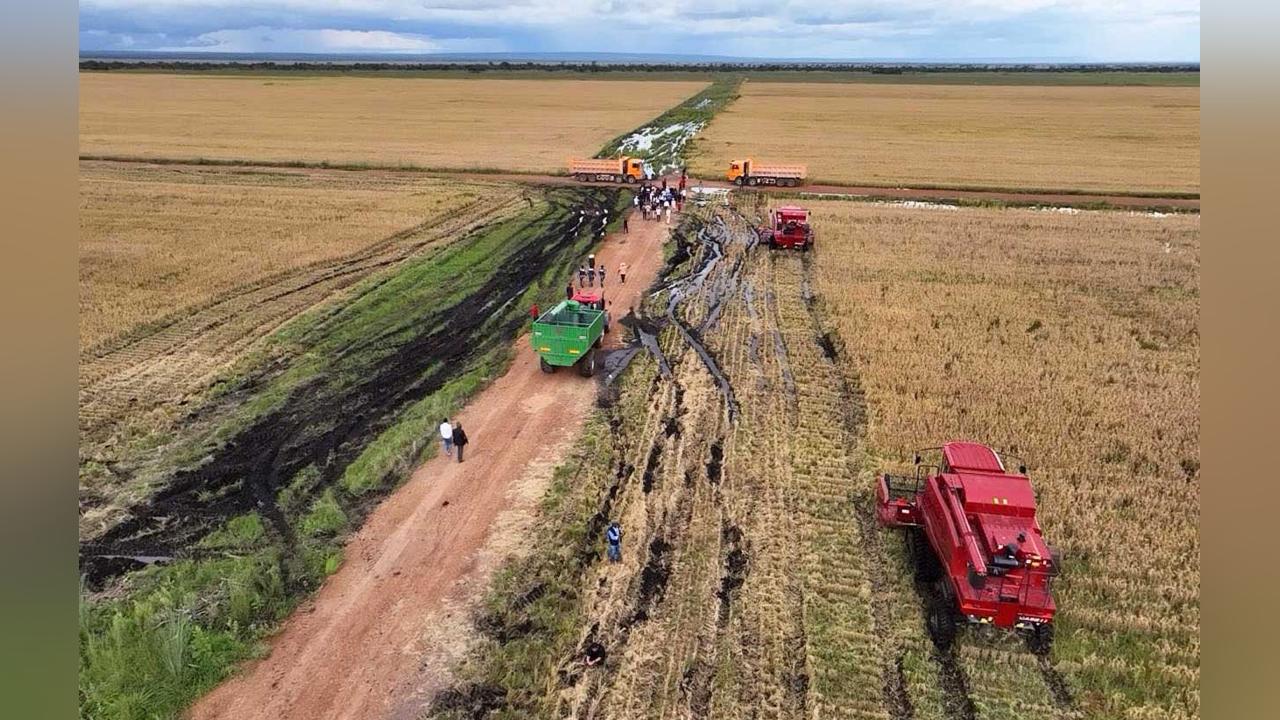
Africa-Press – Angola. Four thousand tons of rice began to be harvested on Friday (21), at Fazenda Marsiris, in the municipality of Luquembo, in an area of 600 hectares, cultivated in October 2022, in response to the Plan for the Promotion of Grain Production ( PLANAGRON).
The project is a private initiative and employed 200 young people, mostly local.
According to the managing partner of the farm, Sónia Morais, the cultivation area will be increased to five thousand hectares in the next agricultural campaign and to 10 thousand within three years, when it is estimated to employ a thousand workers, having therefore requested the intervention. of the State in facilitating access to bank credit.
He made it known that the farm will also dedicate itself to the production of rice seeds adaptable to the climate and soil of the region, without neglecting the support component for families in the areas surrounding the project, with land preparation and technical assistance, to reach of higher incomes.
The act of starting the harvest was presided over by the Secretary of State for Agriculture, João da Cunha, who highlighted Marsiris’ engagement in the production of rice, an important crop for guaranteeing food security for families.
This bet, he considered, demonstrates the strength that the agricultural business sector is having in the country and particularly in Malanje, which was, until 1977, a rice producer on a large scale, whose mystique is being rescued, after years of trying.
He made it known that this cereal had been produced mainly by the family sector, while private initiatives were emerging in the provinces of Uíge, Cuando Cubango, Bié and Malanje, with a tendency to grow, as a result of the incentives given by the Executive, towards the reduction of imports and promotion of exports of this food.
“We import most of the rice we consume, and the strategy is to encourage domestic production, given the edaphoclimatic conditions and human resources available to us”, he added, highlighting the sector’s intervention in technical advice and facilitating the importation of seeds.
In turn, the Secretary of State for the Economy, Ivan dos Santos, underlined PLANAGRÃO’s commitment to promoting the value chain of rice, corn, wheat and soy, with a view to reducing dependence on imports.
To this end, he challenged entrepreneurs in the agricultural sector to be more daring and to prioritize coherence and fairness in the design of their credit access projects, to facilitate the banks’ response.
Meanwhile, Malanje’s deputy governor for the Political, Economic and Social sector, Domingos Eduardo, described the relaunch of rice production on a large scale in the province as a reflection of the Executive’s efforts to mitigate hunger and poverty, promote investment private sector and create jobs.
He stressed that Malanje is open to investment in the agricultural sector and beyond, with a view to diversifying the economy and reducing excessive dependence on the oil sector.
Launched in 2022, PLANAGRÃO will be operational until 2027 and is budgeted at 2.8 billion kwanzas with a view to reducing Angola’s dependence on imports of wheat, rice, corn and soy, mainly in the current context of global shortages, caused by the conflict military between Russia and Ukraine.
The project will cover the country’s 18 provinces but, in a first phase, those of Moxico, Lunda Norte, Lunda Sul and Cuando Cubango were elected.
In practice, the initiative plans to finance 1.7 billion kwanzas, via the Development Bank of Angola (BDA), through the National Development Fund, and another 100 billion, through the Fundo Activo de Capital de Risco Angolano .
The plan foresees an average annual investment of around US$670 million for the production of the crops described above, and around US$471 million annually for the construction and rehabilitation of infrastructures to support the productive and social sector.
With PLANAGRÃO, Angola undertakes to increase its production of rice, corn, wheat and soybeans to 6 million 104 thousand 282 tons in five years, numbers well above the 3 million 026 thousand 140 produced throughout the country, until the year 2021.
For More News And Analysis About Angola Follow Africa-Press