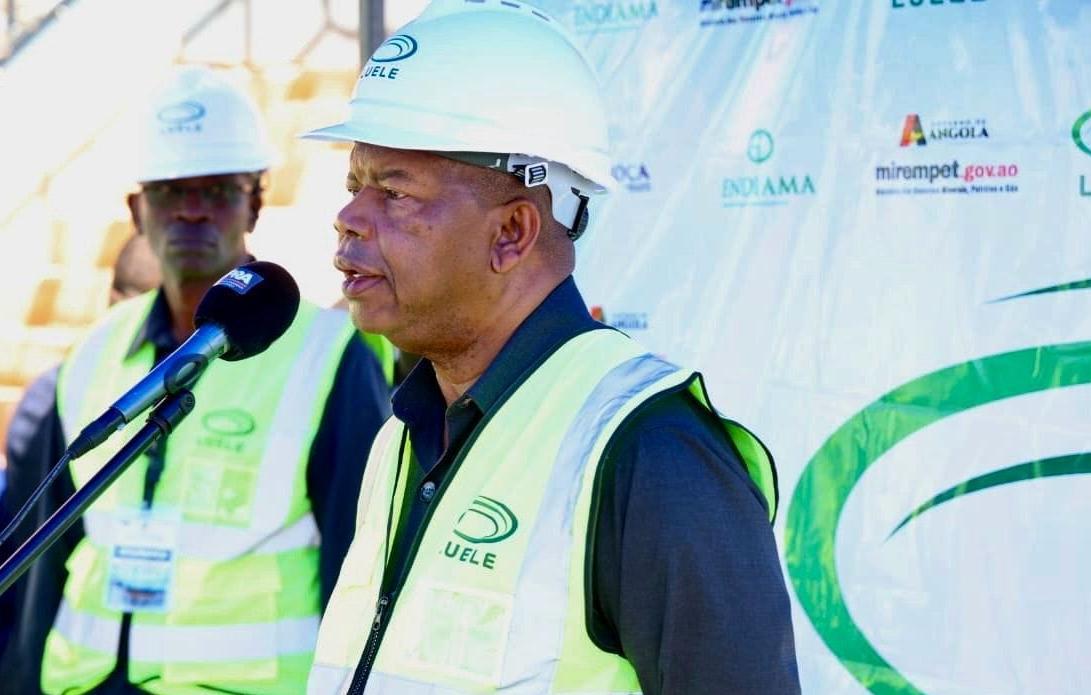
Africa-Press – Angola. Ten million inhabitants, living in the city of Luanda, will benefit from home drinking water connections, by 2027, after the completion of the Quilonga Grande and Bita production and supply projects, guaranteed, on Monday, the President of the Republic, João Lourenço, at the end of the visit made to verify the progress of the works of the gigantic investment in construction in the municipality of Icolo e Bengo.
Access to water, from the supply projects under construction, explained the Head of State, will be done gradually, as the infrastructures are completed, with Quilonga Grande expected to satisfy around five million inhabitants and Bita 2.5 million.
“In addition to the current just over three million inhabitants of Luanda, who already benefit from drinking water, this means that, in 2027, when these two projects are completed, ten million people in the city of Luanda will benefit from drinking water”, said João Lourenço, in a press conference held at the end of the visit to the Quilonga Grande project.
“It is a huge difference compared to the current just over three million inhabitants who are benefiting from drinking water. We are going to go from three to ten. This is undoubtedly a significant step forward”, the Head of State added confidently.
President João Lourenço, who was accompanied by members of ministerial departments, assured, after visiting the construction site, that the project numbers and expected beneficiaries, once the infrastructure is completed, meet the Executive’s expectations. “Once completed, these two major projects, Bita and Quilonga, will produce and distribute water to satisfy at least seven and a half million inhabitants of the city of Luanda”, he reiterated.
Constraints
As with other projects underway in Luanda, the Head of State was once again confronted with some constraints that have been hindering the normal course of the works, such as the haphazard construction of houses. In view of this, João Lourenço said that he had met with the project’s contractors and was informed that “there are still two major constraints”, the first of which is financial, “which will obviously be overcome”, and the second relating to the haphazard construction along the route where the water supply pipes will run.
“We have to overcome the constraints, both one and the other. We have no other choice. All those who are hindering the progress of the works must be notified to remove the infrastructures they have and that were built illegally or the State will do it for them”, he stated, stressing that there is no other choice. “This was done in relation to the new António Agostinho Neto International Airport, because if it had not been done, we certainly would not have an airport or it would not be certified”, he recalled.
The public interest must be safeguarded, added President João Lourenço, stressing that it is important that the vast majority of the population is not harmed by a minority of people who build in an anarchic manner.
Words of comfort
João Lourenço admitted that it is “incomprehensible” that such a “large” number of Angolan citizens do not have access to drinking water and are forced to acquire the precious liquid from tanker trucks, when the province of Luanda is between two large rivers, the Kwanza and the Bengo.
“For those who do not yet benefit from water, a word of comfort and hope, that over the next two years everything will be resolved. It will not be all at once that light will come on, but over the course of these two years, gradually, we will increase the number of citizens who will benefit from drinking water”, reassured the Head of State.
“This is our obligation”, he stressed, before highlighting that the vast majority of the population of Luanda will have drinking water.
“We have around seven million citizens who do not have piped water, they buy water from cisterns. Our effort is to ensure that these seven million, who do not have water, will have it in the coming years”, he reinforced.
João Lourenço also clarified that when we say “the next few years”, it does not mean that we will only increase the water supply in 2027. No. Until then, we will gradually increase it”, emphasized the President of the Republic, to reveal that from the end of this year, there will be areas of the city receiving water from one of the three projects, Bita, Quilongo and Morro Bento (UGP).
The Head of State concluded by stating that the Executive is undertaking “a great effort” to develop major investments in the Water sector in the South of Angola, to also serve the populations of that region of the country and the livestock, considering that “it would be incomprehensible” if an identical effort were not made to serve the populations of the country’s capital.
“We are all equal, human beings, citizens, but the country’s capital cannot be left without water. I plan to return here next year to see the progress of the work and say how many more people will benefit from the water from these three projects,” he promised.
Investments valued at $3.8 billion
The three water supply projects for the city of Luanda, namely Quilonga Grande, Bita and Morro Bento (UGP), are valued at 3.8 billion US dollars, the Minister of Energy and Water, João Baptista Borges, reported yesterday in Icolo e Bengo.
The value of the investment, to be made with the construction of all water supply systems, according to the minister, will make it possible to eliminate the significant deficit of 58 percent in the supply coverage rate of Luanda.
João Baptista Borges announced that there is also another project that will be important, in a more restricted scope, from the point of view of geographical coverage, which is the water pipeline that will take water to Morro Bento, Bairro Huambo, and the entire concentrated area of Pedalé and Multiperfil, including educational and health establishments.
“We are talking about an area where there has never been water. It is a set of relevant projects that, overall, will allow around ten million people to have water by 2027”, he explained.
The Quilonga Grande project will capture water from the Kwanza River to supply localities such as Cacuaco, Viana, Icolo and Bengo, neighborhoods such as Mulenvos de Baixo, Mundial, Belo Monte, 30, Cepa do Bengo, Zango, including the 8,000 centrality, Novo Aeroporto, Cidade Universitária and the Special Economic Zone.
The distribution network will be built over a 30-kilometer stretch, comprising the capture phases, construction of the raw water pipeline, transmission line and external transformation.
For More News And Analysis About Angola Follow Africa-Press