By Quinito Bumba
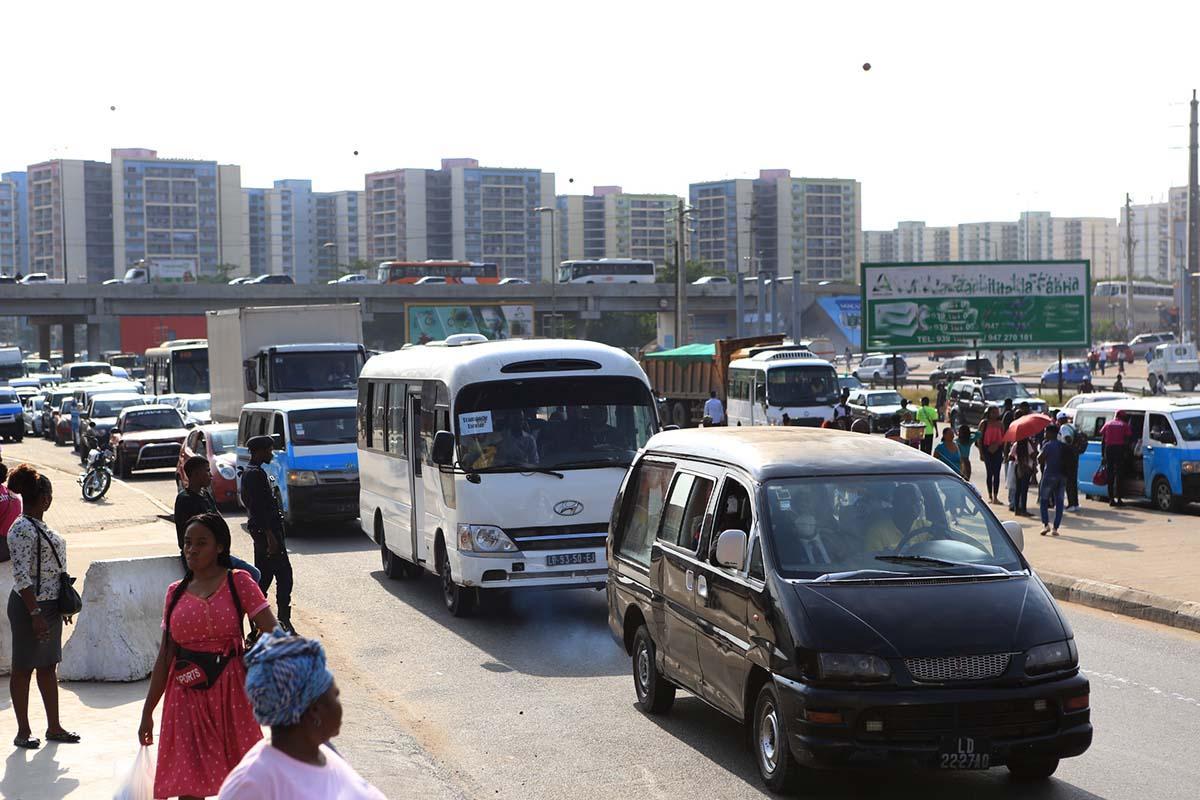
Africa-Press – Angola. The poor condition of secondary and tertiary roads, as well as road traffic congestion, especially on working days, continue to be two of the main “headaches” for the inhabitants of Luanda.
This reality frequently generates traffic jams on the main structural roads that connect the urban center to the outskirts, negatively impacting the quality of life of the approximately 10 million inhabitants of the Angolan capital, founded in 1576.
To reduce the effects of the problem, the Ministry of Public Works, Urbanism and Housing, as well as the Provincial Government of Luanda are engaged in the rehabilitation of existing sections and the construction of new road infrastructure.
Among the roads under construction, the Kimbango/Via Expressa section stands out (in the vicinity of Ponte do 25), passing through the interior of Rua da Suave, Viana, whose works are in the installation phase of the macro drainage system to later be asphalted.
According to the head of the provincial roads service at the National Roads Institute of Angola, Rosária Kiala Nóbrega, this section, which already includes five kilometers of drainage services, will relieve traffic on Deolinda Rodrigues avenues (Catete road – EN 230) and Pedro de Castro Van-Dúnem Loy.
With this, he continued, the new road and the rehabilitation of other sections will significantly reduce the constant traffic jams still recorded on two of Luanda’s main structural routes.
In an interview, the source highlighted Avenida Deolinda Rodrigues as one of the examples that records improvements in road mobility in the capital city, due to the ongoing rehabilitation of this road.
According to the person responsible, on the well-known Catete road, there is already a reduction in time on the Viana/City Center route and vice versa, during rush hours, as a result of the restoration work being carried out on this route.
He highlighted the laying of new asphalt, definition of stops, vertical and horizontal signage, as well as installation of informative gantries as the main works carried out on this section, which connects 1o de Maio/Viana/Catete.
“When the roads are free of potholes and with well-defined signs and stops for public transport, road mobility is carried out smoothly and also reduces the high rate of accidents on the roads”, he added.
According to the source, in addition to benefiting from new stops for public transport, as part of the entry into operation of the Dr. António Agostinho Neto International Airport, opened on November 10, 2023, in the same section the placement of vertical signage is also visible and horizontal.
He mentioned that at Deolinda Rodrigues the rehabilitation of eight existing pedestrian crossings is underway, with plans to place another seven new overpasses, with emphasis on replacing the pedestrian crossings at Grafanil-Bar and Fermat, places where there were already bridges, but were removed because they are degraded.
Status of other structuring routes
Along with Deolinda Rodrigues, Rosária Nóbrega also highlighted the sections Benfica/Ponte do 25 (Avenida Fidel de Castro – Via Expressa), Pedro de Castro Van-Dúnem Loy and Porto de Luanda/Boavista (Kima Kienda), with 80% of physical execution (rigid pavement), like the other structuring roads that are also undergoing rehabilitation and under the responsibility of INEA.
The Benfica/Ponte do 25 section and vice versa), he highlighted, is benefiting from restoration works, with the construction of stops for public transport and the definition of entrances and exits for commercial establishments in both directions of this perimeter.
In the first phase, the project includes the construction of 16 kilometers of service roads in each direction, with the other route being completed in the second stage. In total, the Benfica/Cacuaco Expressway is around 56 kilometers in each direction, with five new pedestrian crossings planned and the rehabilitation of 14 old overpasses.
The source also added that on this expressway, the construction of a third lane in the central corridor is planned, where the surface metro is planned to pass.
On avenues Pedro de Castro Van-Dúnem Loy, 21 de Janeiro, Futungo/Cabo Lombo and Estrada do Patriota, INEA is working on the maintenance and conservation of these sections, a project already completed in Patriota, which has seen a significant improvement in traffic.
On Pedro de Castro Van-Dúnem Loy (Mundo Verde/Golf 2/Estrada de Catete) milling and resurfacing work is underway (replacement of asphalt pavement).
The same work takes place on 21 de Janeiro (4 de Fevereiro Airport/UGP node).
Along the same route, on the Futungo road, a stop for public transport was built, with plans to place a pedestrian crossing at one of the critical points on this route.
They also include the main roads in Luanda, on 21 de Janeiro, Estrada da Samba, Rua dos Comandos, Ngola Kiluanje and Camama (Calemba 2)/Viana (Luanda Sul).
However, the head of INEA recalled that the problem of traffic congestion “cannot be resolved only with the construction or rehabilitation of roads, but with other means that also contribute to improving urban mobility”, such as the railway , BRT, light rail and maritime transport.
Asked about the problem of public lighting, which still exists on almost all roads in Luanda, Rosária Nóbrega said that this issue is the responsibility of the Provincial Government of Luanda (GPL).
Alternative routes to Zango
For the urban district of Zango (Viana), Rosária Nóbrega said that the rehabilitation of the Zango/Calumbo section is being carried out, with the laying of new asphalt, with the benefit of new pedestrian crossings and repairs to old ones.
Regarding the issue of creating other alternative routes to relieve Zango’s only entry and exit, the person responsible said that one of the solutions will be the construction of the Zango 5/EN 230 section (after Dr. António Agostinho Neto International Airport).
He mentioned that, at this moment, the process of this route is still under study, despite already having all the necessary conditions to begin with the works. “We had to divert the route of the road, because, initially, it passed inside the airport city and was very close to the International Airport”, he clarified.
Still on the construction of more access roads to Zango, last November, the provincial governor of Luanda, Manuel Homem, assured that this district will soon gain three new roads, on a route of 38 kilometers, in order to facilitate traffic and road mobility in this district.
These are the roads of Cassocola, Pomobel and the main street of the Muxima Moxi neighborhood, which will serve as alternatives for access to the Zango district. In total, the construction of 12 alternative roads is planned for this district.
On the same occasion, the governor announced that, this year, rehabilitation works will begin on the Vila de Viana/Viaduto do Zango section, passing through the municipal cemetery.
ANGOP
For More News And Analysis About Angola Follow Africa-Press