Africa-Press – Angola. The Angosat-2 satellite has been in orbit since 3 am today, after being launched yesterday at 8 pm local time (16th of Angola), at the Baikonur Cosmodrome, Kazakhstan. Angosat-2 traveled 36,000 kilometers from the Earth’s surface to geostationary orbit, where it must position itself.
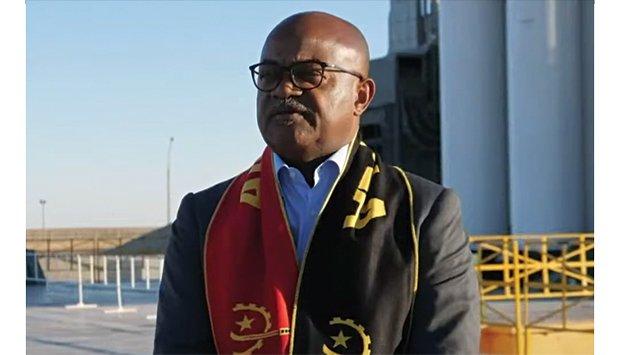
The moment was witnessed by the Minister of Telecommunications, Information Technologies and Social Communication, Mário Oliveira, and the director of the Russian Space Agency – Roscosmos, Yuri Borisov.
The team was completed by senior officials from the Ministry and the Space Agency, who accompanied every moment from the Station Observation Center, which is seven kilometers away.
Angosat-2 was placed in orbit by the Proton-M rocket, from ramp 81. After launch, the rocket and the DM-03 block (upper stage) were separated in the first 10 minutes, followed by three impulses. until it separates from the satellite in geostationary orbit.
Proton-M is made up of three stages, which separate sequentially throughout the launch process. After the separation of the DM block, the satellite stabilization process began and the opening of the solar panels to capture the sun’s rays, which is its main primary source of energy.
Once the satellite separation phase is completed, tests to verify its functionality begin, which may take place in a period varying between 60 and 90 days, whose success is evaluated after the separation of the DM-03 block and the satellite.
During the verification period, there is also a test phase for the verification and operation of the satellite in orbit, which varies between 60 and 90 days. To get to your working position, it takes ten days. According to the information provided by the technical team, the Telecommunications satellite, measuring 56.2 meters long, 7.4 meters in diameter and weighing 705 tons, has a high data transmission rate (HTS) and will ensure full coverage of the national territory. and provide telecommunications services, namely, Telephony, Internet, Telemedicine, Broadcasting and Radio Broadcasting.
Angosat-2 valences
The Telecommunications satellite will have six C Band transponders and 24 Ku Band beams and one KA Band transponder, satellite communication channels. The Angosat-2 payload, where the transponders are incorporated, was built by the European company Airbus, while the Russian company ISS is the satellite’s main integrator and builder. According to data shared by the Angolan technical team, the Angosat-2 payload was built in France and England, then sent to Russia, which integrated it into the platform assembled by the ISS.
After its integration into the platform, between November of last year and July 2022, nine months later, a series of tests were carried out, namely electrical, thermo-vacuum, thermal balance, mechanical, among others.
Angosat-2 began to be built in November 2019, after the disappearance of the first Angolan satellite. The satellite’s lifetime in orbit varies between 15 and 17 years. After the launch ceremony, the Russian side presented to Minister Mário Oliveira the team of engineers who were involved in the entire satellite construction process, culminating in yesterday’s act.
Service Improvement
During the presentation meeting of the team of engineers, the Minister of Telecommunications, Information Technologies and Social Communication highlighted that the launch of Angosat-2 will allow the Executive to fulfill the objectives of improving the sector in the country, thus contributing to the development from Angola.
Mário Oliveira, on behalf of the Angolan Government, thanked the technical team for all the efforts that worked to materialize the challenge: “By the parameters observed during the launch, we believe that we will achieve the Executive’s objectives”.
On the other hand, the director of the Russian Space Agency – Roscosmos, Yuri Borisov, acknowledged that, with this step, Angola took on a very hard and intense challenge, where everyone worked hard to build the satellite and the launch rocket: “We hope that , in less than six hours, the satellite is at the defined point and starts performing its functions.”
For More News And Analysis About Angola Follow Africa-Press