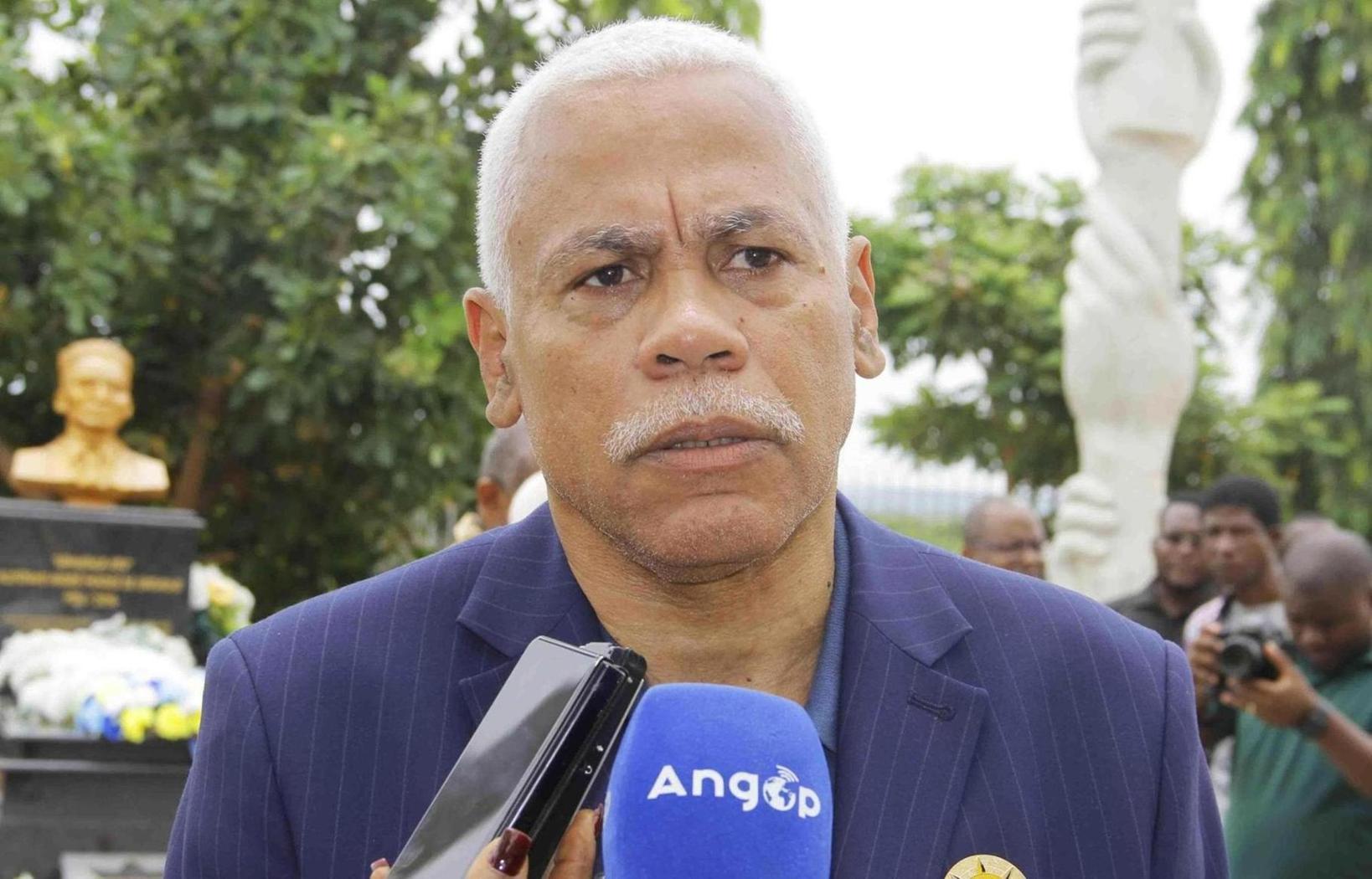
Africa-Press – Angola. The Angolan Academy of Letters (AAL) recognized, this Saturday, Agostinho André Mendes de Carvalho, better known by the literary pseudonym Uanhenga Xitu, in a posthumous homage, in the municipality of Icolo e Bengo, as a unique figure in Angolan literature and letters .
On behalf of the organization, Paulo de Carvalho, president of AAL, said that Uanhenga Xitu knew how to bring literature closer to society and portrayed real events experienced by ordinary people.
These statements were made after the laying of a wreath on the tomb of Uanhenga Xitu, in an act alluding to the celebrations of the 8th of January, National Culture Day.
For him, the nationalist distinguished himself because he knew how to represent not only people from the urban environment, but also from the rural and suburban areas, the result of a wide rural experience that gave him knowledge about the way people lived and the idiosyncrasy of the people of Angola.
With this act, the Academy intended to dignify the figure of Uanhenga Xitu and pass on to the new generations the nationalist’s contribution to letters, unity of the peoples of Angola, as well as to the dissemination of values such as solidarity.
“Our intention as an Academy is also to work for the dissemination of Angolan literature and letters in general”, he reinforced.
By the way, he announced for the first semester of the current year the holding of a round table, on “The canon of Angolan literature”, as he understands that many young people do not have contact with Angolan literature.
“It is necessary that there is contact with Angolan writers from primary education onwards”, he asserted.
For the writer and former Minister of Culture, Boaventura Cardoso, Uanhenga Xitu was a man of letters whose work should be appreciated by all, an unavoidable reference in Angolan literature.
The also member of AAL is of the opinion that it is opportune to pass on the legacy of Uanhenga Xitu to young people and to be included in public libraries.
Fraga de Morais, also a member of the AAL, said that Uanhenga Xitu was a master at writing short stories, with a national and international dimension, recognized in both Portuguese and Brazilian universities.
The official reiterates the need to implement policies that encourage reading in ways that improve the quality of writing and reduce weaknesses, especially among young people.
According to Albino Carlos, another member of the AAL, Uanhenga Xitu is an emblematic figure in Angola for being one of the few who managed to gather in himself the most important human, cultural, political and economic dimensions.
For him, Uanhenga Xitu’s interventionist citizenship should be passed on to younger people, as he was not a man to hear about.
Albino Carlos advises that Uanhenga Xitu’s literary production should be obligatory for everyone to consume.
In turn, André Gaspar Mendes de Carvalho (Meow), son of the deceased, thanked and said that the tribute provided by AAL honors the memory of his father and family, meaning that the legacy is valuable.
He referred to the family’s intention to enrich themselves from the historical point of view, the place where the father is buried, portraying the ancient history to the most recent, until independence, citing the names of those who witnessed this feat.
He announced, within three months, the creation of the headquarters of the Uanhenga Xitu Foundation, in the residence of the deceased, which currently lacks rehabilitation of the false ceiling.
In 2024 Uanhenga Xitu would be 100 years old and, therefore, several ceremonies will be held in his memory, starting in February of that year until August, respectively the months in which he died and was born.
Agostinho André Mendes de Carvalho, better known by the literary pseudonym Uanhenga Xitu, was born on August 29, 1924, in the municipality of Icolo e Bengo, village of Calomboloca, and died on February 13, 2014.
After Angola’s independence was achieved on November 11, 1975, he was appointed to the People’s Revolutionary Council (or “Revolution Council”), in addition to serving as Provincial Commissioner of Luanda between 1979 and 1980 and Minister of Health between 1980 and 1983.
He then began to accumulate diplomatic functions as Ambassador of the People’s Republic of Angola in Czechoslovakia, Poland and East Germany, where he graduated in political science.
He was also a deputy to the National Assembly for the MPLA.
Origin of literary pseudonym
The name Uanhenga Xitu is of Kimbundu origin – the national language, with uanhenga literally meaning “carrying something on the hook” and xitu meaning “meat”, so the expression “uanhenga xitu” conveys an idiomatic notion of “the powerful with lurking enemies” or that “power arouses hatred in others”.
In 2006 he received the distinction of the Culture and Arts Prize in the literature category for the quality of his literary work as a whole, giving him a place on the list of best authors in Angolan literary history.
He was also a founding member of the Union of Angolan Writers (UEA).
Construction
Master Tamoda (1974), Master Tamoda and Other Tales (1977), Manana (1974), Maka na Sanzala (1979), Voices in Sanzala (Kahitu) (1976), Mungo: The Colonial Machine Survivors Testify (1980), The Speeches by “Mestre” Tamoda (1984), Ball with Spell (1974), The Minister (1989), Special Cults (1997) and My Speech (1974).
For More News And Analysis About Angola Follow Africa-Press