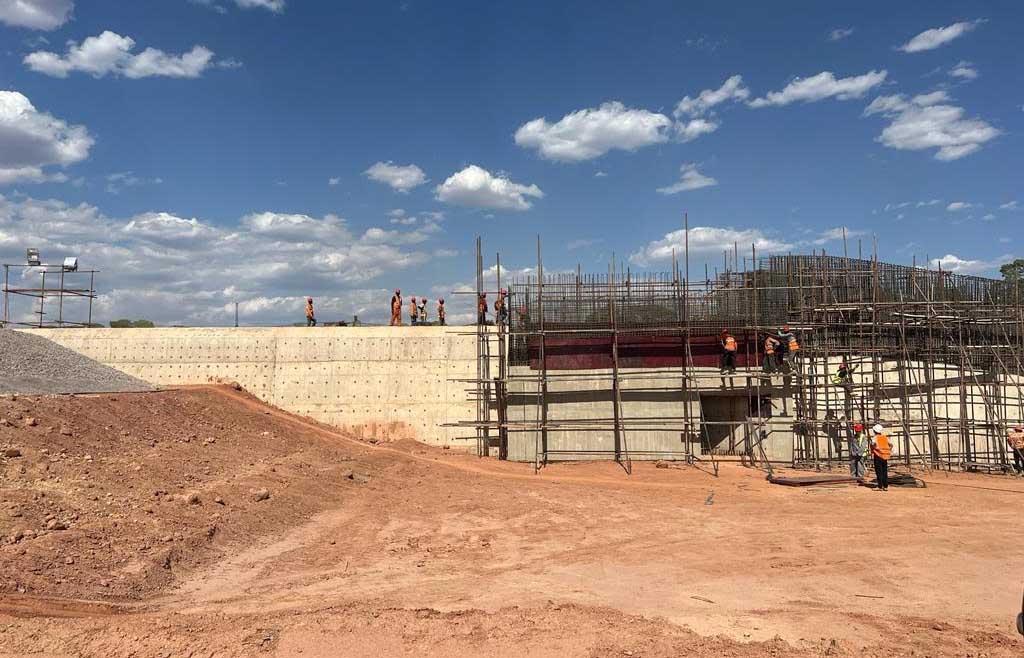
Africa-Press – Angola. The current state of construction of the Ndúe and Calucuve dams, two of the five structural projects to combat the effects of drought in the south of the country, located in the municipality of Cuvelai, province of Cunene, is in the compaction and elevation phase ‘dam body’.
The fact was announced this Tuesday, in Cunene, by the director of the National Institute of Water Resources (INRH), Narciso Ambrósio, on the sidelines of an assessment visit to the respective projects, having ensured that the work registered an acceptable dynamic and corresponding to the compliance with established deadlines.
He highlighted that the works on the Ndúe dam, with capacity to store 170 million cubic meters of water, have been physically completed at 40%, while the financial level is at 29%.
The Calucuve dam, with a capacity of 145 million cubic meters of water, presents a physical and financial improvement of around 27 percent, respectively.
Consigned at the end of October 2021, so far, the excavation of all hydraulic organs has been completed, namely flood spillways, diversion gallery, water intake, bottom discharge and injection curtains, to guarantee water waterproofing.
According to the source, at this time, work is underway in both projects to concrete the hydraulic areas and compact the rockfill areas of the dam body.
Narciso Ambrósio said that from the technical assessment carried out, the work guarantees a positive evolution, after the constraints experienced in the months of August, September and October this year, due to the unavailability of diesel which forced the level of execution of the works to be reduced.
With this situation over, he explained that the level of physical execution of the aforementioned works is satisfactory, ensuring that the contractual deadlines are met.
He said that all conditions were taken to ensure that rain did not negatively impact the pace of construction work, through the regular improvement of access roads and the creation of a drainage system.
He explained that drainage systems were installed at both works, with the placement of cofferdams, drainage channels, hydraulic passages and others that allow the diversion of water flow outside the area of influence of the work.
The INRH director also ensured the availability of the invoices issued, remembering that the projects are safeguarded through a financing line, through an agreement between the financier and the Ministry of Finance.
On that occasion, Narciso Ambrósio announced the construction of conductor channels associated with the two dams for the first quarter of 2024.
He clarified that the Calucuve dam will have a channel of 111 kilometers and 44 chimpacas, on the Calucuve/Ondjiva route, while Ndúe will have a length of 75 kilometers, from the point of the dam to the town of Embundo, in the municipality of Cuanhama.
To this end, he recalled that, since last November, preliminary conditions have been created for the installation of the shipyard, a topographical survey of the route of the respective channels and the start of the demining process in the work intervention area, in addition to the geotechnical and geological survey for preparation of the executive project in the first quarter of 2024.
Calucuve and Ndúe guarantee 245 million cubic meters of water
With the implementation of these projects, a total of 245 million cubic meters of water is expected to be stored for the needs of populations, livestock and agricultural activities.
The construction of the Ndué dam, led by Synohidro Angola, has a deadline of 30 months, with an estimated budget of around 192 million US dollars.
Under construction in the Cuvelai water basin, Nduê is a 26-meter-high earthen dam, a 75-kilometer network of pipelines and another 15 chimpacas.
Meanwhile, Calucuve is 19 meters high and is associated with a network of canals, with a length of 111 kilometers and over 44 chimpacas.
The budget for this project is around 177 million dollars, with the consortium of companies Omatapalo and MotaEngil as contractor, with a 20-month execution period for the work.
The two dams and the construction of canals complete the set of structural works to combat drought, which began with the water transfer project from the Cafu region to the Ondombodola and Namacunde area.
The province of Cunene, specifically in the municipalities of Cahama and Curoca, also counts on the execution of projects in lots 07, 08 and 09 on the right bank of the Cunene river.
For More News And Analysis About Angola Follow Africa-Press