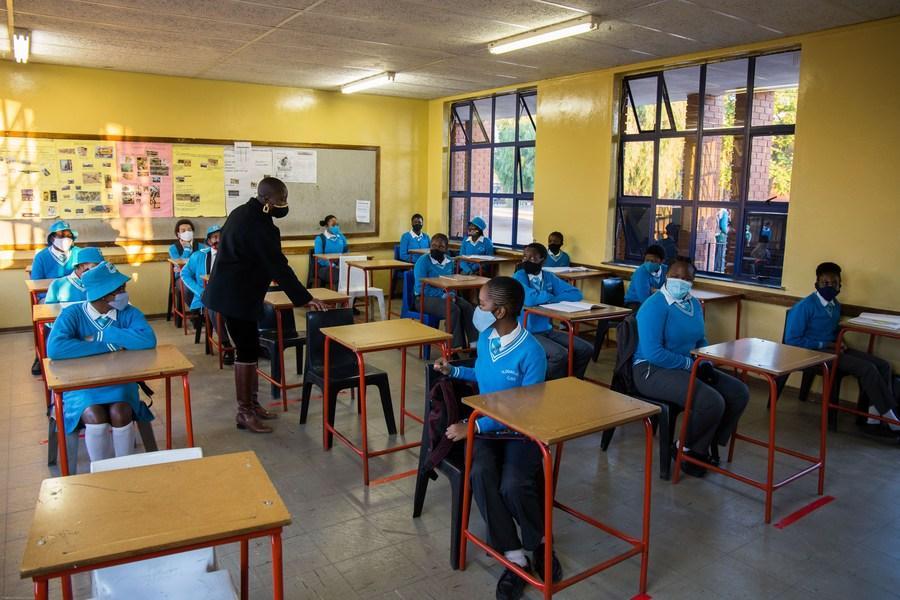
Africa-Press – Botswana. The country’s education system has failed to achieve the objectives of the 1994 Revised National Policy on Education (RNPE), says University of Botswana’s (UB) Professor Richard Tabulawa.
Giving a synopsis of his recently launched book titled: Globalisation and Education Policy Reform in Botswana, Prof. Tabulawa, who is also UB’s acting director for research and development, said the failure to achieve the RNPE objectives was ‘where the problem of quality and decline in student performance came from’.
He, however, acknowledged that impediments to the provision of quality education came in many forms such as a faulty curriculum, assessment practices and outdated pedagogies.
He said the current curriculum was suffocating and de-skilling teachers while denying pupils access to knowledge and skills deemed important in today’s workplace.
Prof. Tabulawa said assessment tests done narrowed the curriculum to low order thinking skills, and that the emphasis was on drilling pupils for examinations.
He argued that it was not conducive to the achievement of a knowledge based economy, adding that the dysfunctional practices were protected by an accountability regime that was punitive and anti-skills based.
The seven-chapter book, he said, sought to address the general education spectrum of the country’s education system.
The first chapter focuses on the state of education in the country at independence in 1966.
It notes the neglect that education suffered during the British colonial era.
The neglect, he said, influenced post-independence policy developments with mechanism of indirect rule at the root of the underdevelopment.
Prof. Tabulawa said that through the mechanism, Britain sought to keep her responsibilities to the protectorate to the bare minimum and that was the reason Botswana had the least education infrastructure of all the colonies in the continent at independence.
He said after independence the country developed the education system by borrowing heavily from policy prototypes in global circulation at the time such as universal primary education.
However, he said upon re-conceptualising the prototypes, Botswana crafted education policies that were unique to the country’s context.
“It is these interplay of global education discourses and local circumstances and the resultant policies that is the main focus of the book,” he said.
Prof. Tabulawa maintains that the country’s education policy was a result of global influences interacting with local pressures in a dialectical fashion to produce policies that had their own peculiarities.
He noted that the National Policy on Education of 1977 was the country’s first education policy, and that it was a response to the neglect of education.
He said the response involved the appropriation of education discourses circulating globally at the time and fusing them with local concerns such as nation building and meeting the human resource demands of the economy, adding that it produced a policy whose effect was a phenomenal expansion of education.
He noted that since independence the provision of general education had grown in leaps and bounds due to three reform policies of the National Policy in Education, the RNPE and the Education and Training Sector Strategic Plan (ETSSP).
He said the policies dramatically improved access to general education, but failed to improve the quality of education. Prof. Tabulawa explained that he regarded the ETSSP as a policy.
“The Education and Training Sector Strategic Plan is not a policy, but clearly a strategic plan, but it makes a very big contribution to the debates on education in the country to a point where you can actually categorise it as a policy on its own,” he said.
He said the book also explained the reforms made and their consequences in terms of their interplay with global forces and domestic pressures, adding that the Revised National Policy on Education of 1994 was the country’s response to globalisation. “It is based on the view that the world of work has changed and education needs to reform correspondently.
New skills have emerged, or so in augment point, which calls for the education and training sector to re-shape, in order to produce school graduates in view with these skills,” he added.
The multi-scale approach to globalisation adopted in the book, Prof.
Tabulawa said recognised the growing significance of the global scale, as a locus of action, but refused to accept the view that it led to the demise of the local scale. Instead, he said the two scales were viewed as being in a dialectical relationship, since they interpenetrate.
“Globalisation, understood as the growing significance of the global scale, does not obliterate territorialism or local scale, but rather leads to emergence of new scales, some sub-national and others supranational,” explained Prof.
Tabulawa. Prof. Tabulawa encouraged the public and all stakeholders to buy the book, which he said was currently being sold on Amazon and other online platforms.
dailynews
For More News And Analysis About Botswana Follow Africa-Press