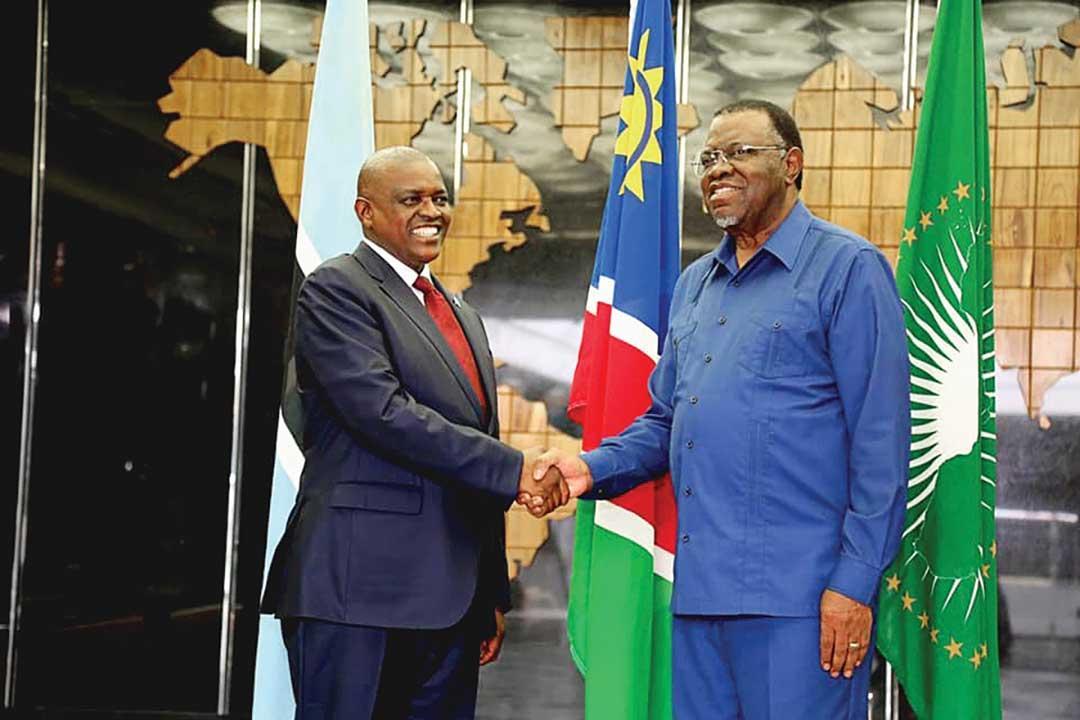
Africa-Press – Botswana. Botswana- Namibia trade relations grew a lot during the time that the late President Dr Hage Geingob held the ministerial portfolio of trade and industry, says chief negotiator in the Ministry of Trade and Industry, Mr Phazha Butale.
In an interview on Monday, Mr Butale said relations between the two nations pre-date the latter’s independence in 1990.
Mr Butale said this was due to geographic proximity and cultural similarity as well as familial relations cutting across the colonial borders between the two countries. He said post-independence, the diplomatic relations between the two states grew exponentially, citing that these covered the political and trade relations.
At a political level, Mr Butale said a forum was established where respective ministries in the two countries had constant contact to discuss and resolve any arising issues between them.
“This was at the level of the Joint Permanent Cooperation Commission (JPCC). As neighbours, we are bound to have a few political tiffs which have hitherto been resolved amicably,” he said.
Mr Butale said Dr Geingob was an important cog in all of the instances, mentioning that the two that immediately came to mind were the territorial dispute over ownership of Sedudu island which had to be referred for international arbitration, whose final ruling was accepted as binding by the two countries.
He said later, there was the constant issue of anti-poaching efforts in the northern part of Botswana, which had threatened to cause a political rift between the two countries.
“Here, the two countries led by their leaders cooperated in instituting a commission of inquiry whose findings would inform future steps to take in addressing the highly flammable issue,” he said.
Mr Butale said this was at a time when the negotiations for the SADC, Economic Partnership Agreement with the African Union were at their peak together with those of Southern African Customs Union (SACU) with the European Free Trade Association states.
Based on the latter, he said later came the monumental negotiations for the African Continental Free Trade Agreement (AFCFTA) and the constant review of the SACU Agreement, both of which happened during Dr Geingob’s presidency.
Whether by design or fate, due to the similarity in circumstances of respective economies, both nations had little option, but to join alliances to increase their bargaining power through a unified voice.
Mr Butale said this could only happen smoothly with the necessary political will, which was provided by Dr Geingob on the Namibian side.
It was to this end that things culminated in the removal of the requirement of a passport for the citizens of the two respective countries to travel between them, he said, mentioning that the move pre-empted the bigger vision of facilitating the free movement of persons on the African continent as envisaged by inter alia the AfCFTA and the African Union Vision 2063.
Still on the trade facilitation side, the two countries have worked on, and continue to do so with the Trans Kalahari Highway, which connects inland Botswana with the port of Walvis Bay, he said.
Mr Butale said currently both countries were in joint efforts to develop the Trans Kgalagadi railway line, which should further improve the ease of doing business and increase trade between our two countries.
For this, he said Batswana were greatly indebted to Dr Geingob for giving the political will and direction in tandem with his Botswana counterparts.
Overall, he said they were grateful to the late President in leading very cordial and neighbourly relations between the two countries, which will remain his legacy and which will motivate future generations to nurture and develop the relations even further, leading to more economic prosperity of both nations.
dailynews
For More News And Analysis About Botswana Follow Africa-Press