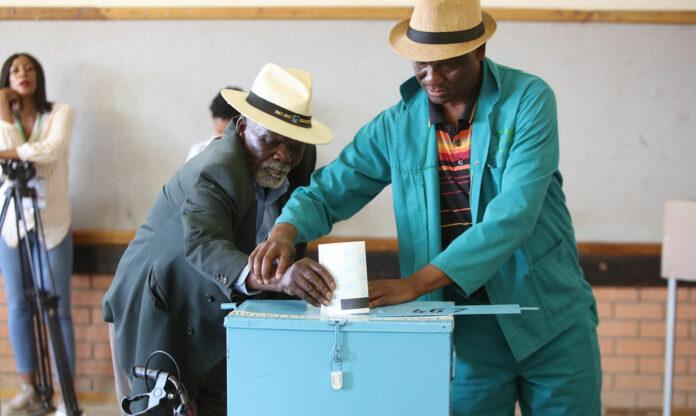
Africa-Press – Botswana. Most Batswana between the ages of 18 and 35 are expected to abstain from voting in the 2024 elections, Brookings Institution has predicted.
This is bad news for Botswana’s opposition parties who see the youth vote as a low hanging fruit because of the country’s high unemployment rate.
Botswana’s youth between the ages of 18 to 35 make up more than 50% of the country’s eligible voting population. According to Dataportal, 11,1% of Batswana are between the ages of 0 and 4, 17,2% between the age 5 and 12, 9,9 percent is between the ages 13 and 17, 12,2% is
between the ages 18 and 24, 16,7% is between the ages 25 and 34, 14,8
% is between the ages 35 and 44, 9.0% is between the ages 45 and 54,
5,3% is between the ages 55 and 64 while only 3,7% is ages 65 and above.
The Brooking Institutions’ forecast lines up with Botswana’s historical voting pattern: 70% of Botswana voters between the ages of 18 and 35 abstained from casting ballots in the 2019 general elections, which the Botswana Democratic Party (BDP) won despite.
With Botswana’s elections slated for the end of this year, Brookings Institution reports that youths “are the least likely to participate in elections.” They also note that this is a common pattern throughout the African continent. Fifteen African countries are due to have presidential and national assembly elections in 2024.
Despite Botswana and other African countries experiencing an increase in population over the last three decades, Brookings Institution notes that “a large portion of African youths remain disconnected from political engagement”. They also add that: “In sub-Saharan Africa, there is a noticeable trend where younger demographics tend to abstain from voting”.
The Brookings Institution is an American think tank that conducts research and education in social sciences, primarily in economics, governance, foreign policy, and economic development.
The think tank makes the following recommendation: “It is imperative to prioritise efforts aimed at enhancing youth political participation for the
sake of fostering good governance and strengthening democracy in the region.”
The findings of the Brookings Institution are supported by the Independent Electoral Commission (IEC), which is in charge of monitoring elections for elected members of Botswana’s Local Authorities and National Assembly. In Botswana, 53% of the eligible voter population cast ballots in 2014; however this figure dropped to 49% in the 2019 elections.
In the 2019 elections, nearly 45% of eligible voters between the ages 18– 25 and about 25% of eligible voters in the 26–35 age group did not cast ballots.
This pattern is expected to recur in the 2024 elections. IEC data indicates that for the 2024 registration period which ran from January 5 to February 3, out of a target of 1 300 000 people, only 736 424 registered to vote. Most who did not register are believed to be the youth.
sundaystandard
For More News And Analysis About Botswana Follow Africa-Press