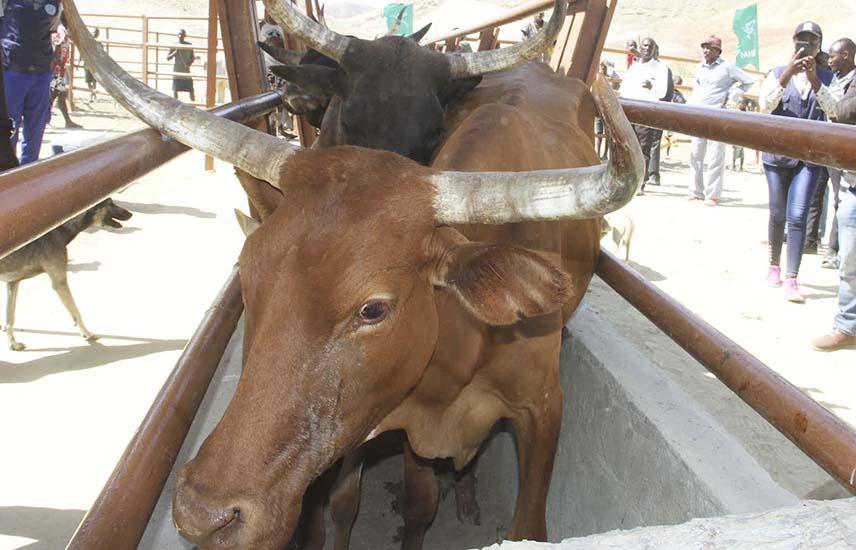
Africa-Press – Botswana. The use of regional approach is critical in controlling trans-boundary animal disease such as Foot and Mouth Disease (FMD) that are a deterrent to the growth of the sector. Presenting at a Tuesday meeting where the Ministry of Agriculture hosted a delegation from the Ministry of Fisheries and Livestock in Zambia, who are on a week-long benchmarking exercise in the country, the Deputy Director – Department of Veterinary Services, Dr Kobedi Segale said it was important for regions or neighbouring countries to have a common approach and work together in safeguarding the livestock sector.
He said over the years, the country has been intensifying measures to control the movement of livestock to avoid the spread of FMD to green zones potentially tarnishing the country’s chances of exporting to lucrative markets in the European Union (EU) and other regions. As such, Dr Segale said the construction of veterinary disease control cordon fences dividing into zones has worked well in managing movement of animals and potential spread of the disease.
He said following the 1996 outbreak of Contagious Bovine Pluro Pneumonia (CBPP) in Namibia spreading into the Ngami area, the country has constructed boundary fence to stop free movement of livestock crossing to either side of the who countries and stopping potential future outbreaks.
He said currently in the Ngamiland area, vaccination against FMD is done bi-annually while in the North West area where livestock share pastures with wild animals, the vaccination is done three times per year. He said the North West has an estimated cattle population of 250 000 while Chobe has about 15 000. Dr Segale said vandalism and damage of the fence by elephants and destruction by wild fires were some of the challenges frustrating government’s efforts of controlling livestock diseases.
However, he said farmers were on the other hand equally making efforts to augment government efforts in fighting diseases such as FMD. Sharing the country’s livestock sector situation with the Zambia delegation Acting Director, Animal Production, Mr Aubrey Ranko said Artificial Insemination (AI) was introduced in the country in 1966 with a view to provide small hold farmers with access to superior breeds of bulls. Mr Ranko said government was currently working on extending the AI services to small stock production.
Additionally, Mr Ranko said the National Artificial Insemination Laboratory (NAIL) at Ramatlabama AI camp was also started in 1950, the move which saw the first importation of superior breeds of cattle from Texas, which included 35 bulls and nine heifers in 1964. Despite the livestock industry remaining lucrative and with the potential to grow the economy, Mr Ranko said the sector was not immune to challenges.
He said the decline in the cattle population could be linked to natural disasters such as recurring droughts coupled with outbreaks of diseases such as FMD. “Despite having a robust disease control system, we continue to be affected by disease outbreaks. Some of the diseases such as the Contagious Bovine Pluro Pneumonia (CBPP), which plagued the Ngamiland area in 1996, were controlled by eliminating the affected animals,” he said. Mr Ranko also added that poor animal husbandry practices also contributed to the decline in the livestock population. He said the poor animal rearing practices contributed low productivity, high mortality and low birth rate.
However, Mr Ranko said government was heavily engaged in projects to revive the sector. He said President Dr Mokgweetsi Masisi, through his bull, rams and buck donation initiative, was geared and supporting and encouraging growth of the livestock population. He said the drive to utilise the revived AI was also a vital ingredient. Mr Ranko said government was encouraging farmers to use technological methods as such AI and proper bulls/heifer ratio to increase the livestock population.
Director-Policy, Research and Statistics, Ms Mmadima Nyathi said some of the factors that might have contributed to the decline in cattle population in Botswana were the fact that the industry was solely anchored on the Botswana Meat Commission (BMC), as the sole exporter and market for the cattle. Over the years, Ms Nyathi said the BMC suffered challenges, resulting in the decline in numbers of farmers selling their cattle to the BMC.
As such, Ms Nyathi said failure to sell led to some farmers becoming reluctant to increase their cattle population since they were not getting enough or satisfactory returns from their sale. However, Ms Nyathi said in 2020 government came up with strategies to end the BMC export market monopoly by allowing farmers to access the market by selling live tollies to lucrative markets outside the country.
She said another positive development from government, which was aimed at resurrecting the beef cattle sector, was that in 2019 a study was conducted, with the focus on liberalising the beef market and have more players in the sector. Ms Nyathi said the study gave birth to the Meat Industry Regulatory Authority (MIRA).
Through the regulator, Ms Nyathi said the country would maintain and improve its standards in the beef industry.
DAILYNEWS
For More News And Analysis About Botswana Follow Africa-Press