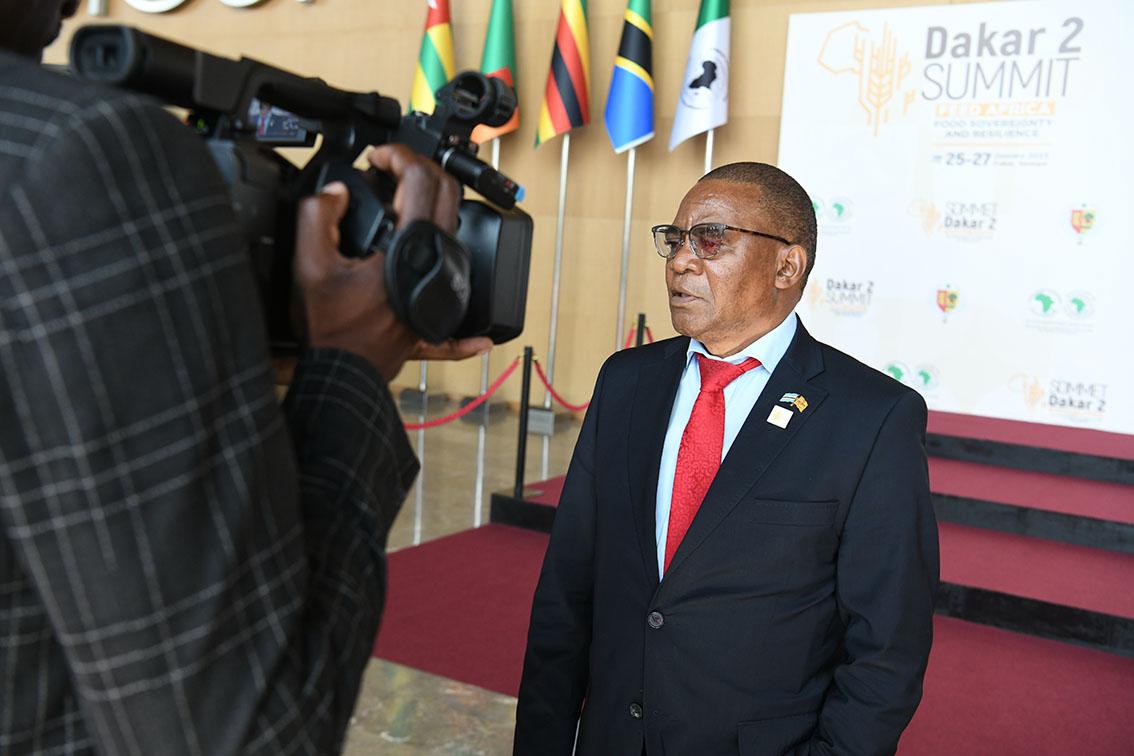
Africa-Press – Botswana. The just-ended second Dakar Feed Africa Summit has been described as an important platform for sharing successful food and agriculture experiences.
Speaking at the end of the summit held in Dakar, Senegal January 25-27, Vice President Slumber Tsogwane said Botswana’s participation at the summit would enable the country to continue enhancing agricultural productivity.
“We are here to ramp up our efforts to resuscitate our once agricultural economy. We have got land although water remains a problem,” he said explaining that before the discovery of diamonds, agriculture was the mainstay of the economy contributing 40 per cent to GDP.
According to Mr Tsogwane, the summit was also a good opportunity to network and chart a path on utilisation of resources availed by financial institutions to improve agricultural yields.
“We will continue to find ways of advancing our efforts in looking for funding for agriculture in such banks as the African Development Bank to improve the sector,” he added.
Mr Tsogwane said agricultural improvement efforts would continue in order to make it attractive.
Targetted areas included digitalisation, smart agriculture and provision of agriculture infrastructure, he said.
Among the key themes of the three-day summit was a call to bolster support for agriculture small and medium enterprises (SMEs) as the backbone of African economies.
A summit communique says despite their potential, agriculture SMEs were burdened by an unmet financing need of about $100 billion annually while women-led and operated SMEs were disproportionately and negatively impacted by the funding gap.
The summit has also called on African Development Bank (AfDB) to support countries’ efforts towards development of financing frameworks for implementing the presidential food and agriculture delivery compacts initiative.
The bank committed to mobilising and deploying concessional resources such as the agri-SME Catalytic Financing Mechanism, de-risking agricultural lending and encouraging the private sector to increase commitment and capacity to support gender-leaning and climate-smart agri-SMEs.
Attended by 34 heads of state and government and their representatives, the summit endorsed the Dakar Declaration on Food Sovereignty and Resilience, which, agreed to finalise development of the Country Food and Agriculture Delivery Compacts in collaboration with country stakeholders to achieve food security and self-sufficiency.
Another resolution is to support implementation of the compacts with time-bound and measurable indicators including concrete national policies, incentives as well as regulations to establish enabling environment for wider and accelerated investments across the agriculture sector.
A third resolution it to mobilise internal and external financing for the compacts from a broad range of bilateral and multilateral partners and the private sector.
The summit’s fourth resolution is to increase financing from national budgets to support the compacts initiative by allocating at least 10 per cent of public expenditure to agriculture.
For More News And Analysis About Botswana Follow Africa-Press