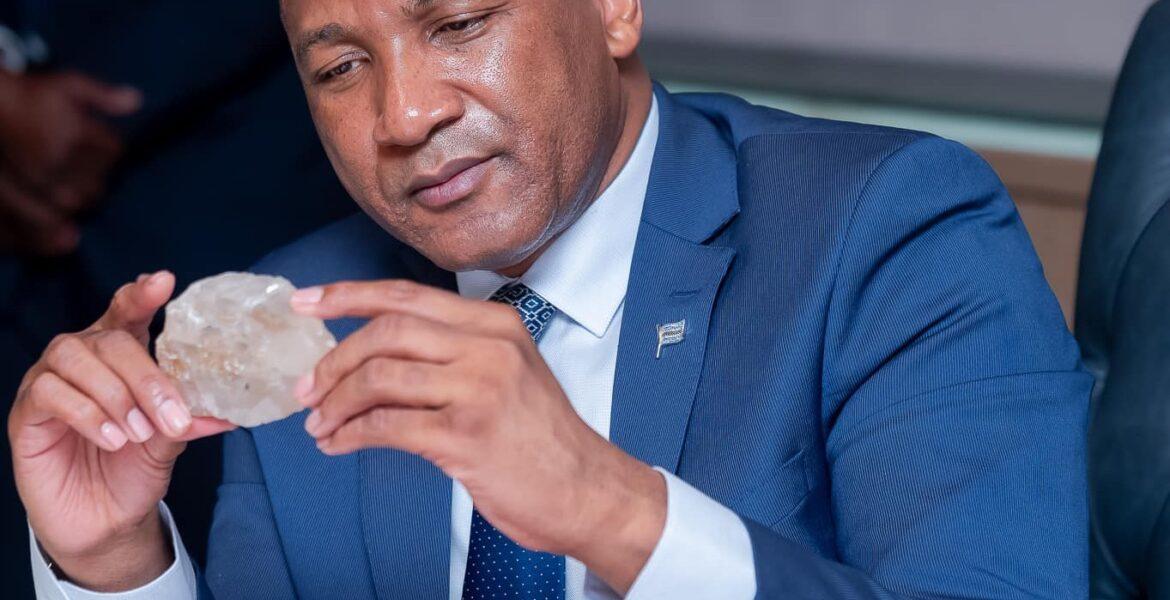
Africa-Press – Botswana. Botswana is banking on a controversial new “golden passport” scheme as it seeks to bolster state coffers drained by falling diamond sales.
The golden passport, which would require foreigners to pay a one-off investment of up to around $100,000 in exchange for citizenship, puts Botswana on a growing list of countries that offer passports-for-cash, including St Lucia, Malta and Grenada. US President Donald Trump too in 2025 announced a $5mn “gold card” that would offer residency.
Armand Arton, chief executive of Arton Capital, a financial advisory firm marketing the scheme, said prospective applicants appeared to be “attracted… by the political stability of Botswana, the opportunities and the rule of law”.
Diamond production has turned Botswana, once among the world’s poorest countries, into one of Africa’s richest over the years. As home to De Beers’ flagship diamond mine, it depends on exports of the precious stones for a third of GDP and almost all its foreign exports earnings.
But the government has been forced to find alternative sources of revenue following a slump in the natural diamond market that is expected to trigger a 1 per cent contraction in the economy in 2025, according to the IMF.
Legislation for the government-backed golden passport proposal now has to go through parliament, with a vote expected in early 2026.
Around 1,000 people have registered their interest to date, with applicants from the US, Zimbabwe and India in the top three, Arton said. He said the aim was to attract up to 5,000 families and generate $500mn over five years.
The level of interest from G7 nations was surprising, he said, as the firm had primarily expected engagement from China and Arab countries.
Industry experts cast doubt on whether the passports would draw a high number of applicants, however.
“I don’t think this will be popular,” said Collins Bogatsu, an immigration consultant based in the capital, Gaborone. The government has not yet issued guidelines on how the process would work, he said. “This thing is all about politics, so politicians might have their own people they want [to attract].”
Please use the sharing tools found via the share button at the top or side of articles. Copying articles to share with others is a breach of FT.com T&Cs and Copyright Policy. Email [email protected] to buy additional rights. Subscribers may share up to 10 or 20 articles per month using the gift article service. More information can be found at https://www.ft.com/tour.
https://www.ft.com/content/b0edfbd4-063c-4bf6-bbce-0afa783c7972
Botswana’s presidency did not respond to a request for comment.
Another professional in the citizenship-by-investment industry said Botswana would be “the lowest of the pile yet” in terms of countries offering passports.
Arton’s own Passport Index shows that Botswana’s passport grants visa-free access to 51 countries, mostly in southern Africa and the Caribbean. Singapore’s, by contrast, offers access to 137 countries, including the EU.
Sarah Kunz, a lecturer specialising in migration studies at the University of Essex, has previously told the FT that “it’s not the real economy that benefits” from these passport schemes, adding that governments often use the funds to pay “running costs”.
Arton said his firm did not know how the government intends to use the funds, but that “low-income housing projects are very important for the government as part of the election promises”.
He added that “funding entrepreneurship” with the visa scheme’s earnings was a second priority for President Duma Boko’s administration.
Boko’s government, which in 2024 unseated the party that had ruled Botswana since independence in 1966, swept to power on populist promises, including a pledge to create 500,000 jobs in five years.
A bid by the government to acquire a majority stake in De Beers — in which it currently owns 15 per cent and supplies 70 per cent of its rough diamonds — has been rocky. The six-decade-long relationship between the world’s biggest diamond company and the government has soured as negotiations have dragged out.
In July, Boko said Botswana was “broke” because De Beers was “not doing its job”. The market slowdown prompted Botswana’s Ministry of Health to delay non-urgent operations while the government, the biggest employer, announced a freeze in new hirings and public procurements.
Countries have long offered citizenship or residency privileges in exchange for one-off investments, but critics say the programmes open the door to corruption, tax evasion and money laundering.In May 2025, the European Court of Justice struck down Malta’s citizenship-by-investment programme, which allowed people to acquire a Maltese passport — and by extension EU citizenship — in exchange for a one-off payment of €600,000 and purchasing or renting a property. The ECJ said the scheme, developed with immigration consultancy Henley & Partners, had made “the acquisition of nationality a mere commercial transaction”.
Arton said his firm had stressed that the government’s own verification services would not be enough to perform background checks on individuals and had recommended two UK-based due diligence companies also be involved when applications are processed.
With those additional checks in place, he believed the chances of a sanctioned person or somebody with a criminal record getting through would be “impossible”, he added.
For More News And Analysis About Botswana Follow Africa-Press