Africa-Press – Botswana. To defend and protect the country’s macroeconomic stability, it’s given that the minister responsible for finance will have to work hard to reverse a structural fiscal imbalance recorded during the entire National Development Plan (NDP) 11 that also made its way into the TNDP.
Through TNDP, which kick-started in April 2023 and will end in March 2025, Serame wants to put Botswana on a path to a balanced budget.
Serame’s resolve to return the national budget to surplus, a feat that can easily be likened to a song that refuses to sell, is a result of the pressure to return the country to fiscal prudence. The national treasury battled with deficits the entire NDP (2017 – 2023) and is projecting to dance to the same song throughout the TNDP.
At the same, on the growth front, while the treasury had projected an average GDP growth of 4.2 percent over the five years from 2017 to 2021, the actual growth averaged only 2.7 percent.
In February 2023 Serame linked the below-par economic performance to amongst other things COVID-19-induced recession in 2020 and the impact of the ongoing Russia-Ukraine war.
Serame said for Botswana to stay on track towards achieving high-income status by 2036, reduce unemployment and eradicate abject poverty, the economy needs to grow at an average of 5.7 percent during TNDP and NDP 12 which is planned to kick start in 2025.
To date, the Ministry that Serame leads, projects that Botswana’s GDP will grow by four and 5.1 percent in 2023 and 2024, respectively. This means that the economy will grow at a less desired rate during those two years which are also part of the TNDP. Given low economic activity, this also means the government is likely to reach a less desired level on the revenue side thus affecting the fiscal reserve. Botswana’s fiscal reserve has over the years shrunk to a point where now the current financial year’s (2023/24) budget deficit is expected to be financed through a combination of debt. The Treasury has said that for the 2023/24 financial year, financing options will include the issuance of domestic Government securities, in the form of bonds and Treasury Bills to the tune of P3 billion. The P3 billion raised is set to finance the P7.6 billion budget deficit forecast for the financial year 2023/2024.
Still, in February, Serame said that another budget financing option for Botswana will be net external financing, from official multilateral and bilateral lenders which is projected at around two billion Pula.
Despite the impressive achievements of the domestic bond market that Serame speaks highly of, Botswana’s capital market is still facing challenges of liquidity.
But where do all these leave the country’s fiscal stance?
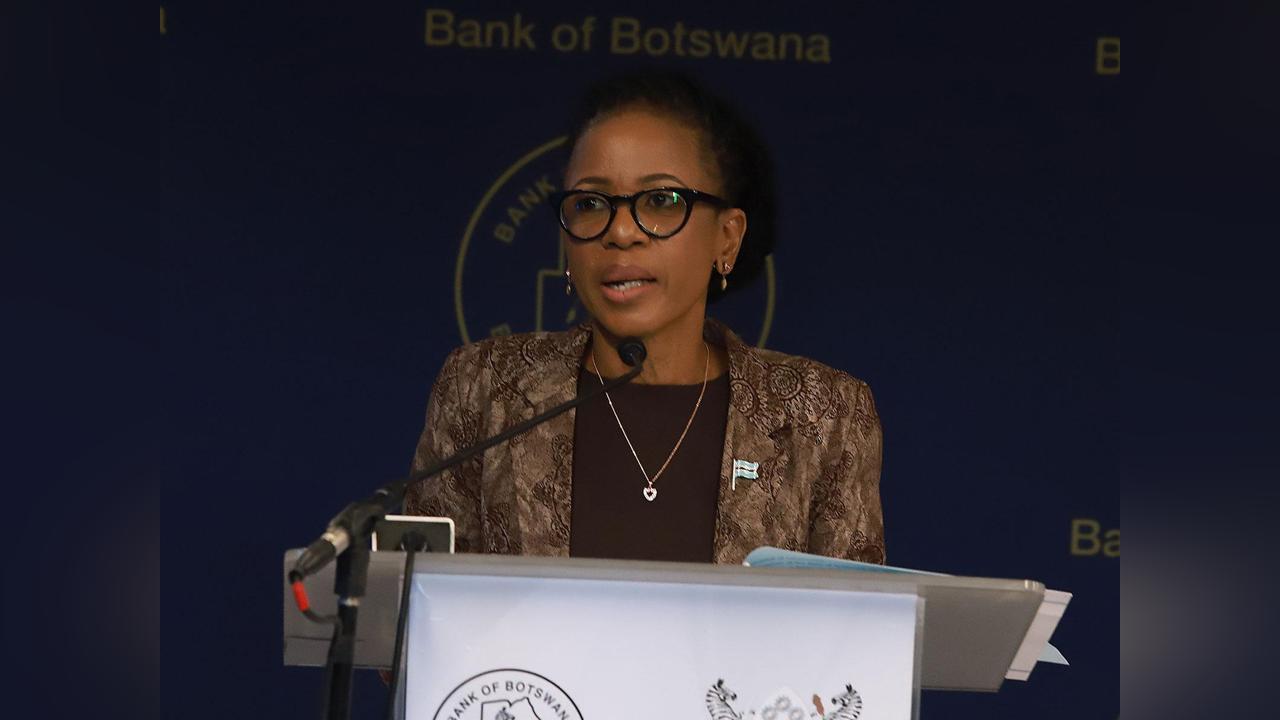
“Botswana, like the rest of many emerging market countries has witnessed a deterioration of financial position as well as increased accumulation of debt in recent times”, Serame told Chief Executives of commercial banks, central bankers, dealers, and financial journalists at the Bank of Botswana recently at the launch of Botswana’s borrowing strategy.
Despite the accumulation of debt over the years, Serame’s ministry says as Government continues to roll out the post-pandemic Economic Recovery Plan as well as the TNDP, external as well as domestic debt financing instruments will be a prominent feature of the fiscal budget over the medium-term.
“While the focus today is on the domestic market, there are also plans to make footprints in global markets as Government may embark on international roadshows”, Serame told her audience which was in a celebratory mood.
Despite the risks of leaving behind a weak fiscal foundation for future generations, Serame said that the nation has benefited from previous participation in the debt markets when the government issued bonds whose proceeds were used to fund the construction of the Botswana International University of Science and Technology (BIUST) and the University of Botswana Medical School.
Serame was speaking at the launch of the government borrowing strategy in the capital Gaborone. The strategy seeks to help Botswana navigates the ongoing global economic uncertainty through borrowing while at the same time embarking on a journey that started in 2003 to develop a domestic debt market.
The new strategy comes at a time when the government has been raising less funds than it wanted in the bond markets. The official data shared by the Bank of Botswana on the latest bond auction results could be a sign that market participants still prefer short-term lending to the government, a stark contrast to the appetite that was noted in the first bond auction of the year in January 2023.
Through the two treasury bonds that were on offer, the government got the P1 billion it aimed for, while the two longer-dated bonds got P81 million instead of the targeted P400 million, leaving BoB to secure nearly P1.3 billion for the government – short of the required P1.8 billion that was put up for auction.
“The secondary market for Government securities is still characterized by lack of liquidity, stemming from a high degree of instrument fragmentation as well as a relatively narrow investor base”, Serame admitted to the captains of the industry on Thursday.
Serame also admitted that the end result of the structural feature in the bond market is the payment of a premium by the government and by extension taxpayers to investors, “to compensate them for the risk of holding relatively illiquid securities”.
In a bid to identify and rectify the deficiencies, the Ministry of Finance has engaged the likes of the International Monetary Fund (IMF) to help in implementing the needed reforms in the various sub-sectors of the domestic bond market.
But is borrowing enough?
As Serame said in February 2023, Botswana’s fiscal policy entered uncharted waters in responding to the COVID-19 pandemic in 2021. That was the same year that the country recorded a yearly trade deficit of P10.8 billion, a significant improvement from the 2020s P25.4 billion trade deficit – the largest trade imbalance on record.
The historic deficit extended the P14.2 billion shortfall recorded in 2019, the third highest since 2012’s trade shortfall of P16.3 billion.
In 2022, official figures peg the trade balance on the surplus side of the ledger, a feat that was last recorded more than four years ago. The 2022 turnaround, just like 2018 one, was propelled by strong diamond sales. But now De Beers, the biggest diamond producer by value, has reported lower rough diamond sales in its latest sales cycle as the diamond industry enters a seasonally quiet period.
In its sales report published in mid-May 2023, the minerals mining giant which is currently locked in diamond sales talks with the Botswana government said that the value of rough diamonds sold in the fourth sales cycle of the year was $480 million, lower than the $542 million fetched in the third sales cycle. The latest provisional sales figure are also lower than the $604 million that was earned in the fourth sales cycle of 2022, continuing what has been a trend this year, with 2023 sales sights being outperformed by last year’s comparable sights.
The diamond mining giant’s first sales cycle of 2023 brought in $454 million, a decline of 31 percent from the same period in 2022, while the second sight raked in $497 million – 24 percent lower than 2022’s second sales cycle that netted $652 million. This year’s third sales cycle value was 4 percent lower than the corresponding sight in 2022. A low sale of diamonds will result in another dent in Botswana’s long-term fiscal plans as the country’s revenue is dependent on it combined with tourism and taxes. With the country’s main revenue streams failing to keep pace with the ever-increasing expenditures, Botswana’s treasury is set to look to the debt market, both locally and internationally. The move will help the current generation to survive economic downturns but with a risk of handing over a nation that has its fiscal structures laid on shaky grounds to the next generation if the diversification song continues to be on the bottom part of the economic charts.
[WHAT IT MEANS: With Botswana’s main revenue streams failing to keep pace with the ever-increasing expenditures, the country’s treasury is set to borrow more, a move that comes with risks to the future fiscal position.]
[QUICK FACTS BOX]
2023/24 Budget Deficit: P7.6 billion
2022 GDP: 5.8%
2023 GDP Forecast: 4%
Q1, 2023 Trade Balance: P1.1 billion,
Q1, 2022 Trade Balance: P251.8 million
Government Investment Account (Feb 2023): P13.6 billion
Government Investment Account (January 2023): P16.8 billion
For More News And Analysis About Botswana Follow Africa-Press