By Masego Manyaapelo and Douglas Rasbash
Africa-Press – Botswana. The Hidden System Driving Botswana’s GBV Crisis
BLURB:
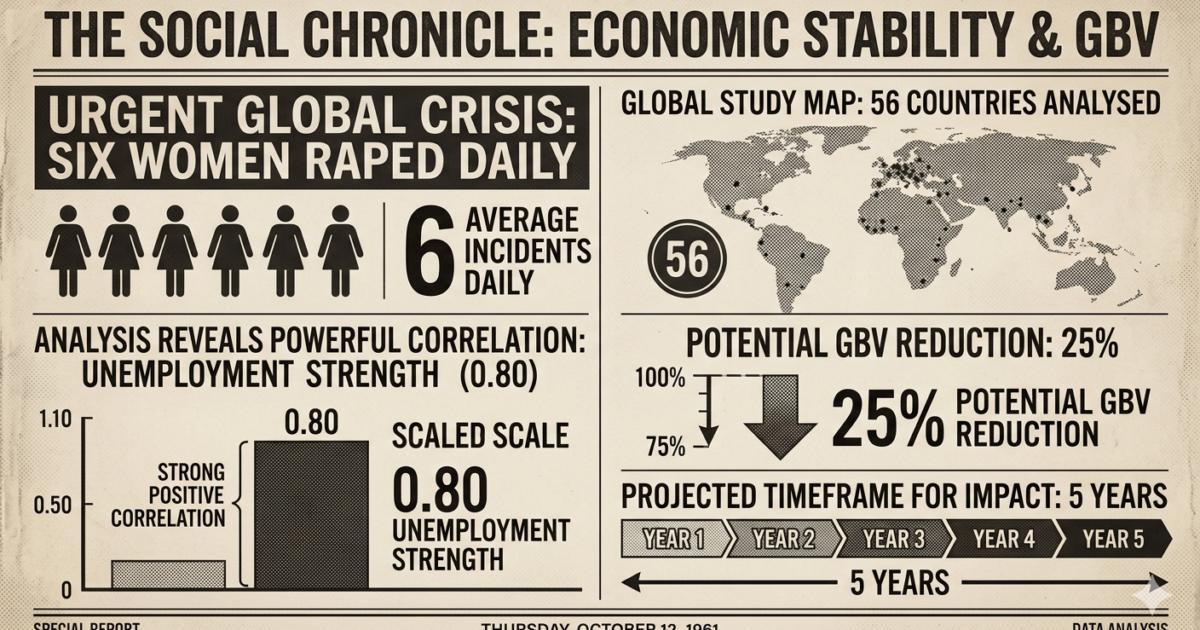
Botswana’s gender-based violence crisis is not random. New research reveals a predictable system driven by unemployment, inequality, and fragile social structures, pointing to solutions that could reduce violence by up to 25 percent.
—
Gender-based violence in Botswana is not random. New research shows it is systemic, predictable, and rooted in structural economic and social stress — and that means it can be reduced. Every day, six women are raped in Botswana. Many more cases go unreported.
SYSTEMIC REALITY
That stark reality is often presented as a moral outrage, a policing failure, or a cultural problem. And it is all of those things. But what if it is something more unsettling still? What if gender-based violence (GBV) is not random, not episodic, not even primarily behavioural—but systemic, structural, and, most provocatively of all, predictable?
A new research paper from the 2nd Republic Policy Think Tank forces us to confront exactly that possibility. Drawing on cross-country data, statistical modelling, and Botswana-specific validation, the study reframes GBV not as a social aberration—but as the outcome of interacting economic and social forces that can be measured, modelled, and ultimately changed.
SHIFTING PARADIGM
The full report is available free of charge, reflecting the Think Tank’s commitment to open, evidence-based public debate.
This is not just another report. It is a shift in paradigm. The report begins not with equations, but with stories—quiet, uncomfortable, and deeply familiar.
HUMAN STORIES
A young woman celebrating her 21st birthday finds herself gradually coerced into a situation she cannot control. A teenage girl is absorbed into an abusive relationship under the guise of support. A worker faces harassment from an employer but cannot leave because she needs the job. Another woman, assaulted by people she knows, chooses silence over reporting—because the consequences of speaking out may be worse.
These are not isolated incidents. They are patterns. They reveal something profoundly important: GBV does not occur in a vacuum.
PATTERN REVEALED
In other words, it is embedded in the system.
KEY DRIVER
But the most significant of these is youth unemployment.
WHY BOTSWANA
Why?
SOCIAL STRESS
A society in which large numbers of people are economically marginalised is a society under stress.
POLICY GAP
And this changes everything.
UPSTREAM SOLUTIONS
The research demonstrates that GBV can be reduced by addressing upstream structural conditions.
TRANSFORMATIONAL IMPACT
That is not marginal. That is transformational.
SYSTEM RESPONSE
Policy effects are not additive.
FINAL REFLECTION
It is not. It is a function of structural stress.
Source: Botswana Gazette
For More News And Analysis About Botswana Follow Africa-Press