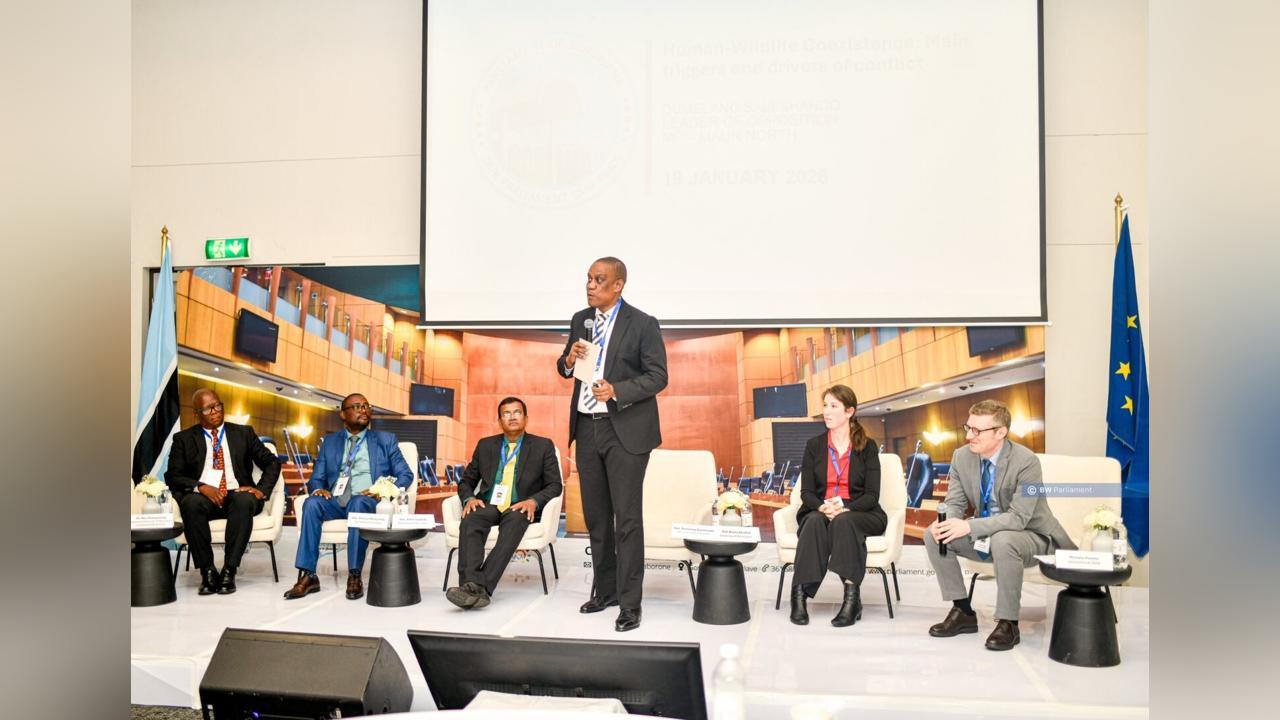
Africa-Press – Botswana. On 19 January 2026, Dumelang Saleshando presented at the International Parliament Roundtable on Human Wildlife Coexistence. He engaged fellow legislators and development partners on an issue that defines daily life in Maun. For communities in the region, human wildlife conflict is a constant reality. It affects food security, income stability and personal safety. Saleshando used the platform to place local lived experiences at the center of international policy discussions.
Saleshando explained that conservation challenges in Maun go beyond theory or policy design. Communities face long delays when authorities respond to wildlife damage. Compensation levels often fail to reflect actual losses suffered by farmers and livestock owners. Some predators remain excluded from compensation policies despite causing frequent harm. These gaps weaken trust in institutions and shift the cost of conservation onto subsistence households.
In Parliament, Saleshando has consistently pushed for policy reform. He highlighted the buffalo fence as a key example that needs long term and sustainable solutions. Current responses rely too heavily on reactive and temporary measures. He argued that communities must shape solutions rather than adapt to imposed decisions. Effective coexistence depends on governance that values local knowledge and prioritizes resilience.
Saleshando also pointed to the economic imbalance in wildlife rich areas like Maun. Tourism generates significant revenue for the national economy. Yet surrounding communities continue to experience high poverty levels. This contrast exposes a clear disconnect between conservation wealth and local livelihoods. Communities that bear the highest costs of wildlife protection see limited economic benefit.
He stressed the need for equitable benefit sharing mechanisms. Conservation must deliver direct and meaningful returns to affected communities. Revenue sharing, local employment and community led tourism models can help close the gap. When livelihoods improve, support for conservation strengthens. Botswana’s global conservation success must now translate into locally supported and socially sustainable coexistence.
Saleshando concluded by reaffirming that conservation and development must move together. Protecting wildlife should not come at the expense of rural livelihoods. Policies must protect farmers, strengthen resilience and restore trust. When communities benefit, conservation gains long term legitimacy. This approach ensures Botswana remains admired globally and supported at home.
For More News And Analysis About Botswana Follow Africa-Press