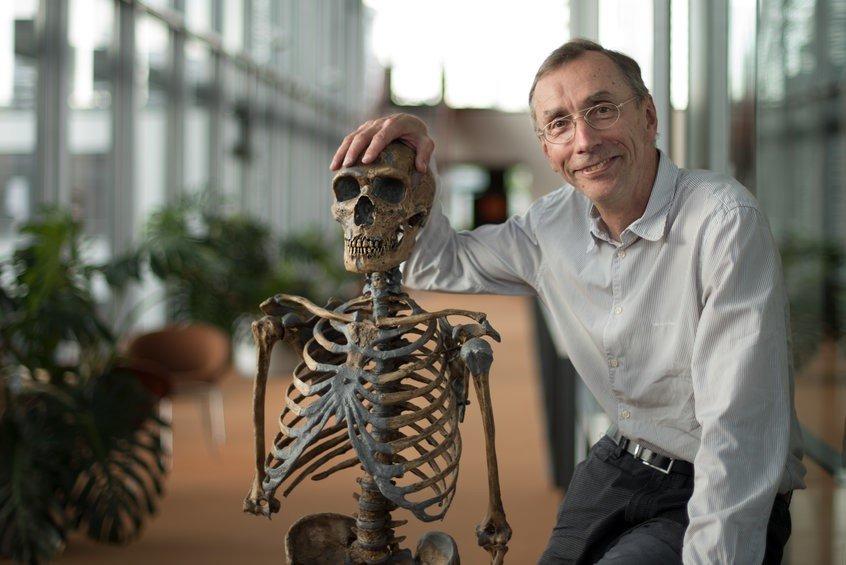
Africa-Press – Botswana. The 2022 Nobel Prize in Physiology or Medicine was awarded to scientist Svante Pääbo, for his discoveries about the genomes of extinct hominins and human evolution, announced this Monday the Nobel Committee at the Karolinska Institute in Stockholm (Sweden).
Svante Pääbo has pored over the mysteries of extinct human species. “Humanity has always been intrigued by its origins. Where did we come from, how are we connected to those who lived before us? What makes us, Homo sapiens (our species), different from other hominins?” .
These questions mentioned in the award announcement and which open a press release about this award are the questions that Svante Pääbo has been trying to answer.
The scientist specialized in Genetics applied to human evolution and is currently in the Genetics Department of the Max Planck Institute for Evolutionary Anthropology, in Germany.
“He’s speechless, he’s amazed. He’s very happy”, he said during the prize announcement conference Thomas Perlmann, secretary of the Nobel Committee for Medicine, about Svante Pääbo’s reaction to the prize, when he called the scientist to share the news.
Minutes later, on the Twitter account of the Nobel Prize winners, the winner appeared visibly happy and accompanied by a mug of coffee. “After the initial shock, one of the first things he said was if he could share the news with his wife Linda.”
From Neanderthals to Denisovans
One of the works that made Svante Pääbo internationally recognized is the sequencing of the genome of Neanderthals, an extinct human species. From an early age, the scholar was interested in the possibility of using genetic methods to study Neanderthal DNA.
But, I also knew that I had to face major technical challenges —especially because, over time, this DNA was chemically modified and degraded into small fragments. Even so, the scientist began to develop methods to study the DNA of Neanderthals.
In the 1990s, at the University of Munich, he decided to analyze Neanderthal mitochondrial DNA. This DNA is the one that is present in the mitochondria and is inherited from the mother, but contains only a small fraction of the genetic information in the cells. However, as it is present in thousands of copies, it increased the possibility of success.
Svante Pääbo actually manages to sequence this region of DNA from a 40,000-year-old bone. “For the first time, we have had access to a sequence of an extinct relative”, notes the Nobel Prize statement. When comparing this information with that of modern humans and chimpanzees, it is clear that Neanderthals are genetically extinct.
From there, your mission becomes to sequence the Neanderthal nuclear genome. He goes to the Max Planck Institute in Germany and that’s where it all ends up happening. It explores new techniques, improves others and attracts more researchers to this work. In 2010, he managed to publish the first sequence of a Neanderthal. Since then, he has been investigating the relationship between Neanderthals and present-day humans (us, therefore).
The Bone Of A Finger
More: much of its recognition also comes from the discovery of another species already extinct: the Denisovans. It all started with the discovery of a fragment of a finger bone found in the Denisova cave in southern Siberia. The bone had well-preserved DNA and Svante Pääbo’s team sequenced it. And that genetic information was unlike anything that was known before.
“Svante Pääbo’s discoveries have generated a new understanding of our evolutionary history”, notes the statement to which Portuguese newspaper Público had access. “Through his pioneering research, Svante Pääbo created a completely new scientific area, paleogenomics”.
This discipline focuses on the study of genomes of ancient organisms. In addition to the initial findings, his group has already studied other genomic sequences from extinct hominins and has provided a deeper understanding of humans in the past and even the influences of our current physiology.
One example of this influence is the Denisovan version of the EPAS1 gene, which confers a survival advantage at high altitudes and is common in the population currently living in Tibet. Another great example is Neanderthal genes that affect the immune response in different types of infections.
At the time of the interview, Público newspaper recalled that, after publishing the article in Cell magazine, in 1997, in which it presented the first fragment of the genome of a Neanderthal, an extinct human species, a lot had changed.
In 2010, a new extinct species of humans was identified, the Denisovans, and in 2013, the complete genome of the Neanderthal woman was published on the Internet, studied by the team of the Swedish biologist who, in 2019, was dedicated to investigating a new species that, also enters the history of ancestral DNA, Homo floresiensis (known as “hobbit”, for its physical characteristics), found in Indonesia.
Other Awardees And Expectations
Last year, the Nobel Prize in Physiology or Medicine was awarded to researchers David Julius and Ardem Patapoutian, for their discoveries of receptors for temperature and touch. That year, the expectation was that the award would be given to a scientist involved in the global battle against SARS-CoV-2, which mobilized everything and everyone. Again, this year, many expected efforts to develop a vaccine in record time that saved millions of lives would be recognized by the Nobel Prize Committee.
Over 120 years, between 1901 and 2020, at least 222 scientists were awarded the Nobel Prize in Physiology or Medicine, 12 of which were awarded to women. In the history of this famous recognition of work in this vast area of research, it is said that the youngest laureate of all time was Frederick G. Banting, who received the Medicine Prize in 1923 for the discovery of insulin when he was only 32 years old.
The oldest recipient of the Nobel Prize in Physiology or Medicine to date is Francis Peyton Rous, who was 87 years old, in 1966. In that category, the first Portuguese neurologist Egas Moniz shared the prize, in 1949, with the Swiss physiologist Walter Rudolf Hess, with whom he developed the prefrontal leucotomy technique.
Nobel Prize In Physics Is Known Today
For this Tuesday, the announcement of the winner or winners of the Nobel Prize in Physics is scheduled and, tomorrow, the Nobel Committee will award the best work in the field of Chemistry, so that, on Thursday, the Nobel Prize for Literature.
The Nobel Peace Prize, considered the most famous of all, can also be announced on Friday, followed by the Nobel Prize in Economics, on Monday.
Nobel Prizes are awarded annually by the Royal Swedish Academy of Sciences, the Nobel Committee and the Karolinska Institute to individuals or organizations who have made outstanding contributions in the fields of Chemistry, Physics, Literature, Medicine and Peace.
The prizes were created in 1895 by Alfred Nobel and, between 1901 and 2021, there are 975 laureates. A small number of individuals and organizations have been distinguished more than once, meaning that 943 individuals and 25 unique organizations have received the Nobel Prize.
From the very beginning in 1901, there were a few years when Nobel Prizes were not awarded. In total, there were 49 prizes in various categories that were not awarded to anyone, most of these decisions were made during the two world wars (1914/1918 and 1939/1945, respectively.
The Nobel Foundation’s statutes read: “If none of the works under consideration is of the importance indicated in the first paragraph, the prize money will be reserved until the following year. If, even then, the prize cannot be awarded, the amount will be added to foundation funds.”
Award-Winning Scientist’s Son
The history we have today about the past of the human species was written by many scientists (from archaeologists to paleontologists, including biologists and geneticists) and has a little bit of everything, incests, wars, romance, crossings, extinctions and various scenarios spread across sites. and caves that kept precious bones and fossils.
Fortunately for everyone, there remains one certainty: history is still incomplete. “I believe we will discover other extinct species of humans,” Svante Pääbo told Público, in the interview published in 2019.
Svante Pääbo was born in 1955 in Sweden and defended his doctoral thesis in 1986 at the University of Uppsala. He also attended the University of California, Berkeley, in the United States.
Since he was a child, he had a certain fascination with Archeology, which was transmitted by his mother, who took him to Egypt when he was 13, reports on the Gruber Foundation website, which awarded him its genetics prize in 2013.
“I had a romantic idea of what archeology was”, notes the scientist himself on this website.
He then studied Medicine, influenced by his father, the biochemist Sune Bergström, who also received the Nobel Prize for Medicine in 1982. “At that time, if you were in Sweden and interested in basic biology research, you would go to medical school “, he recalled. Always with archeology in his mind, he still studied adenovirus and its interaction with the immune system.
Curious about the DNA that could be obtained from ancient tissues, he began by taking and isolating samples from Egyptian mummies. He eventually managed to publish this work in scientific journals. It was just the beginning of something even more remote, the genomes of Neanderthals or Denisovans.
“His work revolutionized our understanding of the evolutionary history of the modern human,” said Martin Stratmann, president of the Max Planck Society, in a statement from the institution on the award of the Nobel.
“Svante Pääbo has shown, for example, that Neanderthals and other hominins made a significant contribution to the ancestry of modern humans.”
Nobel Prize Patron
Alfred Bernhard Nobel, who was born in Stockholm on 21 October 1833 and died in San Remo on 10 December 1896, was a Swedish chemist, engineer, inventor, entrepreneur and philanthropist.
The man was best known for leaving his fortune to establish the Nobel Prize, although he also made several important contributions to science, holding 355 patents in his lifetime.
Nobel’s most famous invention was dynamite, a safer and easier way to harness the explosive power of nitroglycerin; was patented in 1867 and was soon used around the world for mining and infrastructure development.
Nobel showed an early aptitude for science and learning, particularly in chemistry and languages, becoming fluent in six languages, and filing his first patent at age 24.
Nobel embarked on many business ventures with the family, notably owning Bofors, an iron and steel producer which he developed into a major manufacturer of cannons and other armaments.
After reading an erroneous obituary condemning him as a profiteer of war, Nobel was inspired to leave his fortune to the Nobel Prize institution, which would annually recognize those who “have bestowed the greatest benefit on mankind”.
Nobel was elected a member of the Royal Swedish Academy of Sciences, which, according to his will, would be responsible for choosing laureates such as the Nobel Prize in Physics and Chemistry.
For More News And Analysis About Botswana Follow Africa-Press