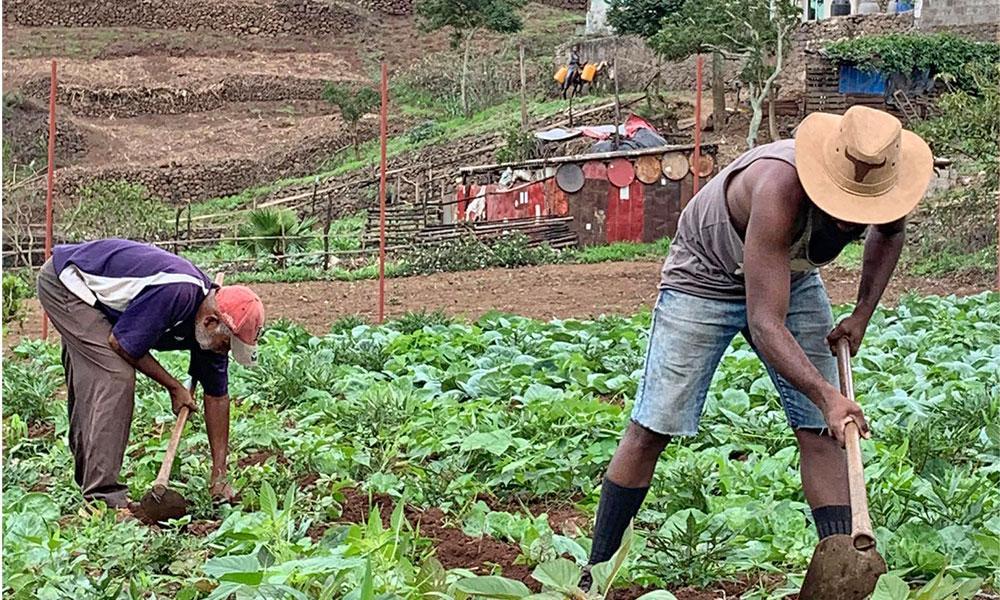
Africa-Press – Cape verde. If, on the one hand, the rains renew the hopes of the peasants, on the other, they continue to struggle with a problem that has worsened in recent years, in various parts of the country: the shortage of labor. Those that remain are more expensive and, in some cases, do not correspond to the level of quality. The causes: exodus of young people and lack of interest in a sector that remains very rudimentary.
Finding available labor to work on crops has been a real headache for farmers on the country’s various islands. If, on the one hand, the exodus of young people, especially in rural areas, is making workers scarce, on the other, a day’s work costs more and more.
In Santo Antão, says farmer and businessman Arlindo Lopes, in general, the availability of hands for farming is already a serious problem. “Many people think that with the arrival of the rains things will improve. But, in fact, everything is more expensive, product prices continue to increase, and things could get even worse”, predicts this peasant, from Planalto Leste.
In this “azágua” season, says farmer Alessio Sequeira, from the town of Stancha, Ribeira Brava, São Nicolau, faced with this difficulty, farmers are doing what they can. On this island, he says, in addition to the departure of young people, for various reasons, many are not interested in the sector and, with the precarious development of the island, the best solution seems to be looking for new opportunities elsewhere, whether in the country or abroad. .
Prices to taste
Arlindo Lopes, who has a company in the agriculture and livestock sector, has managed to maintain his working day at 800 escudos, as is common practice, through employment contracts, with social security and risk insurance. However, he recognizes, for farmers who do not have this possibility, the scenario is different and the work becomes “priceless”.
“With me, these young people work practically all year round, but for those who do sporadic work, it is more difficult to find people to work, because, when this is the case, they hire at a high price, between a thousand and 1,200 escudos/day”, he explains.
On the other side are people who, he says, do not live solely from agriculture, sometimes they have other work, so if they have a farming job, with the desire to complete it quickly and to attract labor, they offer more money.
“But a person whose agriculture is their only activity and who needs that labor practically all year round cannot pay that price”, he says.
This price variation is already a reality on other islands, such as Santiago and São Nicolau. Here, on the island of Chiquinho, says Alessio Sequeira, the price remained in the drop-by-drop area, but this is not the case in dryland work, where the values became higher, reaching around 1200 escudos.
Emileno Ortet, farmer and businessman in the sector in the town of Rui Vaz, Santiago island, says that the variation implies a lot in the life of the farmer who invests in the area.
“If before a day cost 800 escudos, now they receive a thousand, another 1500 and those who already ask for two thousand escudos, in seven/eight hours of work. It becomes increasingly difficult”, he says, believing that the time will come when Cape Verde may have more complications in terms of agricultural production, knowing that, especially in the last two years, there has been a lot of personnel draining from rural areas.
Quality has been falling
Although manual effort is more popular, says Arlindo Lopes, the work is losing quality. “There is no longer the effort that existed years ago. Consequently, the yield is also getting lower.”
Due to the lack of labor, farmers often turn to people who are not accustomed to this type of service, which also ends up compromising quality.
“These are people who have to learn first. In the country we do not have professional training in agriculture. If a person wants to understand agronomy they have to take a four or five year course, while in other areas there is short-term professional training. This makes it difficult to qualify the workforce”, points out Emileno Ortet.
Lack of machinery on the island
In Santo Antão, Arlindo Lopes defends the introduction of machinery in agriculture, as a way of helping farmers combat this problem, which appears to have no other resolution in sight.
“If governments want to maintain food security, it is necessary to invest in machines to help farmers, even if it is for rent. Labor alone is not enough. There is not a tractor for rent on the entire island of Santo Antão”, says the businessman.
“Our agriculture is already unsustainable, if we don’t have labor, it’s even worse. It’s hard work, which requires a lot of strength and effort, and there are few incentives”, adds, on the other hand, Emileno Ortet.
For More News And Analysis About Cape verde Follow Africa-Press