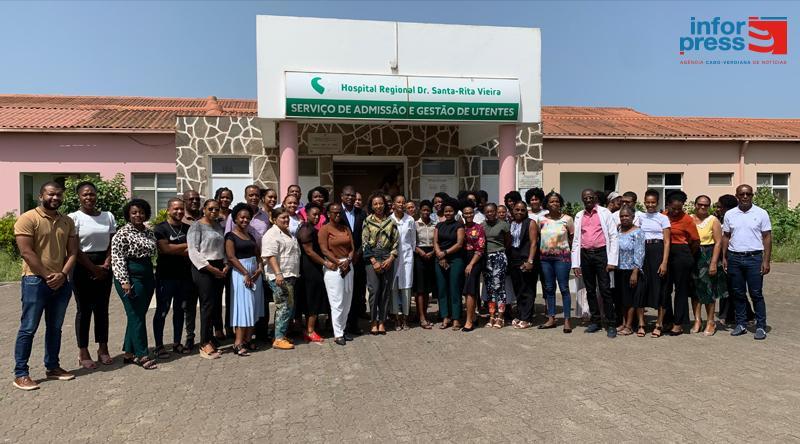
Africa-Press – Cape verde. The National Health Directorate (DNS) today promoted training on malaria case management, aimed at doctors and nurses in the Santiago Norte Health Region (RSSN), and the islands of Fogo, Brava and Maio.
Doctors and nurses receive training on malaria case management
The training action, which took place in the meeting room of the RSSN Technical Office, in Achada Falcão (Santa Catarina) was attended by 35 nurses and doctors from RSSN’s seven health centers and regional hospital, in person, and another 15 from other islands in virtual format, is carried out by DNS, through the National Program for the Fight against Malaria.
Speaking to the press, on the sidelines of the opening of the aforementioned training action, which was presided over by the National Director of Health, Ângela Gomes, the coordinator of the Integrated Program for the Fight against Vector-Transmitted Diseases, António Moreira, recalled that the aforementioned training comes in following another already carried out within the scope of the certification process of Cape Verde as a malaria-free country.
According to him, taking into account that Cape Verde has had no cases of local malaria for five years and seven months, the tendency is to forget about the disease and “know-how” in relation to the diagnosis and follow-up of this disease.
Hence, according to this person, the reason for this training, which aims to retrain and equip health professionals, at a national level, takes into account the dynamics of knowledge, which vary from year to year, and the country must be dynamic and updated accordingly. with WHO recommendations.
At the moment, as reported, there is a lack of nurses and doctors from the Santo Antão and São Nicolau Health Region, whose training begins next week.
On the occasion, António Moreia noted that certification is a benefit for the country, which will have one less disease [malaria], but argued that the biggest challenge is to prevent reintroduction, especially since the country has almost eliminated the disease twice.
According to António Moreia, Cape Verde, which is close to endemic countries, must maintain surveillance and low mosquito density so that there is no transmission from a person who comes with the disease from those countries to those who live here.
In addition to surveillance, which he considered a “fundamental axis”, the focus after certification must involve communication, both within the country and in the Diaspora, taking into account that there are Cape Verdeans in endemic countries and others who travel to them.
Hence, according to the same source, the training will focus on the issues of surveillance, early diagnosis, treatment in accordance with national guidelines that are in line with the WHO, follow-up after discharge and monitoring so that there is no deaths and so that there is no local transmission of these malaria cases.
For More News And Analysis About Cape verde Follow Africa-Press