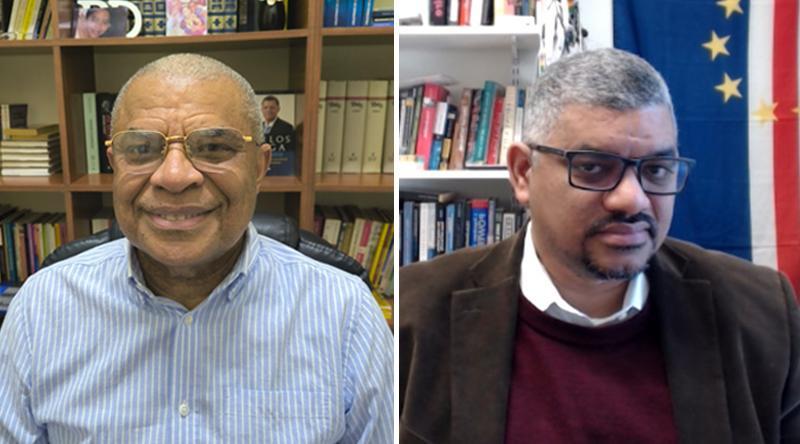
Africa-Press – Cape verde. Political analysts and scholars of Amílcar Cabral Daniel Santos and Abel Djassi Amado consider that the legacy of Amílcar Cabral, who died 51 years ago, is not well disseminated in Cape Verdean society.
In conversation with Inforpress, regarding the 20th of January, the date on which another anniversary of the death of the considered National Hero is marked, these two university professors, with articles and a book published on the thoughts of Amílcar Cabral, present, however, arguments different ways to support their positions.
Daniel Santos states that this legacy of Amílcar Cabral has been “imposed on Cape Verdeans from a perspective, purely and simply, ideological, sacred, doctrinal and dogmatic”, which, in his perspective, is not the most correct way.
“Underlying this orientation is the idea of making every Cape Verdean a Cabral, a task that has proven to be unfeasible. He was a politician, with virtues and defects, whose legacy must be seen in the context in which he produced and left it. Presenting him from a panegyric perspective is not the right attitude”, said Daniel dos Santos, for whom, “despite being a great national figure, Cabral was never the father of Cape Verdean nationality or a state figure”.
The author of the book “Amílcar Cabral: another look” highlights the fact that Cabral, as a politician, is not consensual in Cape Verde, nor in Guinea – Bissau and in PAIGC itself, the party he founded.
For his part, the associate professor of Political Science at Simmons University in Boston, Abel Djassi Amado, also admits that Cabral is not consensual, and even talks about three narratives about Cabral in Cape Verde, namely that of fraud, that of icon and theoretical.
However, he regrets that a figure like Cabral, who is “highly respected and studied in major schools and universities around the world”, does not find a place in school curricula in Cape Verde.
“Cabral as a theorist is not seriously studied in Cape Verde. In primary schools or even secondary schools, Cabral can even be mentioned, but there is no concern to analyze, to make students analyze and study some of Cabral’s writings. If we go to any modern State, there is a concern on the part of the modern State to grow indigenous political ideas, national political ideas”, he maintained,
Abel Djassi argues that studying Cabral does not mean that the person will become a Cabralist.
The two university professors agree that Cabral’s contribution to Independence is undeniable, but they differ in relation to the framing of his ideas and thoughts within the values of democracy rooted today in Cape Verde.
Daniel Santos is categorical in stating that in political, ideological and economic terms, for example, Cabral’s ideas do not currently apply to Cape Verde, adding that today’s archipelago is not the one envisioned by Cabral, under the aegis of a single party .
“Today we have a democratic political regime, which is in the antipodes of that idealized by Cabral, who was, just read his books, the main spiritual animator of mono-partyism in Cape Verde. Cabral was the ideologue, the father, the mentor of the single party. He himself assumed it, many times. On an economic level, Cape Verde is a social market economy, while Cabral was a supporter of the planned economy”, he explained.
Abel Djassi Amado counters this, citing as an example the first document written by Cabral in 1960 and issued by PAIGC and which included, as stated, multi-party elections.
“Cabral admitted that the center of politics would be Parliament. Look, this is the key principle of liberal democracy. And he, from the very beginning, clearly said that the post-independence political process would have to be based on Parliament, what was called a popular national assembly”, he exemplified.
Abel Djassi states that it is necessary to take into account that Cabral was never a “dogmatist” and even at an economic level he adds that there are traces of Marxism in his thinking, but that there are also traces of Western liberalism.
“Therefore, if we could, in one way or another, bring Cabral to today, the most natural thing is that first, what he would do would be to try to understand the concrete reality of Cape Verde today. Now, saying that Cabral is not in line with what is happening in Cape Verde, I think is a very superficial understanding, both of his political ideas and of his own history”, he added.
Regarding the lead of the resolution for the official celebration of the Centenary of the Birth of Amílcar Cabral, Daniel Santos considers that the position of the majority party, the MpD, which ended up rejecting the proposal presented by the PAICV (opposition), is understandable. since the MpD has a doctrine contrary to Cabral’s.
Abel Djassi Amado, for his part, regretted what happened and warned that it is necessary to understand that Amílcar Cabral is a heritage of Cape Verde, the African continent and humanity, which goes far beyond the PAICV.
Amílcar Cabral was born on September 12, 1924, in Bafatá, Guinea-Bissau, son of Juvenal Cabral and Iva Pinhel Évora. Cabral was a poet, agronomist, and considered the “father” of the joint independence of Cape Verde on July 5, 1975 and Guinea-Bissau officially on September 10, 1974.
On January 20, 1973, the founder of the African Party for the Independence of Guinea and Cape Verde (PAIGC) was murdered in Guinea-Conakry, eight months after the unilateral declaration of Guinea-Bissau’s independence.
For More News And Analysis About Cape verde Follow Africa-Press