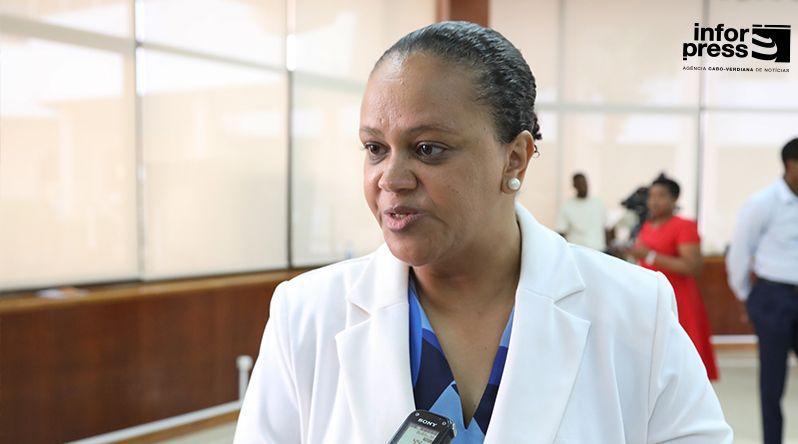
Africa-Press – Cape verde. The president of the Cape Verdean Institute for Equality and Gender Equity (ICIEG), Marisa Carvalho, said on Tuesday that people still tend to interpret gender as projects that specifically benefit women, not men and women.
The president of the ICIEG made this observation in statements to Inforpress on the sidelines of a technical workshop held for the validation and integration of gender indicators into the National Statistical System (SEN), when questioned about the challenges of the State Budget based on gender.
“We have been gradually training technicians every year so that they can correctly mark existing projects, remembering that it is a governmental commitment that must materialize in projects, but also in the budget,” she said.
The president of the Cape Verdean Institute for Equality and Gender Equity (ICIEG), who admits the existence of gender markers, acknowledges that they are not implemented in the way the institution desires, arguing that they still fall “far short of expectations.” And to further emphasize this point, he said that ICIEG has been working and insisting, every year, on the need for training and budgeting.
In this process, he highlighted the support of international partners who have helped the institution supplement funding, particularly in the needs of fulfilling the national gender equality plan.
“Spanish cooperation has been an undeniable partner in ensuring the continuity of projects. We are marking here the beginning of a new project that follows on from another and is for a period of 36 months,” he specified, noting that gender challenges change and that social dynamics also change.
Faced with the problem, he emphasized that ICIEG is always “attentive and aware” in order to make the necessary adaptations to public policies, aiming for concrete solutions to the problems.
“And for this, it is fundamental that our statistics reflect the distinct experiences of men and women, boys and girls, in every sphere of social, economic, and political life. In this sense, in collaboration with the National Institute of Statistics, we have been reinforcing the integration of a gender perspective in the production and analysis of national statistical data,” he emphasized.
Along these lines, he reinforced the need for an update of the indicator matrix so that the exercise proves, above all, useful, since “what is not measured cannot be transformed.”
He also admits that if there is no collection and analysis of data that reveal gender inequalities, there is a risk of perpetuating silent injustices, invisible on the surface, but deeply rooted in people’s daily lives.
He explained, on the other hand, that integrating updated gender indicators into the national statistical system is more than a technical necessity, but an act of vision, courage, and commitment.
The overall objective of today’s meeting is to promote the analysis, validation, and technical consolidation of a set of gender indicators, ensuring their consistency with international standards and the country’s strategic frameworks.
For More News And Analysis About Cape verde Follow Africa-Press