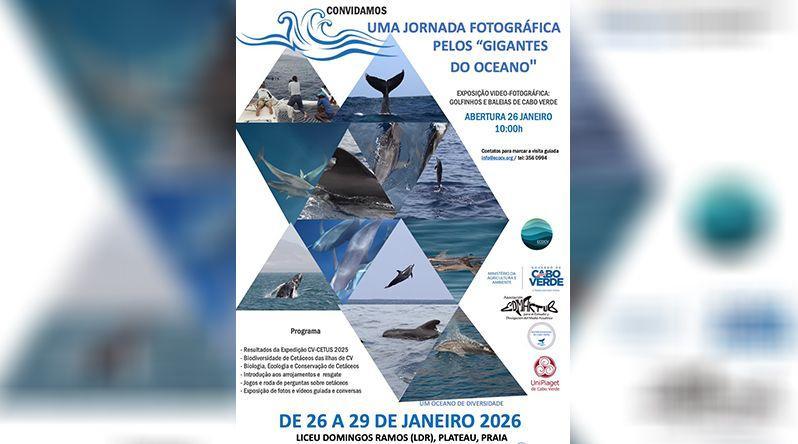
Africa-Press – Cape verde. Domingos Ramos High School hosted an exhibition on Monday dedicated to whales and dolphins in Cape Verde, aiming to raise public awareness and knowledge about these marine mammals.
According to Edita Magalevichute, a marine biologist from the ECO-CV Association, speaking to Inforpress, this exhibition, in addition to raising awareness, also presents some of the results of the scientific monitoring expedition carried out in the summer of 2025, in partnership with the National Directorate of the Environment.
The data collected, she continued, demonstrate that the concentration and distribution of cetaceans in Cape Verdean waters are still not well known.
With the exception of the humpback whale, about which there is a greater volume of information, the most important habitats of the other species are still being identified.
According to the same source, during the scientific expedition, however, two areas considered to be of great importance for cetaceans were identified, one located south of São Nicolau Island and the other south of Fogo Island.
Edita Magalevichute considered the monitoring of whales and dolphins fundamental because it is directly related to the protection, conservation, and management of human activities that affect these species.
“Without concrete data on their location, abundance, and threats, it becomes impossible to implement effective management and conservation measures,” said the official.
The biologist highlighted that in the last three to four centuries, human activities at sea have increased significantly, and in Cape Verde, this growth has had an impact on areas such as fishing, poorly regulated tourism, maritime traffic, and marine and coastal pollution.
“The mere presence of humans can cause disturbances in cetaceans, especially when vessels approach rapidly, interfering with essential behaviors such as reproduction, feeding, and resting,” the biologist assured.
Edita Magalevichute said that ECO-CV is part of the National Committee for Cetacean Conservation and actively participates in the development of codes of conduct for scientific and recreational observation, and that the data obtained during monitoring are delivered to the National Directorate of the Environment.
“This will allow the authorities to define appropriate management measures,” he said.
Among the main challenges identified is the poor monitoring of activities at sea, associated not only with a shortage of human resources, but also with a lack of awareness about the needs of these animals, which are mammals and can live between 50 and 60 years.
Some species are resident and occupy very specific areas, which makes them particularly vulnerable to impacts such as fishing, bycatch, and other threats, which can result in strandings.
One such case recently occurred on Sal Island, with the stranding of a sperm whale on one of the beaches, reinforcing the need for public awareness.
The biologist explained that this exhibition has “a strong educational component,” and is currently being presented in a school context, with the aim of raising students’ awareness of the importance of whales and dolphins in the marine ecosystem.
According to the promoters, student participation has been very positive, marked by high curiosity and interest, considered essential for the learning process.
For More News And Analysis About Cape verde Follow Africa-Press