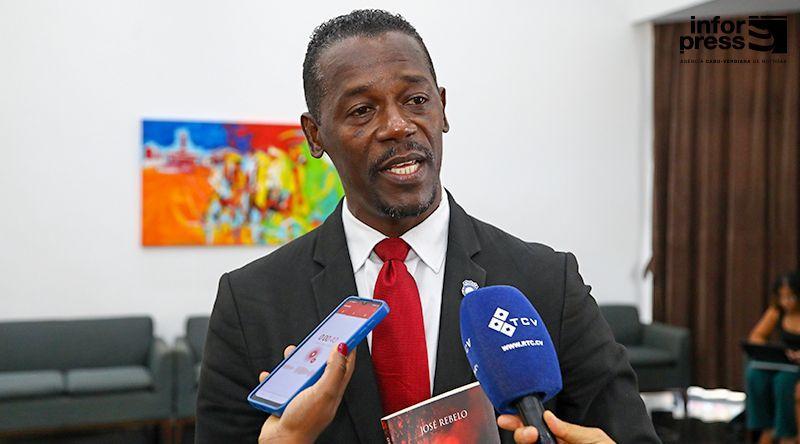
Africa-Press – Cape verde. Public Security researcher and university professor José Rebelo believes that crime in Cape Verde, analyzed using data from the National Police, does not reflect the overall reality of the phenomenon, ignoring flaws in measurement.
This expert explained that crime in Cape Verde, analyzed using data from the National Police, reveals a political interpretation that ignores flaws in measurement, institutional coordination, and trust in security and justice entities.
In an interview with Inforpress, José Rebelo argued that any serious analysis of crime in Cape Verde must start from at least three distinct dimensions: the crime actually classified, the existing measurement mechanisms, and the so-called “dark figures” (crimes that are never reported).
According to the researcher, political discourse has repeatedly confused police occurrences with real crime, using the reduction in police reports registered by the National Police as a synonym for a decrease in crime, when, in practice, this interpretation does not withstand cross-analysis with data from the Public Prosecutor’s Office.
“In 2019, the National Police contributed to only about 48 percent (%) of the crimes classified by the Public Prosecutor’s Office. In 2023 and 2024, this difference reached even more significant values, on the order of 11,000 crimes,” he explained, emphasizing that the Public Prosecutor’s Office is the only entity with legal competence to classify reported facts as crimes.
According to José Rebelo, in the last seven years, Cape Verde has registered, on average, about 27,700 crimes per year, classified by the Public Prosecutor’s Office, a much higher number than the number of police reports publicly disclosed.
For the researcher, this discrepancy reveals not only methodological weaknesses but also an attempt at “statistical normalization” of crime.
Despite a slight downward trend announced for 2024 and 2025, with approximately 26,000 to 27,000 criminal cases, the expert recalled that the country reached a historical peak in 2024, with 32,222 crimes, “contradicting the narrative of the Minister of Internal Administration, Paulo Rocha, who had affirmed a sustained reduction in crime.”
He pointed to homicide data, frequently used as an international benchmark to assess a country’s level of violence, as one of the most worrying indicators.
José Rebelo emphasized that, although the National Police recorded an average of six to seven homicides per year in its reports, the consolidated data from the Public Prosecutor’s Office reveal a different reality.
At certain times, Cape Verde recorded rates exceeding 15 homicides per 100,000 inhabitants, notably in 2022, when approximately 144 homicides were recorded, equivalent to 28 homicides per 100,000 inhabitants.
“It is contradictory to claim that there was a reduction in crime in a year in which homicides increased from 54 to 76 cases,” he stressed, warning of the risk of minimizing an indicator that, by itself, places the country at a level of high concern.
The perception of corruption is another critical and worrying factor that, although not always supported by material evidence, continues to have a significant impact.
About 26% of those interviewed believe that the National Police is corrupt, a feeling that, according to the researcher, often results from negative experiences of contact with institutions.
In this regard, he stated that the difference between the Afrobarometer and the IBGE suggests that, although the perception of corruption in the police is real and persistent, the levels vary according to the methodology and sampling of each survey.
Regarding the Public Prosecutor’s Office, he acknowledges the reduction in pending cases, from approximately 105,000 to 65,000 since 2018, but warned that this decrease is mainly due to dismissals, with about 80% of complaints closed without charges, primarily due to a lack of suspect identification or insufficient evidence.
He further added that the institutional culture of the security forces remains closed and vertical, hindering community policing, and that, despite the qualification of the National Police force, this human capital is not being fully utilized.
According to the researcher, Cape Verde currently faces a structural problem in the interpretation, management, and governance of crime, where data is used more as a political instrument than as a technical basis for decision-making.
He argues that without an integrated criminal information system, without real coordination between the National Police, the Public Prosecutor’s Office, the courts, and social institutions, and without public policies based on scientific evidence, the country will continue to operate under a statistical illusion of control.
José Rebelo argued that public safety can no longer be treated as mere rhetoric, but as a state policy, anchored in prevention, intelligence, and crime.
“As long as crime is understood only through convenient numbers and not through the phenomena that exist, Cape Verde will continue to manage perceptions and not realities,” he concluded.
For More News And Analysis About Cape verde Follow Africa-Press