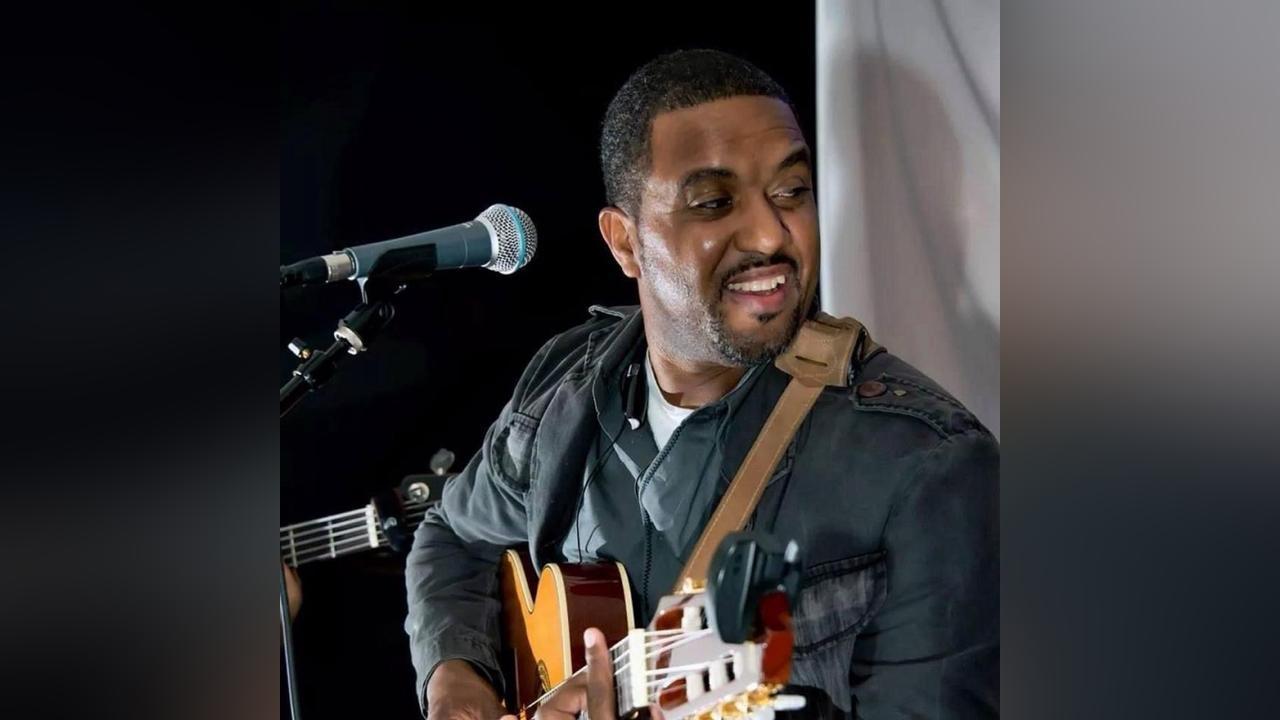
Africa-Press – Cape verde. More than a musician, Zé Rui de Pina is a cultural and social agent. With new songs on the way, the artist talks about his career, the impact of the “Abrasu Muzikal” project, and his commitment to promoting Cape Verdean music. Beyond music, Zé Rui de Pina develops social projects, notably supporting students in accessing higher education. The musician owns the Djeu View Residencial space in Praia, where he combines tourism, gastronomy, and music. In an interview with Expresso das Ilhas, Zé Rui de Pina speaks about his love for music and his social projects.
A native of Praia, Zé Rui de Pina began his musical journey at the age of 8. He is related to musicians such as Nhô Djonzinho Alves, his uncle, and Kim Alves, Kaku Alves, and Tó Alves, his cousins.
“I started in music when I was 8 years old. We are a family of musicians. At 15, I went to the United States and participated in several projects there, including playing with Norberto Tavares,” he says.
Zé Rui de Pina affirms that his musical career owes much to the social work he does, because he associates social work with artistic work.
Abrasu Muzikal
During the pandemic, Zé Rui created the social project “Abrasu Muzikal” to help fellow artists who were going through difficult times.
“The ‘Abrasu Muzikal’ project exceeded my expectations. I planned it to be small, but things exploded. Thank God, I did my part, and ‘Abrasu Muzikal’ is now my brand,” he assures.
According to Zé Rui de Pina, many people still remember the impact of the project, which he speaks of with enthusiasm, but also with some bitterness.
The musician confesses that he was saddened to feel that, despite all the effort made, little has changed within the artistic community. “We were the first to stop and the last to resume. I thought that, with all this, artists would value themselves more, but unfortunately we continue playing with our souls.”
Even so, the “Abrasu Muzikal” project continues, with the goal of supporting artists in music production. “We will look for talented artists who don’t have the means to record and we will produce their work.”
Zé Rui explains that the idea is to do things differently, despite the bitterness towards the artistic community. “A short time ago we created the Santiago Artists Association, we got to the voting stage, we elected a president and he disappeared without giving any explanation.”
According to the musician, the group managed to reach the most difficult part of the process, which was the voting.
“I usually say that, because of my culture, I do my part as far as I can. When I can’t anymore, I say: ‘Now, I’ve done my part’,” he says.
In addition to the studio, Zé Rui explains that he has been inviting artists to perform at his live music venue, aiming to gain visibility.
“From there, they become known. I’ve received a lot of positive feedback. Some artists ended up signing with big companies after performing there. I’m just doing my part,” he emphasizes.
Music
Zé Rui affirms that music is his life. “It’s easier to ask what I would be without music. Music has been in me since I was a child. What I am today is thanks to music.”
The musician reveals that he has two songs ready for release this year. “I have a morna, a cavaquinho solo, like when I was 10 years old, the first instrument I played. Many people like to see me play the cavaquinho, and I’ve never done a project solely with that instrument. I decided that the next project would be a cavaquinho solo, instead of a song with vocals.”
Furthermore, he has two songs already finished and is deciding which one to release first. One of the tracks may be released in June. Regarding her career, she describes the current moment as very positive. “Three months ago I went to the United States, at the invitation of a museum of Cape Verdeans born there, where I gave a workshop on the cavaquinho and Cape Verdean music.”
Despite not having performed on large stages recently, she assures that she remains active. “I’ve been playing mainly at my house, at Djeu View Residencial, but that doesn’t mean I don’t like big stages.”
Morna
“Well, today morna is heritage and is in the place where it should always have been. For me, morna has always been heritage,” she says.
According to the musician, morna touches people’s souls. “Just yesterday, January 20th, I had a group of Portuguese people at my place who came just to listen to morna.”
Zé Rui highlights that every Wednesday he promotes “Morna Night” at his venue, as a way to contribute to the appreciation of this musical genre.
“I am very happy because I know I am doing my part. Morna deserves recognition. It’s not enough to have the title of World Heritage; it needs to be elevated and showcased more.”
He also argues that morna should be taught in schools so that students learn to write and understand it better. “As an artist, I continue to do my part.”
The musician recalls that he recently received about 24 senators from the United States of America, who were welcomed with…
Batuque. “I explained everything to them about batuque, especially since some are descendants of Cape Verdeans. This is also part of tourism.”
According to Zé Rui, Cape Verde needs to invest more in cultural tourism. “Many times, tourists arrive and don’t find anywhere to listen to music, even though they think there’s music everywhere here.”
He recounts that, on one occasion, he received a group from Israel and made a point of playing in several places to showcase the country’s musical diversity. “Our greatest wealth is our culture,” he emphasizes.
Controversy over the duet with Bana
Regarding the controversial unreleased duet with Bana on the song “Amor Sofredor,” Zé Rui affirms that he has a clear conscience.
“I am confident in what I did. I am not the kind of person to make mistakes like that, especially when it comes to an artist of Bana’s caliber,” he assures.
He explains that the duet was a request made directly to Bana. “He himself said that I took too long to make that request.”
Zé Rui clarifies that he only released the song now because he considered it the right time. “When the reaction from a lawyer claiming to represent the family arose, I also consulted my lawyers, because Bana went with me to the studio to record the song.”
He adds that if it were a previously recorded song, there could be problems, but it is an unreleased work, whose lyrics Bana learned to record.
He states that he does not regret the release and assures that he performed with the artist’s consent. So far, he says he has only received one message informing him of the intention to take the case to court and to remove the song from YouTube.
“I haven’t removed the song and I’m waiting for notification from the court,” he states.
Zé Rui laments the situation, but emphasizes that the controversy has also brought Bana’s name back into the collective memory. “Bana sang Cape Verde from A to Z and deserves much more recognition.”
Social Projects
In addition to music, Zé Rui develops several social projects. Through his association in the United States, he funds the university education of students from their first year until graduation.
Every year, the musician selects a student to support in their higher education. “We visit schools, we choose students who are underprivileged but have good academic performance.”
Zé Rui de Pina is also an ambassador for SOS Children’s Villages in Cape Verde, an association dedicated to the protection and care of children.
For More News And Analysis About Cape verde Follow Africa-Press