Africa-Press – Cape verde. The Non-Governmental Organization (NGO) Biosfera is seeking monitors and volunteers to protect sea turtles on the islands of Santa Luzia and São Vicente, Cape Verde—an archipelago that hosts one of the world’s largest populations of the species.
For now, recruitment for monitors is underway until May 10; applications for volunteers will open thereafter, coordinator Catelene Monteiro explained to the Lusa news agency.
“We are looking for adults who are passionate about nature” and possess the capacity “to work in an isolated environment, such as the island of Santa Luzia”—the only uninhabited island in Cape Verde—in addition to the portion of the project conducted on the beaches of São Vicente, home to the country’s second-largest city, Mindelo.
For monitors, prior experience is requested to assist during the nesting season, which runs from June to October; selected candidates will receive updated theoretical and practical training.
Following this training, the monitors will be qualified to impart their knowledge to the volunteers.
The application link can be found on the NGO’s social media channels.
The work involves beach patrols, identifying nests and tracks, relocating at-risk nests, rescuing adult turtles and hatchlings disoriented on the sand, as well as assisting with scientific studies.
“The nights are typically long and cold; we need to be in good physical condition,” the coordinator noted.
Applications for monitors are currently open “to individuals both within and outside the country, though we give significant priority to people already here in Cape Verde, who are already familiar with the local biodiversity and terrain,” she added.
Before the end of May, the application portal for volunteers—”both national and international”—will be launched; these volunteers will be supervised in the field by the monitors, who will have already completed their training.
“On Santa Luzia, there will be up to seven monitors in the field, and eight on São Vicente,” concluded Catelene Monteiro. “We conduct patrols both during the day and at night. At dawn, we walk along the beach, observe the tracks, identify and georeference every nest, and sometimes we encounter turtles that have come ashore to lay eggs but became disoriented and got lost,” she describes.
In such cases, it is necessary to “follow the entire trail—both up and down the sand—and by the time we find the turtle, we must already be equipped with buckets of water to attempt to hydrate her and guide her back toward the sea.”
The task can be challenging because, “sometimes, when you are a long way off, you have to carry the turtle, and she can be quite heavy.”
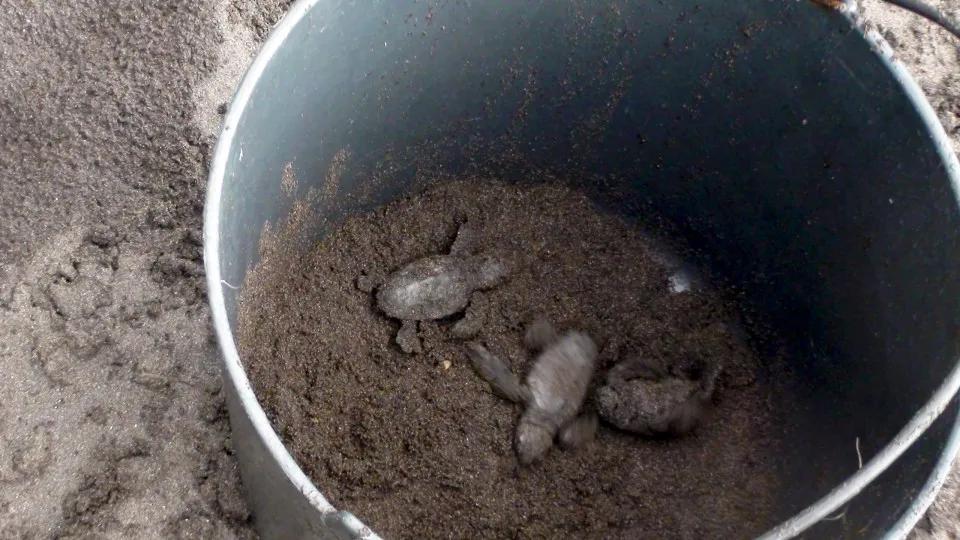
There is also “the hatching of the baby turtles, and we often find several of them lost as well.”
“Sometimes, due to artificial lighting on the beaches, they end up becoming disoriented” and heading toward the light during the night.
Five species of turtles inhabit the waters of Cabo Verde, and Biosfera monitors the loggerhead turtle—an endangered species—as the archipelago hosts the third-largest population of this species globally.
“The turtle is a species that has existed on our planet for a very long time. Studies suggest they have been here since the age of the dinosaurs,” yet humanity has created challenges for the species’ survival: “we face poaching, egg harvesting, and fishing nets,” in addition to unregulated tourism and marine pollution.
“All these factors render the turtle highly vulnerable and contribute to a decline in its population. Through conservation efforts, we can raise public awareness regarding this critical issue,” notes Catelene Monteiro.
The peak number of nests was reached in 2021: on Santa Luzia, Biosfera recorded a record high of over 12,000 nests, while on São Vicente, there were approximately 4,000. These represent only a portion of the total nesting in Cape Verde: the eastern islands (Boa Vista, Sal, and Maio) host more than 50% of the total nests recorded in the archipelago.
For More News And Analysis About Cape verde Follow Africa-Press