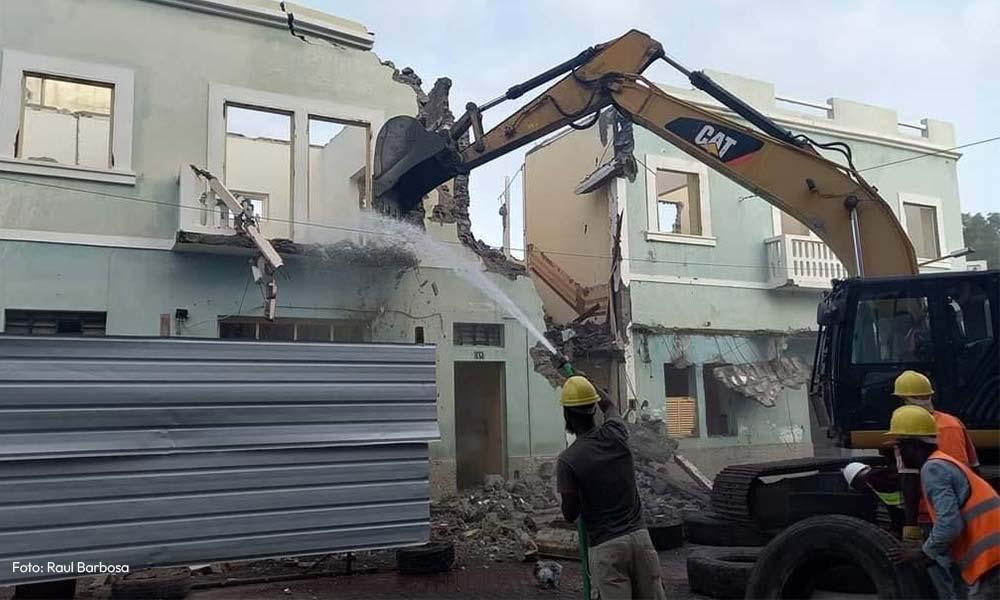
Africa-Press – Cape verde. The controversy surrounding the demolition of the Luso-Africana Building, located in the Historic Center of the Plateau, is far from over. After its total demolition, the guardianship has already taken the case to the courts, for “serious violation of the law”, while the owner of the work, the Kim Negoce Group, says he has legality on his side. Between the two litigants is the Municipality of Praia, which seems to agree with the owner of the work.
The first demolition works on the building took place last July and were then interrupted by the Cultural Heritage Institute (IPC), which requested the embargo, as it is classified as Historical Heritage, like most of the buildings on the Plateau.
Even so, after the rains in early September, the Kim Negoce Group, owner of the building they intend to build on the site, ordered the total demolition of what was once the Luso-African house, claiming the risk of the entire structure collapsing.
Unauthorized, the Ministry of Culture and Creative Industries (MCIC, under the IPC), says that the resumption of the demolition of the building constitutes a “serious violation of the law” and decided to take the case to court.
“Platô is one of the areas classified as heritage in total, it is on UNESCO’s indicative list”, recalled the minister, Abraão Vicente, in statements to the press, on Monday, on the sidelines of the Council of Ministers, in Ribeira Grande de Santiago.
That ruler, as he warned, will act “to the last consequences”, guaranteeing that he has legal instruments to do so.
“What happened was a premeditated break-in on the part of the building’s owner to speed up the process, at a time when the IPC was sitting with the developer to negotiate the architectural aspects of the building”, he underlined.
Kim Negoce denies rating
On the other hand, the Kim Negoce Group does not recognize the building in question as a Cultural or Historical Heritage, having said, in a statement released last Saturday, that legality is on its side in the process.
“Legally, the building in question is not classified, as mentioned in the IPC opinion issued for that purpose. The Cultural Heritage Legal Regime (Law No. 85/IX/2020) determines in Article 17(4) that cultural assets are classified by means of an Ordinance of the Minister of tutelage”, he maintained, indicating, however, that this Ordinance “does not exists”.
“This Ordinance does not exist, so the building is not classified and unfortunately they are acting as if it were, contrary to and disrespecting the law itself”, accused the private group.
The investor evokes a classification procedure, according to which, he says, there is a prior process to be followed, but which, however, has not even been started.
Deficient knowledge of the law
Like the investor, the mayor of Praia also appeared to raise doubts about the classification of the building as Cultural Heritage, by urging institutions to consult if it is on the list of UNESCO Heritage Sites. For Francisco Carvalho, the appeal to the court does not necessarily mean that the appellant is right.
For Abraão Vicente, based on the opinions issued by the municipality and this position of that mayor, there is a deficient knowledge of the framework law on Cultural Heritage.
“I think institutions need to be better advised. If he knew well the framework law on Heritage, approved by the National Assembly, the mayor would obviously not make these statements, just as the developer would not make a public confession, first, that he had transgressed, overthrowing the building”, he defended.
Historic Site Classification
According to the minister, the Historic Center of the Plateau, as a whole, is classified and is on the UNESCO indicative list, so there is no “house to house” classification, but a classification of the “historic site”.
The executive warned, on the other hand, that although the IPC is open to dialogue, the Government “is not open to accepting the confrontation in the public square with the order of the national authority”.
Demolished, however, what was left of the old Luso-Africa na, a society that came from the colonial period, the Kim Negoce Group, which has been spreading in a network through various corners of the capital and the island of Santiago, plans to build a modern building, with several floors. For this, and acknowledging the reservations imposed by the authorities, the Group states that the project had to be retouched in “record time” to be carried out.
Now, with the intervention of the MCID, it remains to be seen how long the city will have only the rubble of the former Luso Africana on the site.
“Common Sense” Question
For the jurist João Santos, even if there were some gaps in the legislation, the management of this dossier, which he admits not being fully monitored, must be, above all, a matter of common sense.
“Law cannot be seen only as what is written in the law or not. The invocation of illegality by the IPC, I believe, must be understood as something that goes far beyond the letter of the law. Now, as there is no law, we have to pull our heads up, we have to let common sense work”, he defended, to A NAÇÃO, when asked about the interpretation given to the matter by the investor.
“So, is a building like that, located in the heart of the Plateau, not logically and obviously considered a heritage site, because of its age? I believe that it is not necessary to have a law to see that that building, due to its location, the architectural style, cannot be seen or treated as any small house, located in Ponta Belém, for example”, adds João Santos.
For this jurist, the fact that the city has to develop and that entrepreneurs have to find stimulus to invest is not incompatible with the consideration that must be made, even in the existence of a law that expressly catalogs any building as heritage.
For More News And Analysis About Cape verde Follow Africa-Press