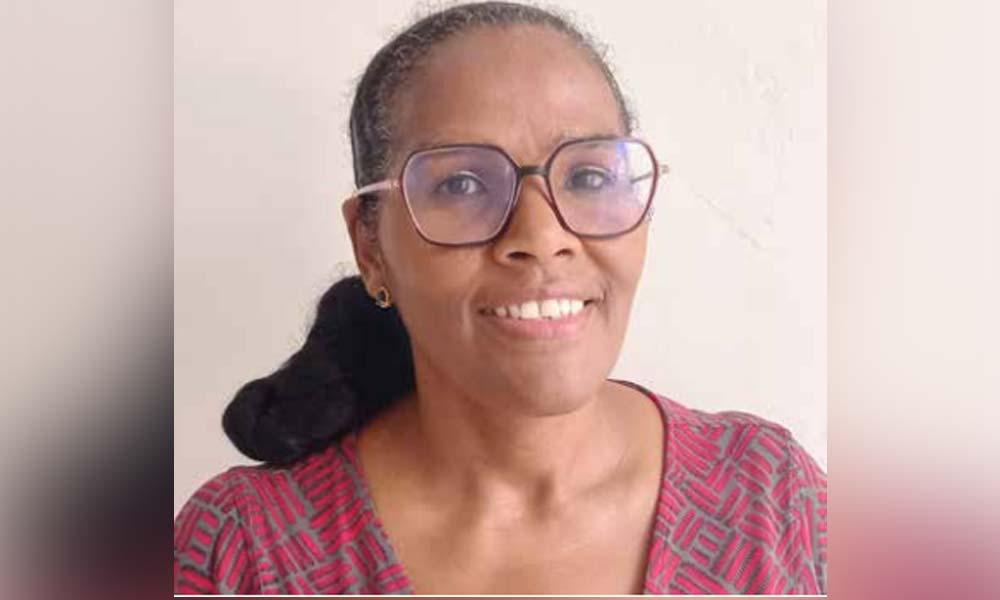
Africa-Press – Cape verde. University professor Elvira Reis is against the fact that the Portuguese School of Cape Verde prohibits or discourages the use of Creole outside the classroom, among students, inside the school. In an interview with A NAÇÃO, she warns that this is not “efficient” for learning Portuguese, as it also inhibits creativity and conditions the cognitive development of children. In this sense, it urges the State to defend linguistic human rights.
Doctor in Education and Human Development, Elvira do Reis is one of the teachers linked to the petition to change language policy in Cape Verde, which defends the officialization of Creole and its teaching, as well as its standardization.
Confronted by A NAÇÃO on the controversy raised around the non-use of Creole in the Portuguese School, it is categorical:
“I don’t agree, because this was the imperialist attitude based on the logic of a language, an empire”, he starts by saying, stating that the logic of our days is different and opposite.
“It’s about adding languages, not subtraction; of valuing plurilingual competences established in education for linguistic diversity, where the prohibition of the use of languages does not match education”, he analyzes.
More languages, greater integration
In the view of this teacher, “the more languages the subject masters, the greater their capacity for social integration and personal fulfillment”. However, he continues, “according to modern theories of language acquisition, it is undeniable that Cape Verdean Creole is the basis of the linguistic repertoire and the most representative language in the brain of most Cape Verdean children, since it is the language was naturally stabilized”.
Therefore, he argues that forbidding them to use Creole during breaks “is to inhibit their creativity and condition their cognitive development”. Because, as he explains, this is, “most of the time, the only grammar completely stabilized in its repertoire, lacking only explanation through literacy”.
Asked if this measure of the Portuguese school is effectively efficient for a good proficiency of students in the Portuguese language or is it a myth, once again, it is surgical to say no.
“If that were the case, Cape Verdeans would be good speakers of the Portuguese language, as this was the strategy used throughout the colonial period and, even today, after independence, in many contexts”, he explains.
Strategies don’t go through the ban
Reis argues that “modern and efficient strategies for raising awareness for learning a language do not involve prohibiting the use of others”, but rather, “mobilization and good management of the learner’s linguistic repertoire”, that is, “a knowledge of the languages that the child already has in the brain and a deep reflection on how to take better advantage of their previous linguistic knowledge for teaching and learning the target language, that is, the one to be taught”.
It also involves “increasing exposure to the target language and intentionally diversifying the contexts of use and practice of this language, without this interfering with the child’s freedom to use their mother tongue to express what, due to the limitations of the Portuguese language that he is still learning, he cannot express himself in this language”.
State must defend linguistic human rights
Also questioned about the fact that despite being a Portuguese school, in national territory, the State should not have a more defined policy with regard to the mother tongue, urges the same to take another position.
“The State must fight against all types of prejudice and this measure, in addition to being prejudiced, encourages the development of equally prejudiced attitudes that, in this case, can develop from an early age”, because, as it justifies, “ these children, not being able to use their mother tongue to play, create and recreate their linguistic imagination during breaks, may grow up associating their mother tongue with something illegal, harmful and, therefore, prohibited”.
This is because, he continues, “as Claude Hagège argues, all methods of teaching a language are based on the power of its effects on the child.”
“What if the children played in English or French? Would they be equally prohibited, or would that be a source of pride?”, he asks.
Elvira Reis also warns that it is up to the State to “defend linguistic human rights” and that the measure “violates these rights in its article 3, point 2” of the Constitution.
Profile
Elvira Gomes dos Reis has a PhD in Education and Human Development with research in Language Education and a focus on linguistic diversity as a factor of human development, from the University of Santiago de Compostela – Galicia.
Among other skills, she is a Master in Language Didactics, specializing in Teaching Portuguese as a Non-Mother Language, from the University of Aveiro and a degree in Portuguese Teaching, from the Open University of Lisbon.
In higher education in Cape Verde, he has taught Curricular Units in the areas of Cape Verdean Language, Portuguese Language, and Cape Verdean Linguistics and Portuguese Linguistics, Bilingual Education, Education for Linguistic Diversity and Portuguese Teaching Methodology.
Elvira Reis also warns that it is up to the State to “defend linguistic human rights” and that the measure “violates these rights in article 3, point 2” of the UNESCO Universal Declaration of Linguistic Rights.
For More News And Analysis About Cape verde Follow Africa-Press