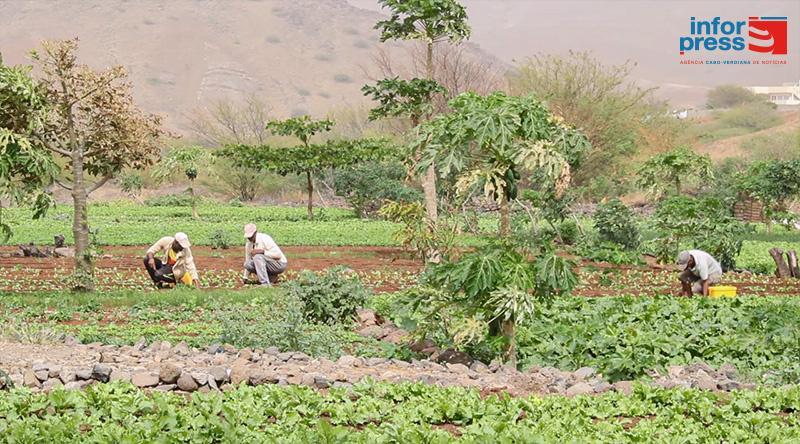
Africa-Press – Cape verde. Farmers from Ribeira do Calhau are requesting intervention from the Ministry of Agriculture and Environment to stop the proliferation of the acacia species which, they say, is absorbing water from groundwater and compromising cultivation.
The appeal was launched to Inforpress by one of the oldest farmers in the Calhau valley António Fortes, who stated that the multiplication of these species has worried farmers because, in addition to consuming a lot of water, they serve as a nest to harbor pests such as grasshoppers, which decimate the cultivation.
“Water is the main problem we have here, because this tree they planted is a pest that we have in Cape Verde. It is a plant that only serves to dry water. They have been talking about water desalination for a long time and recently I heard deputy João Gomes speaking in the National Assembly that the Calhau problem had already been resolved because it already had funding. We are here waiting. If we don’t die, until this project starts, it will reach us”, he stated.
According to the farmer, if it weren’t for the acacia trees, the valley would still have plenty of water, despite the years of drought.
But, he maintained, the scarcity of this resource for irrigation is already evident, which is why a campaign is needed to remove these trees that are invading agricultural land.
“This acacia takes practically three thirds of that water and we only keep one third. In the past, when it rained there was a lot of water in this valley and the rocks had springs even during the drought. Today there aren’t that many and acacia trees are largely to blame for this”, he added, arguing that national authorities should carry out a study to solve this problem.
According to the president of the Calhau Agricultural Association, Ederley Rodrigues, acacias have adapted to Cape Verde’s climate, but they are “extremely competitive” species, because their roots can fetch water from a well.
“An acacia root can reach the depth of a well because the roots of this tree have been found in wells. Acacia was introduced into the country, but there was a lack of control because animals also carry seeds to other places, it grows easily and is extremely adaptable”, he said.
Another problem, according to the person responsible, is that acacia trees serve as a hiding place for a type of large grasshopper, from the African continent, and this insect has caused “great damage” to agricultural properties.
“Locusts survive in vegetable gardens and hide in acacia trees and reproduce. Before, there were few, but now there is an increase in these locusts. We can see them in almond trees and in plots that have acacias because these are most affected by this pest,” she explained.
The same source added that the biggest problem for farmers in that valley is water retention because, in addition to competing with acacia trees, most of the retention dikes are not working due to siltation.
“In terms of water level, São Vicente has been included in the contingency plan for a long time because of the rain that fell and the damage it caused, but here in Calhau no intervention was carried out in terms of dikes or any desilting or even new structures to retain the water”, criticized the same source.
He recalled that to combat the locusts “they distributed a bait” to place on the plots, but “in a negligible quantity” to combat the pest, because the plots are huge and two bags per plot “are only good for two hectares”.
For Ederley Rodrigues, the problem is that the Ministry of Agriculture and Environment works with plans that the Government makes, but they are plans for rainfed agriculture, and in Calhau farmers work with irrigated cultivation, so there is a lack of support.
“The help that the Ministry of Agriculture and Environment gives us is insignificant for the number of people we have working in irrigation in Calhau. They have no idea of the number of people who work in irrigation and vegetable gardens, this is bad policy for our Island”, criticized the president of the Calhau Agricultural Association.
“We work more with drip irrigation and those who cultivate in the dryland are the people who work in agriculture as a hobby”, he reinforced, arguing that for production in São Vicente to develop, to meet the demand of tourism, it is necessary to keep up with the pace development in agriculture.
“What I see is that agriculture is not keeping up with this pace of development not only because sometimes programs don’t work, but programs have to be created specifically aimed at the location for production”, he noted.
According to Ederley Rodrigues, in this agricultural perimeter there are 15 Toyota hiace vans that work directly linked to agriculture, so for families to have income, agriculture needs to work.
“They bring saleswomen who take the goods to the city and beyond. These are almost direct jobs. But there are also dozens of women who come to buy vegetables, there are people here who have already created companies and who place products in supermarkets and stores because they prefer Calhau products, because they last longer. The one who is most harmed is the farmer because he is the person who sells the product and then the product will be outsourced and when value is added it is almost in the hands of the consumer”, concluded the president of the Calhau Agricultural Association.
In Ribeira de Calhau there are around 220 hectares of agricultural land, of which around 90 are occupied, but of these only 12 hectares are active.
Most do not produce due to difficulties in accessing water because, of the approximately 360 existing wells, around 100 less are active.
According to the Statistical Yearbook carried out by the National Statistics Institute (INE), agricultural production in Cape Verde increased from 70,926 tonnes in 2016 to 42,085 tonnes in 2020.
Agricultural production fell every year from 2016 onwards, with the worsening effects of the drought, accumulating a reduction of 40.6 percent (%) over the four-year period.
In the month of June 2023, data from the national survey on food vulnerability showed that 81 thousand people in Cape Verde, that is, 17% of the population were in the subpressure phase, just over 40 thousand, that is, 8% already in the food crisis phase and a little less than 1% in the food emergency phase
In the same year, the Ministry of Agriculture and Environment announced the implementation of the water mobilization program for agriculture in Cape Verde, financed by the Government of Hungary at 3.8 million contos (3.5 million euros). But, in the first phase, it will benefit five municipalities in the country, namely São Domingos, Santa Cruz, São Lourenço dos Órgãos, Maio and Boa Vista.
For More News And Analysis About Cape verde Follow Africa-Press