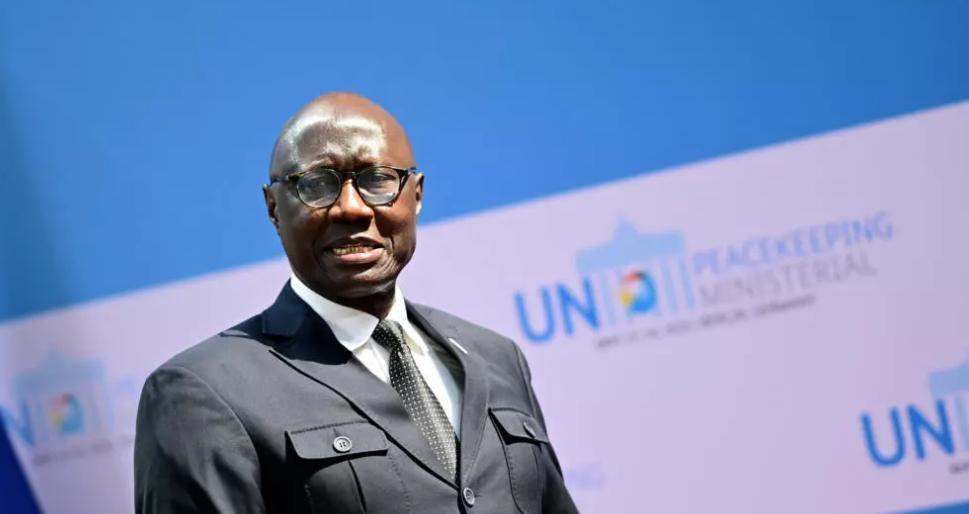
Africa-Press – Cape verde. The new president of the Economic Community of West African States (ECOWAS), Biram Diop, has pledged to deepen cooperation with Mali, Burkina Faso, and Niger, which recently withdrew from the organization to form a parallel bloc known as the Sahel Alliance.
In his speech during the official inauguration ceremony as president of the group, alongside the new administration of the ECOWAS Commission in Abuja, Diop stated that the organization must urgently enhance internal cohesion and deepen communication with the breakaway member states, emphasizing that “ECOWAS stands at a crossroads.”
He added that geographical proximity and shared security, social, and economic challenges have made this cooperation more urgent. Diop noted that ECOWAS member states and the West African Economic Union share borders extending approximately 5,250 kilometers, and interactions among their peoples will continue.
He stated, “We have no other choice; our brothers, neighbors, and companions have departed, but geography remains unchanged.” He affirmed, “Therefore, we have no option but to work in solidarity and combine efforts for the benefit of both regions.”
He also identified terrorism, irregular migration, transnational organized crime, and environmental challenges as common threats requiring coordinated responses from both sides.
Earlier, the former president of the ECOWAS Commission, Dr. Omar Touray, described the handover process as a confirmation of trust in the regional organization, stressing the need for institutions to remain stronger than individuals.
He stated, “Leadership is temporary, while institutions endure. The strength of an institution is not measured by the person leading it, but by its ability to achieve its goals after their term ends.” He noted that the previous administration left a legacy of achievements, including progress in major infrastructure projects and regional connectivity, such as the African Atlantic Gas Pipeline and the Abidjan-Lagos Highway.
Touray explained that his achievements included regional electricity connectivity, trade and transport corridors, economic and monetary integration, preparations for the launch of the Eco currency in 2027, and programs targeting food security, youth, women, education, and skills development.
He pointed out that the West Africa Roundtable on Rice Investment, for example, was an initiative that resulted in an influx of investments worth $1.54 billion, of which $1.47 billion were confirmed commitments.
He also highlighted the connection of rural communities to national electricity grids as part of the regional electricity access project, progress in the regional battery storage program, and more.
President Bola Tinubu, represented by the Minister of State for Foreign Affairs, Ambassador Sola Enikanolaiye, urged the new leadership of ECOWAS to prioritize regional integration, financial accountability, peace, and security.
According to him, the leadership transition in ECOWAS confirms the continuity of the collective pursuit of regional integration. He added, “ECOWAS should be a state for citizens, not for governments, where artificial borders and narrow national interests do not hinder the goals of the supranational bloc.”
The president emphasized Nigeria’s commitment to the progress, growth, and stability of ECOWAS but called for greater financial integrity and accountability from the organization. He stated, “For Nigeria, ECOWAS must continue to justify the massive investments and sacrifices made, not only by the government and people of Nigeria, including paying community fees, but also by other member states in the sub-region to support the organization.”