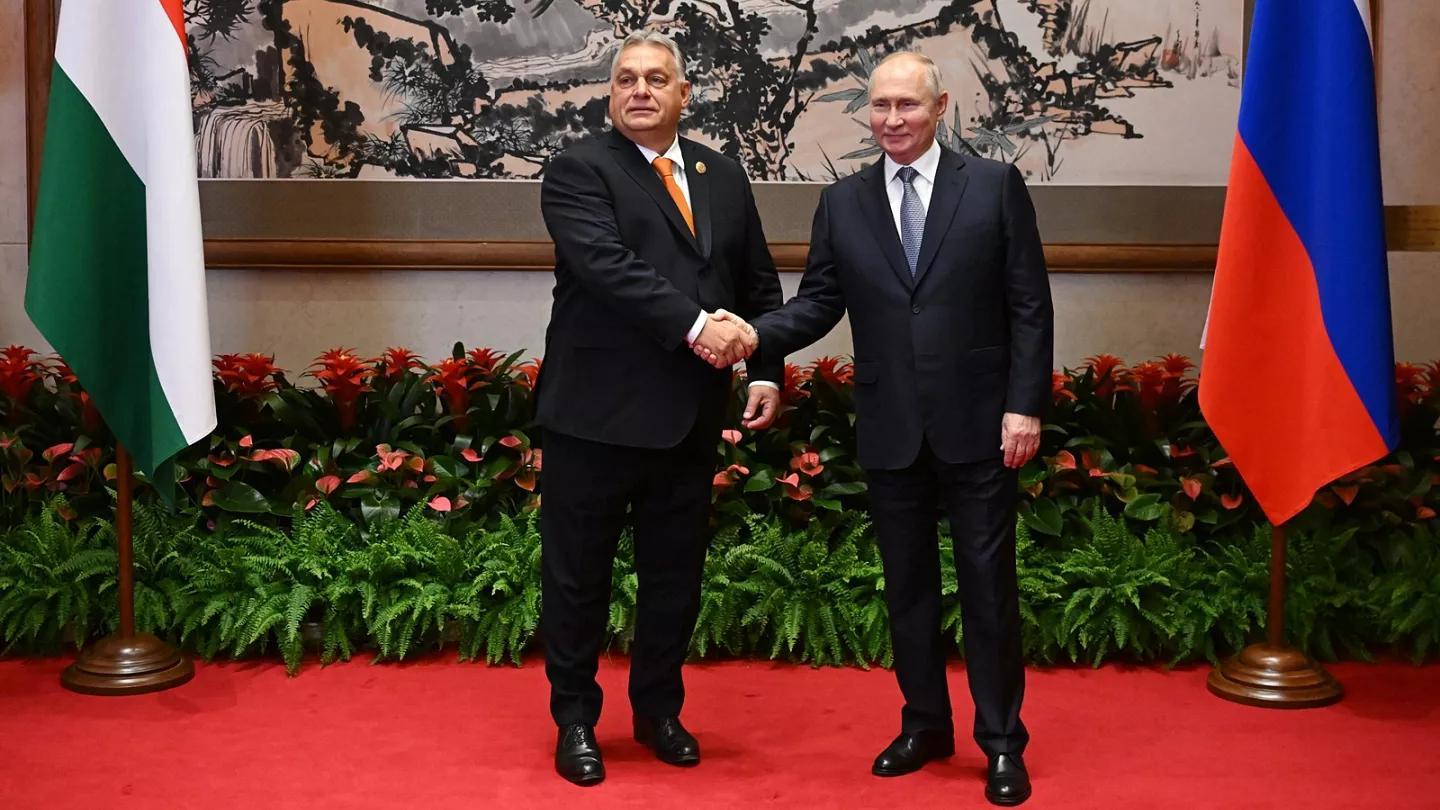
Africa-Press – Cape verde. The meeting between the Hungarian Prime Minister, Viktor Orbán, and the Russian President, Vladimir Putin, alarmed the leaders of the European Union (EU) and even motivated an emergency meeting, due to the implications for the cohesion of the bloc and NATO itself.
Russia/Ukraine War: Western cohesion shaken by Orban-Putin handshake
Asked about the uneasiness created among the Member States by the meeting between Putin and Orbán – with an ostentatious handshake and exchange of mutual compliments – a diplomatic source from Brussels replied that the 27 are free to meet with whoever they want, but did not allow warnings.
Putin, the same source stressed, has an international arrest warrant and the EU’s position is to unequivocally support Ukraine, which does not change under any circumstances.
Negative reactions to Orbán and Putin’s meeting in Beijing last Tuesday came mainly from the eastern and Baltic countries, those that have most defended Ukraine since the Russian invasion in February 2022.
Former NATO general and now President of the Czech Republic, Petr Pavel warned Orbán that Putin “ does not meet with European leaders with the aim of achieving peace in Ukraine ”.
“ Peace can be achieved without any negotiations on your part and, simply, with a ceasefire and the withdrawal of your troops from Ukrainian territory ”, he added, warning Orbán that meetings like this only contribute to “ tearing apart the unity of European countries and the entire democratic world ”.
“ We must not fall for their tactics” , he warned in a statement to the British daily The Guardian.
Estonian Prime Minister Kaja Kallas also stressed that the handshake between Orbán and Putin defied logic and was unpleasant.
In Hungary, the German ambassador, Júlia Gross, wrote on the social network X (formerly Twitter) that she believed Orbán only met with Putin to discuss the end of hostilities in Ukraine: “Right? ” .
The meeting, in Beijing and on the sidelines of a summit on China’s New Silk Road strategic initiative, was the first between Putin and a European leader since February 24, 2022, the day the Kremlin began a large-scale invasion of Ukraine. .
Putin himself came to defend the Hungarian conservative leader against accusations of being “pro-Russian” for regularly opposing the support provided to Ukraine by the European Union.
“ This is nonsense, as [Orbán] has no pro-Russian feelings. He is not a pro-Russian politician, he is a pro-Hungary politician. They attack him, mainly, because of the position he takes, perhaps different from that of other leaders (…), but because he has the courage to defend the interests of his people, courage that many political figures in Europe today do not have, do not have . They are jealous and attack him ,” Putin stressed.
The Russian leader traveled to China despite the arrest warrant issued by the International Criminal Court (ICC) against him for the illegal deportation of Ukrainian children.
The United States ambassador in Budapest, David Pressman, said that the Hungarian prime minister chose “ to stand alongside a man whose troops are responsible for crimes against humanity ” in Ukraine: “While Russia bombs Ukrainian civilians, Hungary pleads for trade agreements [with Moscow] ”.
And according to news released on Thursday by Radio Free Europe (a media outlet financed by the US Government) there was an emergency meeting between the ambassadors of NATO countries to Hungary to discuss the Orbán/Putin meeting.
The ambassadors reportedly expressed “security concerns” with the deepening of relations between Budapest and Moscow.
Orbán and his Government are considered the ‘most distant ally’. Hungary keeps the ratification of Sweden’s NATO accession agreement in its parliament on the back burner and not even the efforts of the secretary general and other countries have managed to unblock the situation.
Turkey has also not done so yet, despite the promise made by President Recep Tayyip Erdogan at the July summit of the Atlantic Alliance.
And since the beginning of the Russian invasion of Ukraine, Orbán has been the insistent voice calling into question the political, economic-financial, humanitarian and military support that the EU is giving to Kiev.
On Tuesday he also advocated the end of sanctions on Russia, which the EU and the United States are using as a way of putting pressure on the Russian economy and curbing the Kremlin’s military intentions.
For More News And Analysis About Cape verde Follow Africa-Press