Africa-Press – Cape verde. The Minister of Culture and Creative Industries stated this Saturday that by honoring Nha Nácia Gomi and Séma Lopi, justice is being done to batuque, finaçon and funaná, which still have a lack of recognition.
Santa Cruz: “Today we do justice to batuque, finaçon and funaná by honoring Nha Nácia Gomi and Séma Lopi” – Minister of Culture
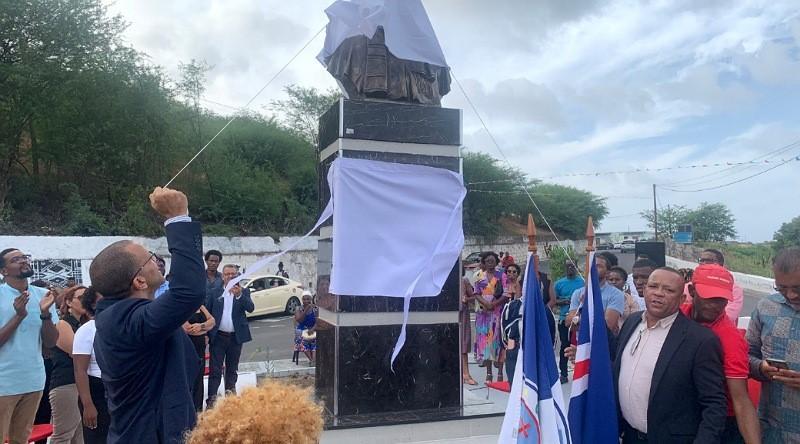
“Today is a day that we do justice to the culture of Cape Verde, to batuque, finaçon and funaná”, said Abraão Vicente, speaking to the press, on the sidelines of the inauguration of the bust of Nha Nácia Gomi, and the requalification works at the Séma Lopi Cultural Center, formerly the “Cineteatro de Porto Baixo”, in the municipality of Santa Cruz, in the interior of Santiago.
“Holding events and cultural activities are not enough to honor our culture. It is necessary to perpetuate it over time (…) and inspire this generation so that they can see that whoever actually did it with consistency that Cape Verde recognizes”, she noted.
“Cape Verde has a historical debt to national figures, and in the case of the island of Santiago, and in the case of batuque, finaçon and funaná, we have a deficit of recognition from the Cape Verdean people themselves”, continued the government official.
For Abraão Vicente, the tribute to the “queen of batuque and finaçon” Nha Nácia Gomi is also a tribute to Cape Verdean women.
In addition to the bust placed in front of the roundabout that gives access to Ribeira Seca and Achada Fazenda, Nha Nácia Gomi also lent its name and gained a moral in the same circular of this “eminently agricultural” municipality.
“This is a moment in which we recognize a great figure [Nha Nácia Gomi] and also a tribute to Cape Verdean women, because Nha Nácia Gomi, with her scarf tied around her head, with all her clothing, posture and all the work she she did during her life ends up being a journey equal to that of an ordinary woman”, she said, adding that “Nha Nácia Gomi is the face of batucadeiras and finançon nowadays”.
On the other hand, he clarified that this tribute is not just because of the elevation of batuque to national heritage and the plans to elevate this Cape Verdean musical genre to the heritage of humanity.
Regarding the attribution of the name Séma Lopi to the Cultural Center, which houses the Semá Lopi/Funaná Interpretive Center, within the scope of the “1 auditorium per municipality” program, the government official explained that its objective is to be a small stage for artists not yet renowned and established artists can perform their first concerts and encourage and promote art at a community level.
“The cultural center is a space to value the local community, and the interpretive center is so that people can learn a little about the history and so that it can have dividends for the community. In other words, the interpretive center aims to consolidate the research we are doing around funaná and to take it to another level, both nationally and internationally”, he indicated.
On the occasion, the Minister of Culture announced that both Semá Lopi and Antão Barreto (Santa Cruz), and Codé de Dona (São Francisco) will have their busts, having guaranteed that those of Orlando Pantera (São Lourenço dos Órgãos) and Bibinha Cabral (Tarrafal) are already ready and will be delivered later this year.
In turn, the president of the Santa Cruz City Council, Carlos Silva, who recalled that the municipality he heads has a “strong cultural heritage”, argued that perpetuating the memory of Nha Nácia Gomi with the bust and giving the name Semá Lopi to the Cultural Center will help promote culture.
As he said, taking into account that they aim to make Santa Cruz a tourist destination par excellence, he believes that the two projects materialized in partnership with the Government, now inaugurated, which join the funeral graves of the “great figures” of the municipality and the Church of São Tiago Maior, will help promote cultural, religious and scenic tourism.
The two tributes “from the people of Santa Cruz and Cape Verde” observed by family members, in front of many residents and artists, take place within the scope of Culture and Communities Day, marked on October 18th, under the motto “We are Culture” .
Nha Nácia Gomi (Maria Inácia Gomes Correia), the woman with the famous phrase “Sima nu kre nu ka podi sta, mas sima nu sta nu ka podi Fica” (As we want we can’t be, but as we are we can’t stay) found it in Batuco the way of explaining the world as he saw it.
Born in the former Vila de Pedra Badejo, now a city, in the municipality of Santa Cruz, on July 18, 1924, Nha Nácia Gomi was one of the voices of Cape Verdean cultural resistance.
Considered the ‘queen of finason’, she was also well known as a storyteller. Much of her music was improvised in the moment.
She recorded three albums and participated in many more as a guest. In 2005 she released two albums: ‘Finkadu na Raiz’, with batuque player Ntóni Dénti d´Ôro, and ‘Ku ses Mocinhos’.
Séma Lopi (Simão Tavares Lopes), who was born in 1941, was a simple farmer who became an excellent harmonica player and renowned funaná composer.
He is the author of several musical compositions, including “Ôi, Séma Lópi, côrpu dí tchõ, álma dí Crístu”, having worked in the world of music with Carlos Alberto Martins (Katchás), founder of Bulimundo, who recorded several of his compositions.
For More News And Analysis About Cape verde Follow Africa-Press